
Influence of Salinity on the Growth and Yield of two Varieties of Okra (Abelmoschus esculentus (L.) Moench) in Abeokuta, Ogun State, Nigeria
DOI:
https://doi.org/10.33003/fjs-2026-1014-5800Keywords:
Abelmoschus Esculentus, Nacl Stress, Salinity Tolerance, Relative Growth Rate, Net Assimilation Rate, Leaf Area RatioAbstract
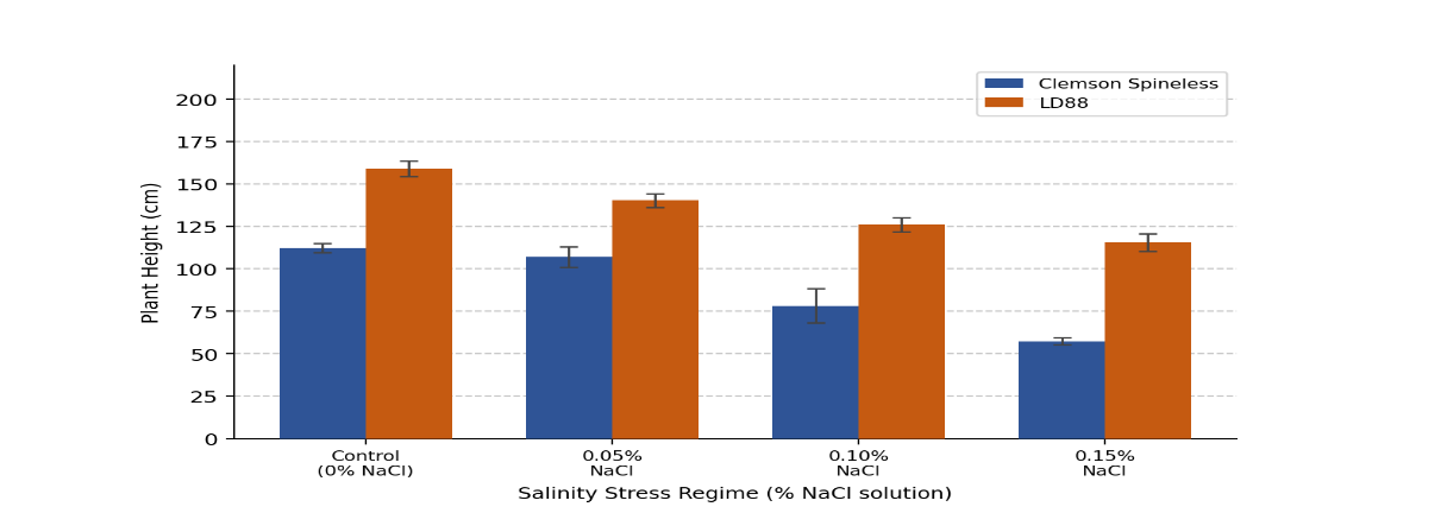
Soil salinity is one of the most severe abiotic factors limiting vegetable crop production. The present study aimed to evaluate the effect of salinity on growth, biomass and yield of two okra (Abelmoschus esculentus (L.)) varieties: Clemson Spineless and LD88 (Moench) varieties grown under screen-house in Abeokuta, Ogun State, Nigeria. The seeds were obtained from National Horticultural Research Institute (NIHORT), Ibadan, Nigeria and cultivated in 4.5 litre plastic pots in sandy-loam soil (pH 6.7) under completely randomised design (CRD) with three replications in the Department of Botany screen house, Federal University of Agriculture, Abeokuta. The salinity regim of Sodium Chloride (NaCl) imposed were 0% NaCl (control), 0.05%, 0.10% and 0.15% NaCl solution, at 3-day intervals. Growth measurements such as plant height, number of leaves, leaf area, shoot and root dry weight, pod number, pod length, pod dry weight, relative growth rate (RGR), net assimilation rate (NAR) and leaf area ratio (LAR) were taken every week. All growth and yield parameters were significantly (P<0.05) inhibited with salinity in both varieties when compare with the control. The RGR of Clemson Spineless decreased from 0.46 to 0.14 g g⁻¹ month⁻¹ at 0.15% NaCl. RGR of LD88 decreased from 0.46 to 0.14 g g⁻¹ month⁻¹ at the highest salinity level. The optimal concentration of NaCl that has the inhibitoriest effect on all parameters is 0.15%. Throughout the studies Clemson Spineless was consistently outperformed by LD88. A. esculentus is very salt sensitive, while the salt tolerant LD88 is recommended for growing in saline areas
References
Adekiya, A.O., Agbede, T.M., Olayanju, A., Ejue, W.S., Adekanye, T.A., Adenusi, T.T. and Ayeni, J.F. (2020). Effect of biochar on soil properties, soil loss, and cocoyam yield on a tropical sandy loam Alfisol. The Scientific World Journal, 2020, 9391630. https://doi.org/10.1155/2020/9391630
Adetunji, I.A., Adigun, M.O. and Bello, O.B. (2022). Growth and physiological responses of okra (Abelmoschus esculentus (L.) Moench) to sodium chloride salinity in southwestern Nigeria. Journal of Horticultural Science and Biotechnology, 97(4), 512–521. https://doi.org/10.1080/14620316.2022.2033281
Ajayi, J.O., Olosunde, O.M., Fawibe, O.O., Ojewumi, A.W., Mustafa, A.A. and Agboola, D.A. (2022). Effect of sowing depth on growth performance of selected members of the family Cucurbitaceae. Nigerian Journal of Botany, 35(1): 35–45. https://dx.doi.org/10.4314/njbot.v35i1.5
Ali, J., Jan, I., Ullah, H., Fahad, S., Saud, S., Adnan, M., Ali, B., Liu, K., Harrison, M.T. and Hassan, S. (2023). Biochemical response of okra (Abelmoschus esculentus L.) to selenium (Se) under drought stress. Sustainability, 15(7), 5694. https://doi.org/10.3390/su15075694
Aliyu, O.M., Usman, M.G. and Abubakar, B.Y. (2023). Growth and yield responses of okra (Abelmoschus esculentus (L.) Moench) genotypes to irrigation frequency and mulching in the Nigerian Sudan Savanna. Horticulture, Environment and Biotechnology, 64(2), 227–241. https://doi.org/10.1007/s13580-022-00483-x
Atta, K., Mondal, S., Gorai, S., Singh, A.P., Kumari, A., Ghosh, T., Roy, A., Hembram, S., Gaikwad, D.J., Mondal, S., Bhattacharya, S., Jha, U.C. and Jespersen, D. (2023). Impacts of salinity stress on crop plants: improving salt tolerance through genetic and molecular dissection. Frontiers in Plant Science, 14, 1241736. https://doi.org/10.3389/fpls.2023.1241736
Basu, S., Kumar, A., Benazir, I. and Kumar, G. (2021). Reassessing the role of ion homeostasis for improving salinity tolerance in crop plants. Physiologia Plantarum, 171(4), 502–519. https://doi.org/10.1111/ppl.13112
Dağdelen, N., Sezgin, F. and Gürbüz, T. (2021). Effect of deficit drip irrigation on yield, quality, and water productivity of okra (Abelmoschus esculentus (L.) Moench) in sub-humid climate conditions. Agricultural Water Management, 250, 106841. https://doi.org/10.1016/j.agwat.2021.106841
El Kheshin, M. and Hmmam, I. (2025). Polyethylene glycol and proline synergistically improve salinity tolerance via physiological and biochemical reprogramming in mango. BMC Plant Biology, 25, 1145. https://doi.org/10.1186/s12870-025-07211-4
Farooq, M., Park, J.-R., Jang, Y.-H., Kim, E.-G. and Kim, K.-M. (2021). Rice cultivars under salt stress show differential expression of genes related to the regulation of Na⁺/K⁺ balance. Frontiers in Plant Science, 12, 680131. https://doi.org/10.3389/fpls.2021.680131
Gemede, H.F., Ratta, N., Haki, G.D., Woldegiorgis, A.Z. and Beyene, F. (2021). Nutritional quality and health benefits of okra (Abelmoschus esculentus): A review. Journal of Food Processing and Technology, 12(3), 1–8. https://doi.org/10.4172/2157-7110.1000883
Haq, I.u., Azam, N., Ashraf, M., Javaid, M.M., Murtaza, G., Ahmed, Z., Riaz, M.A., Iqbal, R., Rahman, M.H.u., Alwahibi, M.S., Elshikh, M.S., Aslam, M.U. and Arslan, M. (2023). Improving the genetic potential of okra (Abelmoschus esculentus L.) germplasm to tolerate salinity stress. Scientific Reports, 13, 21504. https://doi.org/10.1038/s41598-023-48370-4
Hatfield, J.L. and Dold, C. (2020). Water-use efficiency: Advances and challenges in a changing climate. Frontiers in Plant Science, 10, 103. https://doi.org/10.3389/fpls.2019.00103
Hirich, A. and Bhargava, A. (2024). Editorial: Advances in alternative crop production and valorization in salt-affected areas. Frontiers in Plant Science, 15, 1384030. https://doi.org/10.3389/fpls.2024.1384030
Hussain, S., Hussain, S., Ali, B., Ren, X., Chen, X., Li, Q., Saqib, M. and Ahmad, N. (2021). Recent progress in understanding salinity tolerance in plants: Story of Na⁺/K⁺ balance and beyond. Plant Physiology and Biochemistry, 160, 239–256. https://doi.org/10.1016/j.plaphy.2021.01.029
IBM Corporation (2020). IBM SPSS Statistics for Windows, Version 26.0. IBM Corp., Armonk, NY.
Mbow, C., Rosenzweig, C., Barioni, L.G., Benton, T.G., Herrero, M., Krishnapillai, M., Liwenga, E., Pradhan, P., Rivera-Ferre, M.G., Sapkota, T., Tubiello, F.N. and Xu, Y. (2021). Food security. In: Shukla, P.R. et al. (Eds.), IPCC Special Report on Climate Change and Land. Cambridge University Press, Cambridge. pp. 437–550. https://doi.org/10.1017/9781009157988.007
Nkansah, G.O., Ayarna, A., Abukari, H., Yanney, B., Afari-Mintah, C. and Asante, K. (2022). Response of okra (Abelmoschus esculentus) to varying irrigation regimes and nitrogen fertilisation in the forest–savanna transition zone of Ghana. Irrigation Science, 40(1), 77–90. https://doi.org/10.1007/s00271-021-00750-4
Pantuwan, G., Fukai, S., Cooper, M., Rajatasereekul, S. and O’Toole, J.C. (2000). Yield response ofrice genotypes to drought under rain-fed lowlands: 2. Selection of drought resistant genotypes. Field Crops Research, 73: 169–180.
Poorter, H., Niinemets, Ü, Ntagkas, N., Siebenkäs, A., Mäkelä, A., Tail, S. and Fonti, P. (2022). A meta-analysis of plant responses to light intensity for 70 traits ranging from molecules to whole plant performance. New Phytologist, 233(4), 1698–1732. https://doi.org/10.1111/nph.17661
Saddiq, M.S., Iqbal, S., Hafeez, M.B., Ibrahim, A.M.H., Raza, A., Fatima, E.M., Baloch, H., Jahanzaib, A., Woodrow, P. and Ciarmiello, L.F. (2021). Effect of salinity stress on physiological changes and growth in okra (Abelmoschus esculentus) genotypes. Agronomy, 11(5), 826. https://doi.org/10.3390/agronomy11050826
Shahid, S.A., Zaman, M. and Heng, L. (2023). Soil salinity: Historical perspectives and a world overview of the problem. In: Zaman, M., Shahid, S.A. and Heng, L. (Eds.), Guideline for Salinity Assessment, Mitigation and Adaptation Using Nuclear and Related Techniques. Springer, Cham. pp. 43–53. https://doi.org/10.1007/978-3-319-96190-3_2
Yunusa, A.Y., Hayatu, M., Sani, L.A. Babura, S.R., Aminu, M.A., Namadina, M.M., Phoebe, A.O. (2025). Impact of Salinity Stress on Ion Homeostasis of Some Selected Groundnut (Arachis hypogaea L.) Varieties. (2025). Sahel Journal of Life Sciences FUDMA, 3(2), 198-204. https://doi.org/10.33003/sajols-2025-030222-24
Downloads
Published
Issue
Section
Categories
License
Copyright (c) 2026 Ajayi, David, Ajiboye, Chukwuma, Ojewumi, Ameh, Oyetunji, Agboola

This work is licensed under a Creative Commons Attribution 4.0 International License.


