
Systemic T-Cell Activation and Exhaustion Phenotypes in Pediatric Patients Correlated with Malarial and Intestinal Helminthic Co-Infections in Bauchi State, Nigeria
DOI:
https://doi.org/10.33003/fjs-2026-1012-5222Keywords:
Co-infection, Helminthiasis, Malaria, PediatricAbstract
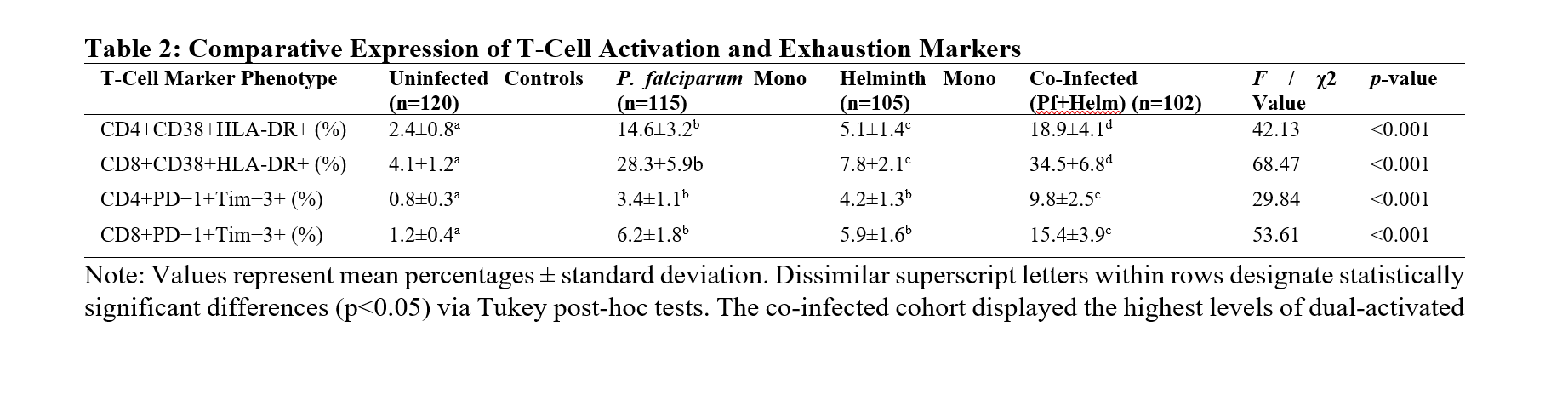
In sub-Saharan Africa, concurrent infections with Plasmodium falciparum and soil-transmitted helminths (STHs) present a complex immunological challenge to the developing pediatric immune system. Immunophenotyping of cellular response profiles during co-infection remains scarce within Northern Nigeria. This study evaluated the phenotypic shifts in circulating CD4+ and CD8+ T-cell activation and exhaustion markers among children co-infected with malaria and helminthic infection in Bauchi State. A cross-sectional survey conducted among 442 pediatric participants (aged 5–12 years) stratified into four cohorts: uninfected controls (n=120), P. falciparum mono-infection (n=115), helminth mono-infection (n=105), and co-infected (n=102). Parasitological validation was via light microscopy, Kato-Katz concentration, and multiplex PCR. Peripheral blood mononuclear cells (PBMCs) were isolated and analyzed using multi-color flow cytometry to quantify activation (CD38/HLA-DR) and exhaustion (PD−1/Tim−3) marker expression. Co-infected children exhibited lower geometric mean malarial densities compared to malaria mono-infected peers (2,450 vs. 5,890 parasites/μL, p=0.002). Prevalence of STHs indicated Ascaris lumbricoides 54.9%, Hookworm 32.4%, and Trichuris trichura 12.7%. However, dual activation markers (CD38+HLA-DR+) were higher among co-infected cohort on both CD4+ (18.9%) and CD8+ (34.5%) T-cells (p<0.001). Cellular exhaustion defined by dual expression of PD−1+Tim−3+, peaked sharply in co-infected patients (CD8+:15.4%), supassed malaria (6.2%) and helminth (5.9%) mono-infections (p<0.001). Multivariate logistic regression identified co-infection as a dominant independent predictor of advanced T-cell exhaustion (AOR=4.12, 95% CI: 2.34–7.28). Chronic co-parasitism suppresses acute malarial replication but induces robust systemic T-cell hyper-activation, accelerating progression toward functional cellular exhaustion.
References
Blackwell, A. D., Martin, M., Kaplan, H., and Gurven, M. (2013). Antagonism between two intestinal parasites in humans: The importance of co-infection for infection risk and recovery dynamics. Proceedings of the Royal Society B: Biological Sciences, 280(1770), Article 20131671. https://doi.org/10.1098/rspb.2013.1671
Borkow, G., and Bentwich, Z. (2004). Chronic immune activation associated with chronic helminthic and human immunodeficiency virus infections: Role of hyporesponsiveness and anergy. Clinical Microbiology Reviews, 17(4), 1012–1030. https://doi.org/10.1128/CMR.17.4.1012-1030.2004
da Silva, A. J., Bornay-Llinares, F. J., Moura, I. N. S., Slemenda, S. B., Tuttle, J. L., and Pieniazek, N. J. (1999). Fast and reliable extraction of protozoan parasite DNA from fecal specimens. Molecular Diagnosis, 4(1), 57–64. https://doi.org/10.1016/S1084-8592(99)80050-
Day, C. L., Kaufmann, D. E., Kiepiela, P., Brown, J. A., Moodley, E. S., Reddy, S., Mackey, E. W., Miller, J. D., Leslie, A. J., DePierres, C., Mncube, Z., Duraiswamy, J., Zhu, B., Eichbaum, Q., Altfeld, M., Wherry, E. J., Coovadia, H. M., Goulder, P. J. R., Klenerman, P., Ahmed, R., Freeman, G. J., and Walker, B. D. (2006). PD-1 expression on HIV-specific T cells is associated with T-cell exhaustion and disease progression. Nature, 443(7109), 350–354. https://doi.org/10.1038/nature05115
Diallo, T. O., Remoue, F., Gaayeb, L., Schacht, A.-M., Charrier, N., De Clerck, D., Dompnier, J.-P., Pillet, S., Garraud, O., N'Diaye, A. A., and Riveau, G. (2010). Schistosomiasis coinfection in children influences acquired immune response against Plasmodium falciparum malaria antigens. PLOS ONE, 5(9),
https://doi.org/10.1371/journal.pone.0012764
Garcia, L. S. (2001). Diagnostic medical parasitology (4th ed.). American Society for Microbiology Press. Chicago, 46.
Hartgers, F. C., and Yazdanbakhsh, M. (2006). Co-infection of helminths and malaria: Modulation of the immune responses to malaria. Parasite Immunology, 28(10), 497–506. https://doi.org/10.1111/j.1365-3024.2006.00901.x
Hotez, P. J., Aksoy, S., Brindley, P. J., and Kamhawi, S. (2020). What constitutes a neglected tropical disease? PLOS Neglected Tropical Diseases, 14(1), Article e0008001. https://doi.org/10.1371/journal.pntd.0008001
Langhorne, J., Ndungu, F. M., Sponaas, A.-M., and Marsh, K. (2008). Immunity to malaria: More questions than answers. Nature Immunology, 9(7), 725–732. https://doi.org/10.1038/ni.f.205
Maizels, R. M., Hewitson, J. P., and Smith, K. A. (2012). Susceptibility and immunity to helminth parasites. Current Opinion in Immunology, 24(4), 459–466. https://doi.org/10.1016/j.coi.2012.06.003
Medana, I. M., Day, N. P. J., Hien, T. T., Mai, N. T. H., Bethell, D., Phu, N. H., Farrar, J., Esiri, M. M., White, N. J., and Turner, G. D. (2002). Axonal injury in cerebral malaria. American Journal of Pathology, 160(2), 655–666. https://doi.org/10.1016/S0002-9440(10)64885-7
Moreau, E., and Chauvin, A. (2010). Immunity against helminths: Interactions with the host and the intercurrent infections. Journal of Biomedicine and Biotechnology, 2010, Article 428593. https://doi.org/10.1155/2010/428593
Nfon, C. K., Toko, E. N., Tomo, P., and Fujioka, H. (2006). Effects of helminth co-infection on cellular immune responses to malaria antigens in children. Infection and Immunity, 74(11), 6122–6130. .
Oyinloye, S. O., Bukbuk, D. N., and Sanda, F. A. (2019). Surveillance of hepatitis B biomarkersin Borno State, Nigeria. Journal of Advances in Medicine and Medical Research, 28(10),18. https://doi.org/10.9734/JAMMR/2018/v28i1030033
Verweij, J. J., Blangé, R. A., Templeton, K., Schinkel, J., Brienen, E. A. T., van Rooyen, M. A., van Lieshout, L., and Polderman, A. M. (2004). Simultaneous detection of Entamoeba histolytica, Giardia lamblia, and Cryptosporidium parvum in fecal samples by using multiplex real-time PCR. Journal of Clinical Microbiology, 42(3), 1220–1223. https://doi.org/10.1128/JCM.42.3.1220-1223.2004
Wherry, E. J. (2011). T cell exhaustion. Nature Immunology, 12(6), 492–499. https://doi.org/10.1038/ni.2035
World Health Organization. (2025). World malaria report 2025: Addressing the threat of antimalarial drug resistance. https://www.who.int/teams/global-malaria-programme/reports/world-malaria-report-2025
Downloads
Published
Issue
Section
Categories
License
Copyright (c) 2026 Kyauta Mallam Thomas, Anthony John, Tabitha Silas, Mispha Titus, David Ochiobi, Moses Ashem, Ezekiel Bitet, Joshua Gyang

This work is licensed under a Creative Commons Attribution 4.0 International License.


