
EVALUATION OF CYTOLOGICAL VARIATIONS IN HYDROXYLAMINE HYDROCHLORIDE AND X-RAY-INDUCED M1 AND M2 GENERATIONS OF GROUNDNUT (Arachis hypogea L.) GENOTYPES
DOI:
https://doi.org/10.33003/Keywords:
Groundnut, Cytological Variations, Chromosomal Number, EuploidyAbstract
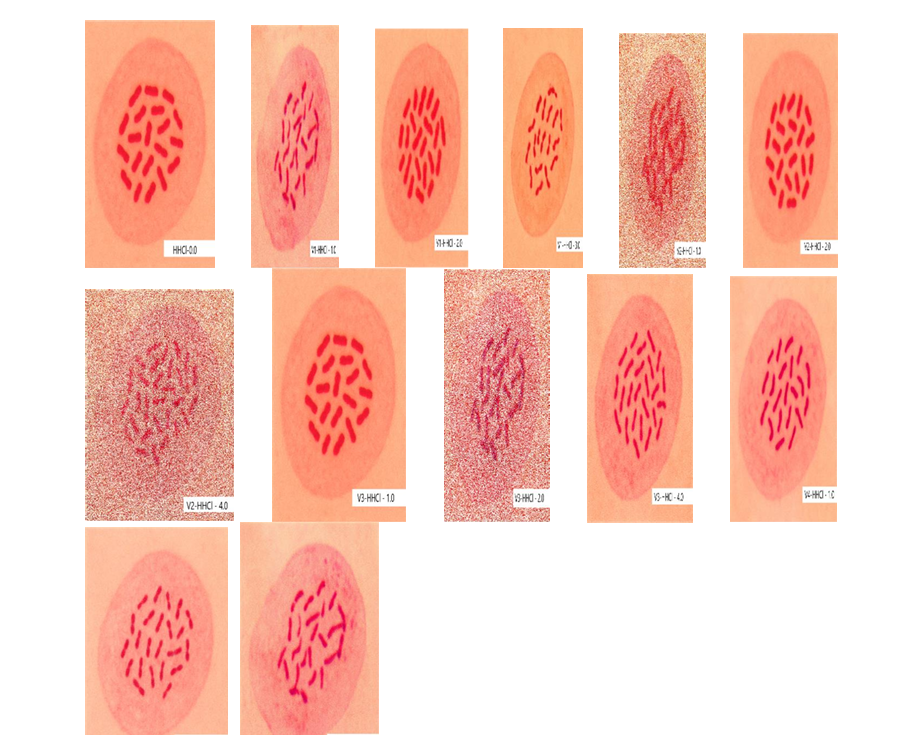
It is pertinent to concede the transmissible portion of polymorphism as it provides heterogeneity component measure for the transmission of traits to next generation. The research is aim at evaluating cytological variations in Hydroxylamine hydrochloride and X-ray-induced M1 and M2 generations of groundnut (Arachis hypogea L.) genotypes. Groundnut production in Nigeria is constrained by multiple factors including low genetic variability. Pot trials were carried out during 2024/2025 dry seasons at the teaching and research field, Department of Plant Science and Biotechnology, Bayero University, Kano. Two improved groundnut genotypes (SAMNUT-24, SAMNUT-25) were collected from Kano State Agricultural and Rural Development Authority (KNARDA) and the two Local varieties (’YAR-GINGO and ’YAR-FARA) were collected from Dawanau Market, Dawakin Tofa Local Government Kano State. The experimental design used was Complete Randomized Design (CRD) with a total of nine hundred seeds of each variety. The seeds were soaked in different concentrations of Hydroxylamine hydrochloride (0.00mM, 1.0mM, 2.0mM, 3.0mM and 4.0mM) for three (3) hours. Seed irradiation was carried out at Radiography department, Specialist Hospital Dutsin-Ma, Katsina State at 0, 100, 200, 300 and 400 Gy, with non-irradiated bag as the control. The results revealed significant variation among the genotypes. YARGINZO treated with maximal dose of Hydroxylamine Hydrochloride at 3.0 Mm and SAMNUT-25 at 4.0mM produced highest frequency of severely aneuploidy cells when compared to control and the remaining treatments. It is recommended that, farmers should adopt the use of genotypes with mild hyper-aneuploidy and near-aneuploidy best for genetic improvement due to relative stability.
References
Adewale, B. D., & Ogunbosoye, D. O. (2022). Cytogenetic effects of chemical mutagens on chromosome behaviour in legumes. African Journal of Plant Science, 16(4), 112–120.
Akinwale, R. O., Adegbite, A. E., & Yusuf, M. A. (2023). Radiation-induced cytological variability in selected groundnut genotypes. Nigerian Journal of Genetics, 37(2), 55–67.
Aremo, A. O., Bello, L. L., & Ibrahim, Y. K. (2024). Mutagenic induction of chromosomal variability in cultivated peanut. Journal of Crop Improvement, 38(1), 89–101.
Bado, S., Forster, B. P., & Ghanim, A. M. (2021). Mutation breeding in crop improvement: Cytogenetic implications and applications. Journal of Plant Mutation, 14(2), 45–59.
Bello, O. B., Azeez, M. A., and Abdulmaliq, S. Y. (2023). Cytogenetic responses of legumes to chemical mutagenesis. Journal of Plant Genetics and Breeding, 15(1), 44–56.
Chen, Y., Li, X., & Wang, H. (2021). Radiation-induced chromosomal abnormalities in oilseed crops. Cytologia, 86(3), 201–209.
Datta, S.K. (2001). Role of classical mutagenesis for development of new ornamental varieties. Journal of Plant Mutation Breeding, 8(10), 300–302.
Doyle, J.J. and Coate, J.E. (2019). Polyploidy, the nucleotype and novelty, the impact of genome doubling on plant biology. International Journal of Plant Biology. 180 (1), 1-52.
FAOSTAT, (2018). Food and Agriculture Organization of the United Nations, Statistical Division. “Export quantities for Groundnuts shelled in 2017; crops and livestock products; pick lists for Regions/world list/Export quantity”. Retrieved November 11, 2018
Girma M., Manikandan, M. and Yohannes P. (2023). Effect of Chemical Mutation through Hydroxylamine Hydrochloride on Quantitative Traits Variation in Phaseolus vulgaris L. International Journal of Scientific & Technology Research, 3(7), 89-101.
Ibrahim, A. K., Musa, A. M., and Suleiman, M. N. (2021). Chromosomal abnormalities induced by chemical mutagens in crop plants. African Journal of Biotechnology, 20(7), 312–320.
Janila, P., Nigam, S.N., Pandey, M.K., Nagesh, P. and Varshney, R.K. (2016) Groundnut Improvement, the use of Genetic and Genomic Tools. Frontiers in Plant Science.
Jetsada, A., Partrichart, P. Sarawut, R., Udomsak, L. and Prakai, R. (2025). Selection for High-yielding Peanut lines. Journal of Agricultural Science, 16(12), 41-49.
Karthika, G., & Dorairaj, M. S. (2023). Cytological response of legumes to ionizing radiation exposure. International Journal of Plant Sciences, 18(1), 33–41.
Khan, S., Ahmad, F., & Rahim, M. (2024). Induced mutation and chromosomal variability in self-pollinated crops. Plant Breeding and Biotechnology, 12(2), 77–91.
Konzak, C.F. and Wagner, J. (2015). Efficient chemical mutagenesis, the use of induce mutation in plant breeding. Journal of plant Science, 2(9), 49-70.
Kumar, V., & Bhat, T. A. (2022). Chromosomal stability and mutagenic response in legumes. Journal of Genetics and Genomics, 49(6), 511–520.
Kumar, P., Singh, R., and Verma, A. (2021). Radiation-induced chromosomal abnormalities and mutagenic effects in crop plants. Journal of Cytology and Genetics, 22(3), 95–104.
Mensah, J. K., Ibrahim, A., & Yusuf, A. U. (2021). Cytological characterization of cultivated groundnut genotypes. International Journal of Agronomy and Agricultural Research, 19(3), 61–70.
Mensah, J. K., Obadoni, B. O., and Akomeah, P. A. (2023). Cytogenetic variability induced by physical mutagens in legumes. International Journal of Plant Breeding and Genetics, 17(2), 55–67.
Nada, Y., Pramesh K., Renuka TH, Bireswar S. and Okendero N.S. (2023). Mutagenic effectiveness and efficiency of Sodium Azide in groundnut (Arachis hypogaea L.) in M2 generation. The Pharma Innovation Journal, 12(12), 3743-3746.
Oladosu, Y., Rafii, M. Y., & Abdullah, N. (2021). Principle and application of mutation induction in crop improvement. Biotechnology & Biotechnological Equipment, 35(1), 123–135.
Patil, S. B., Jadhav, A. S., & Pawar, P. R. (2023). Genotypic differences in mutagen sensitivity among legumes. Legume Research, 46(7), 903–910.
Rahman, M. M., Islam, M. S., & Hasan, M. (2024). Cytological effects of X-ray irradiation on chromosome behaviour in plants. Journal of Radiation Research and Applied Sciences, 17(1), 100–109.
Raina, A., Laskar, R. A., & Khan, S. (2024). Chemical mutagenesis and chromosomal alterations in crop breeding. Genetic Resources and Crop Evolution, 71(2), 455–470.
Rizwan S.G., Ansari Y.S., Kim, H.K., Seo, G.S., Kim, G., and Khang, H.S., (2007). Effects of Hydroxylamine hydrochloride on the flora decoration of Zinc Oxide. Synthesized by solution method”. Journal of Plant Biology. 9(42), 640-659.
Samah, A. Sabry, E., Abdou, T., Amal, M. Abdul, M. (2022). Studying the Effect of Mutations on some genotypes of Peanut. Journal of Plant Production Sciences, 22(13), 382–412
Singh, R., Kaur, P., & Singh, S. (2023). Aneuploidy and chromosomal instability in induced plant mutants. Cytologia, 88(1), 51–60.
Singh, R., and Sharma, V. (2020). Chromosomal instability induced by ionizing radiation in agricultural crops. Cytologia, 85(3), 201–209.
Sharma, A.K., & Sharma, A. (2013). Chromosome Techniques: Theory and Practice. Butterworth-Heinemann, London.
Sinta, M., (2018). Effects of ionizing radiation on plant chromosomes. Journal of Radiation Botany, 1(3), 13–31.
Tarra, J. (2024). The Genetic variability in Groundnut Crop, a Scientific Basis for Improvement. Journal of Oilseeds Research, 17(11), 388–411.
Wang, X., Morton, J.A., Pellicer, J., Leitch, I.J. and Leitch, A.R. (2021). Genome downsizing after polyploidy: Mechanisms, rates and selection pressures. The International Journal of Plant Science, 107: 1003–1015.
Wani, A. A., Khan, M. H., & Kozgar, M. I. (2022). Cytogenetic effects of ionizing radiation in plants. South African Journal of Botany, 146, 315–324.
Downloads
Published
Issue
Section
Categories
License
Copyright (c) 2026 Abubakar, Musa, Kutawa, Yakubu, Banani, Mubarak, Sani

This work is licensed under a Creative Commons Attribution 4.0 International License.


