
A Mathematical Modeling and Global Stability Analysis of an Integrated Control Measures for Diphtheria Diseases, Incorporating Immunization, Surveilllance, Prompt Case Management Strategies
DOI:
https://doi.org/10.33003/fjs-2026-1009-5017Keywords:
Diphtheria, Surveillance, Basic Reproduction Number, Prompt Care Management, Global StabilityAbstract
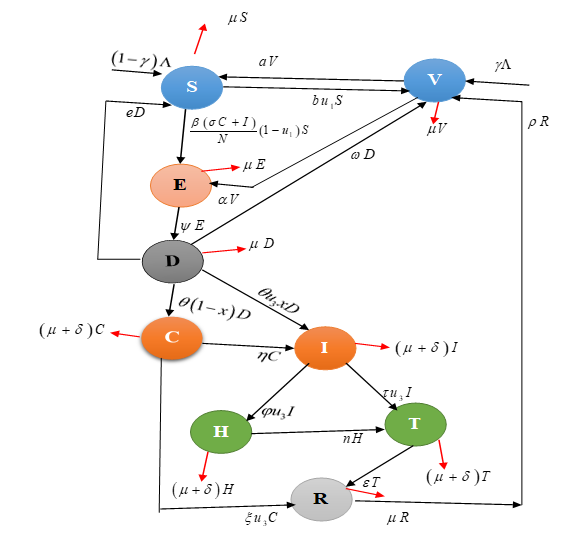
This study develops and analyzes a mathematical model for diphtheria transmission dynamics incorporating immunization, surveillance, and prompt case management as control measures. Analytical results include the disease-free and endemic equilibria, the basic reproduction number , global stability using Lyapunov function and a sensitivity analysis showing that transmission rate, immunization coverage, surveillance and prompt case management effort have the greatest influence on disease spread. Numerical simulations using Matlab2024a demonstrate that combined interventions have drastically reduced both carriers and infected individuals, achieving Diphtheria elimination within 100 days. These results provide quantitative guidance for public health strategies, emphasizing the importance of immunization, surveillance and the prompt care management control measures for proper control of diphtheria.
References
A. S. Afolabi and M. Miswanto, (2025). Mathematical Modeling, Optimal Control and Cost-Effectiveness Analysis of Diphtheria Transmission Dynamic. Jambura J.Biomath, vol. 6, no. 2, pp. 88–108, 2025, https://doi.org/10.37905/jjbm.v6
Clarke, K. E. N. (2019). Review of the epidemiology of diphtheria—2000–2016. Vaccine, 37(1), 6–14. https://doi.org/10.1016/j.vaccine.2018.10.035
Diekmann, O., Heesterbeek, J. A. P., & Metz, J. A. J. (1990). On the definition and the computation of the basic reproduction ratio in models for infectious diseases in heterogeneous populations. Journal of Mathematical Biology, 28(4), 365–382. https://doi.org/10.1007/BF00178324
Eloho B. A., Eirene O. A., Ngozika J. E., Akindele M. O.(2023). Mathematical Modelling of Diphtheria Transmission Dynamics for Effective Strategies of Prevention and Control with Emphasis on Vaccination and Vaccine-Induced Immunity. International Journal of Research in Interdisciplinary Studies 4(1) https://www.ijris.com |ISSN (Online): 2584-1017.
Eloho B. A., & Akindele M, O. (2025). Mathematical Modeling of Diphtheria: The Role of Antibiotics, Quarantine, and Healthcare Resource Allocation. ISAR Journal of Science and Technology Volume 3, Issue 9, 2025, Page: 16-27. https://isarpublisher.com/journal/isarjst
Efstratiou, A., & George, R. C. (1999). Microbiology and epidemiology of diphtheria. Reviews in Medical Microbiology, 10(1), 13–19.
Fatuma Z. G., Shewafera W. T. & Haileyesus T. A., (2025). Optimal Control and Economic Evaluation of Diphtheria Disease Model with Booster Immunization and Hospitalization | https://doi.org/10.1038/s41598-025-21549-7
Hadfield, T. L., McEvoy, P., Polotsky, Y., Tzinserling, V. A., & Yakovlev, A. A. (2000). The pathology of diphtheria. The Journal of Infectious Diseases, 181(Suppl. 1), S116–S120. https://doi.org/10.1086/315554
Hethcote, H. W. (2000). The mathematics of infectious diseases. SIAM Review, 42(4), 599–653. https://doi.org/10.1137/S0036144500371907
Hethcote, H. W. (2000). The mathematics of infectious diseases. SIAM Review, 42(4), 599–653. https://doi.org/10.1137/S0036144500371907
Hycienth, O. O. Nyiutya, C. I., Washachi, D. J. Baidu, A. A. & Kwaghkor L. M. (2025): Mathematical Model for Managing Diphtheria Outbreaks in Nigeria via Vaccination, Enhanced Surveillance, Effective Quarantine, and Social Distancing Measures. Mathematical Modelling and Numerical Simulation with Applications, 202x, x(x), 1–35
Lenhart, S., & Workman, J. T. (2007). Optimal control applied to biological models. Chapman & Hall/CRC.
Maia, R. (2015). An introduction to Mathematical epidimology. Pringer. New York Heidelberg Dordredit London.
Nasiru M. Mohammed & Musa Kida (2026). A Multi-Intervention Framework for Diphtheria Eradication: Optimizing Public Health Via Vaccination, Early Diagnosis, Isolation and Community- Driven Infection Control. International Journal of Science for Global Sustainability, Federal University Gusau, Nigeria. DOI:ttps://doi.org/10.57233/ijsgs.v11i4.1020
Truelove, S. A., Keegan, L. T., Moss, W. J., Chaisson, L. H., Macher, E., Azman, A. S., & Lessler, J. (2020). Characterizing the impact of diphtheria vaccination coverage on outbreaks. The Lancet Infectious Diseases, 20(12), 1508–1516. https://doi.org/10.1016/S1473-3099 (20)30404-7
Van den Driessche, P., & Watmough, J. (2002). Reproduction numbers and sub-threshold endemic equilibria for compartmental models of disease transmission. Mathematical Biosciences, 180(1–2), 29–48. https://doi.org/10.1016/S0025-5564(02)00108-6
World Health Organization. (2017). Diphtheria vaccine: WHO position paper. Weekly Epidemiological Record, 92(31), 417–436.
World Health Organization. (2023). Diphtheria. WHO Fact Sheets.
Downloads
Published
Issue
Section
Categories
License
Copyright (c) 2026 Nasiru Mohammed Mangga, Musa Kida

This work is licensed under a Creative Commons Attribution 4.0 International License.


