
ISOLATION AND EVALUATION OF INDIGENOUS FUNGAL SPECIES FOR BIOSORPTION OF CADMIUM (Cd) FROM CONTAMINATED SOIL
DOI:
https://doi.org/10.33003/fjs-2026-1006-5070Keywords:
Bioremediation, Fungal remediation, Heavy metals, Biosorption, Heavy Metals toleranceAbstract
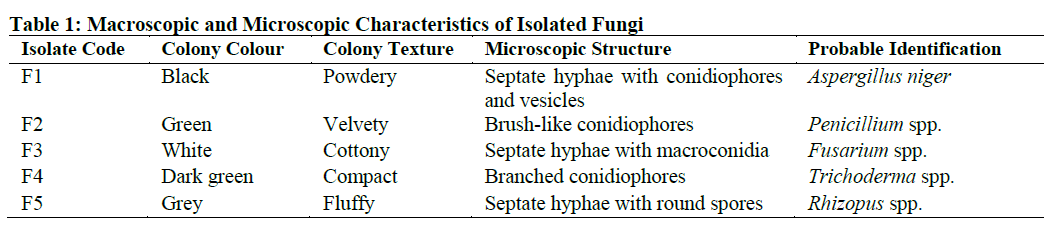
Heavy metal contamination, particularly by cadmium, poses a significant environmental and public health challenge due to its toxicity, persistence, and bioaccumulative nature in soil and water systems. Conventional remediation methods are often expensive and environmentally disruptive, thereby increasing interest in sustainable biological approaches such as fungal bioremediation. This study investigated the isolation, cadmium tolerance, and biosorption potential of indigenous fungal species for the remediation of cadmium-contaminated environments. Soil samples were collected from a contaminated site and subjected to fungal isolation using standard microbiological techniques. Morphological and microscopic characterization identified five fungal species, namely Aspergillus niger, Penicillium spp., Fusarium spp., Trichoderma spp., and Rhizopus spp., indicating a diverse fungal community adapted to polluted soils. The tolerance of the isolates to cadmium was evaluated using the poisoned food technique at a concentration of 100 ppm cadmium. All isolates exhibited growth in cadmium-amended media, although radial growth was reduced relative to the control. Among the isolates, Trichoderma spp. demonstrated the highest tolerance with the lowest percentage growth inhibition. Biosorption studies conducted in liquid culture further revealed that all tested fungi were capable of removing cadmium from solution with varying efficiencies. Trichoderma spp. recorded the highest cadmium removal efficiency (72%), followed by Aspergillus niger (66%), while Penicillium spp. exhibited the lowest removal efficiency (59%). The findings demonstrate the significant potential of indigenous fungal species, particularly Trichoderma spp., as cost-effective and eco-friendly agents for the bioremediation of cadmium-contaminated environments.
References
Abdullahi, M., and Garba, I. (2023). Fungal biosorption mechanisms in heavy metal remediation. Journal of Environmental Biotechnology, 15(2), 112–121.
Adebayo, T. O., and Lin, Y. (2023). Experimental design considerations in fungal biosorption of heavy metals. Journal of Environmental Biotechnology, 18(2), 115–128.
Adebayo, T. O., and Lin, Y. (2024). Toxicological behavior and environmental persistence of cadmium in contaminated soils. International Journal of Environmental Toxicology, 29(1), 41–55.
Adeyemi, K. A., Musa, S. A., and Bello, R. O. (2024). Assessment of fungal tolerance to cadmium using the poisoned food technique. African Journal of Microbial Research, 16(3), 89–101.
Adeyemi, T., and Bello, A. (2022). Soil fungi as agents of environmental remediation. Journal of Applied Microbial Research, 12(4), 201–210.
Chen, H., and Huang, L. (2021). Colorimetric determination of cadmium using dithizone complexes. Analytical Chemistry Review, 14(2), 67–78.
Garba, M., and Musa, H. (2023). Adaptation of soil fungi to polluted environments. Journal of Environmental Biology, 27(2), 88–96.
Gonzalez, R. M., and Adeyemi, K. A. (2024). Indigenous soil fungi as bioresources for heavy metal remediation. Journal of Environmental Microbiology, 22(2), 134–147.
Khan, M. A., and Otieno, J. O. (2021). Vertical distribution of heavy metals in contaminated agricultural soils. Soil and Sediment Science, 35(3), 201–214.
Khan, M. A., and Otieno, J. O. (2023). Microbial diversity and adaptation in metal-stressed soil environments. Ecological Microbiology Reports, 7(4), 189–202.
Li, J., Sun, Y., Jiang, X., Chen, B., and Zhang, X. (2018). Arbuscular mycorrhizal fungi alleviate arsenic toxicity to Medicago sativa by influencing arsenic speciation and partitioning. Ecotoxicology and Environmental Safety, 157, 235–243.
Liu, Z., Martins, A. C., and Silva, P. R. (2022). Preparation and stability of cadmium standard solutions for laboratory biosorption studies. Journal of Chemical Standards, 10(1), 55–63.
Liu, Z., Martins, A. C., and Silva, P. R. (2023). Comparative biosorption performance of fungi and bacteria under cadmium exposure. Biotechnology Advances, 41(2), 107–119.
Martins, A. C., and Silva, P. R. (2023). Shaking incubation parameters influencing fungal biosorption of heavy metals. Applied Environmental Biotechnology, 15(3), 176–188.
Mensah, D. K., and Adeyemi, K. A. (2024). Adaptive responses of fungi to cadmium-induced oxidative stress. Journal of Stress Biology, 8(1), 23–35.
Mensah, D. K., Boateng, E. A., and Yusuf, M. T. (2022). Replication and statistical reliability in laboratory biosorption experiments. Journal of Experimental Biology and Statistics, 5(2), 61–72.
Mohammed, B., and Sule, A. (2020). Environmental factors affecting fungal biosorption of heavy metals. Journal of Environmental Chemistry, 9(2), 77–85.
Musa, A., and Adamu, S. (2023). Heavy metal tolerance in filamentous fungi. Journal of Environmental Toxicology, 16(1), 33–41.
Nguyen, T. H., and Ali, N. S. (2024). Limitations of culture-dependent techniques in soil fungal ecology. Soil Microbiology Perspectives, 12(1), 44–56.
Ojo, T., and Ahmed, K. (2021). Microbial tolerance to cadmium contamination in soil ecosystems. Journal of Environmental Science and Sustainability, 13(2), 92–101.
Okafor, N. J., and Jimoh, A. A. (2021). Morphological identification of soil fungi using lactophenol cotton blue staining. Mycology Methods Journal, 6(2), 78–90.
Okafor, N. J., and Jimoh, A. A. (2023). Relevance of classical fungal identification techniques in modern environmental studies. African Journal of Mycology, 9(1), 15–27.
Okeke, C. C., and Jimoh, A. A. (2023). Environmental factors affecting fungal biosorption of cadmium. Journal of Environmental Chemistry, 19(4), 301–314.
Okoro, V. O., and Mensah, D. K. (2023). Cadmium contamination and ecological risk in industrial soils. Journal of Environmental Risk Assessment, 17(2), 98–111.
Olatunji, D., and Yakubu, M. (2020). Fungal adaptation to polluted soil environments. African Journal of Biological Sciences, 11(4), 240–249.
Rakotoarisoa, H. R., and Bello, R. O. (2022). Limitations of conventional remediation methods for heavy metal-contaminated soils. Environmental Engineering Review, 28(3), 145–158.
Rashid, A. M., and Bello, R. O. (2022). Serial dilution techniques for isolation of soil fungi from contaminated sites. Laboratory Microbiology Journal, 13(1), 33–45.
Rashid, A. M., and Bello, R. O. (2023). Structural properties of fungal cell walls in heavy metal biosorption. Journal of Fungal Research, 21(2), 97–109.
Sani, S., Abdullahi, A., and Garba, H. (2024). Microbial approaches for heavy metal remediation. Journal of Environmental Biotechnology, 19(1), 70–81.
Singh, P., and Okafor, N. J. (2024). Biological approaches to heavy metal remediation: Current trends and challenges. Environmental Biotechnology Advances, 30(1), 1–14.
Singh, P., Zhao, L., and Kim, S. H. (2023). Temperature and nutrient effects on mesophilic fungal growth. Journal of Applied Microbiology, 124(3), 811–822.
Singh, S. (2017). Microbe-induced degradation of pesticides. Springer.
Suleiman, A., and Abdullahi, Y. (2024). Bioremediation potentials of fungi in heavy metal contaminated soils. Environmental Biotechnology Review, 17(2), 95–104.
Tan, Q., Chen, G., Zeng, G., Chen, A., Guan, S., and Li, Z. (2015). Physiological fluxes and antioxidative enzymes activities of immobilized Phanerochaete chrysosporium loaded with TiO2 nanoparticles after exposure to toxic pollutants in solution. Chemosphere, 128, 21–27.
Usman, M., and Bello, A. (2021). Functional groups involved in fungal metal biosorption. Journal of Applied Environmental Microbiology, 6(3), 120–128.
Wang, Y., Li, H., and Zhou, X. (2024). Adaptive evolution of soil fungi in heavy metal-contaminated environments. Soil Ecology and Evolution, 18(1), 52–66.
Williams, E. F., and Carter, J. P. (2023). Quality assurance and calibration practices in trace metal analysis. Analytical Quality Control Journal, 12(4), 233–246.
Yakubu, S., and Mohammed, H. (2022). Biosorption potential of Aspergillus niger in metal contaminated environments. African Journal of Environmental Studies, 15(2), 60–68.
Zhou, X., Wang, Y., and Li, H. (2024). Foundational laboratory assessments in fungal bioremediation research. Journal of Environmental Biology, 39(1), 10–22.
Downloads
Published
Issue
Section
Categories
License
Copyright (c) 2026 Umar Aliyu Abdullahi, Suleiman Musa, Hamza Garba, Sani Ahmad, Sani Shuaibu Kafin Hausa

This work is licensed under a Creative Commons Attribution 4.0 International License.


