
Physicochemical Analysis of Water Samples Sources from Wells and Boreholes in Residential Areas Close to Cemeteries: A Review
DOI:
https://doi.org/10.33003/fjs-2026-1017-6092Keywords:
Groundwater contamination, Cemetery leachate, Physicochemical analysis, Water quality, Public health, NigeriaAbstract
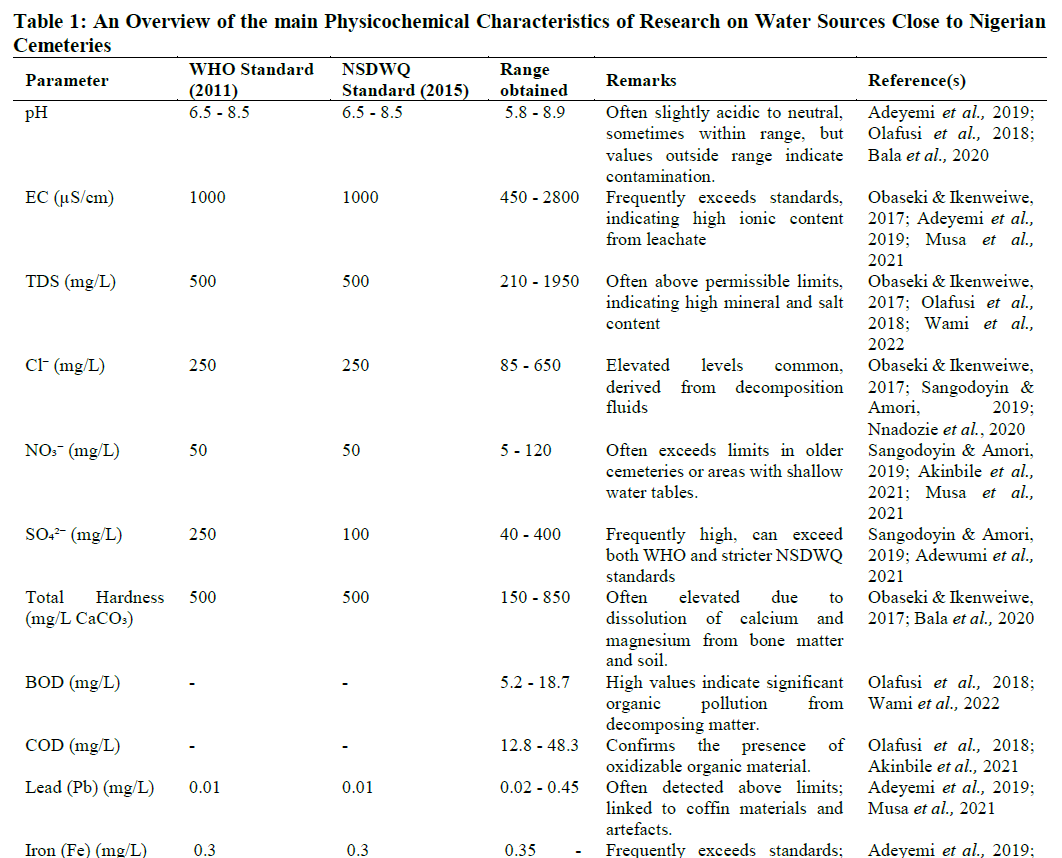
The proximity of groundwater sources to cemeteries poses a significant public health risk due to the potential leaching of contaminants from decomposing human remains. This review synthesizes literature on the physicochemical quality of water from wells and boreholes near Nigerian cemeteries, aiming to evaluate contamination levels against WHO and NSDWQ standards. Findings consistently reveal deteriorated water quality, with parameters such as pH (5.8–8.9), electrical conductivity (450–2800 µS/cm), total dissolved solids (210–1950 mg/L), chloride (85–650 mg/L), nitrate (5–120 mg/L), sulphate (40–400 mg/L), and heavy metals like lead (0.02–0.45 mg/L) and iron (0.35–2.10 mg/L) frequently exceeding permissible limits. Microbial contamination, particularly coliform bacteria, is also prevalent, indicating faecal pollution. The evidence confirms that cemeteries act as point sources of groundwater pollution, with contamination influenced by hydrogeological factors and burial practices. This review underscores the urgent need for stricter regulatory guidelines on cemetery siting, improved leachate management, and continuous water quality monitoring to safeguard public health. It calls for integrated environmental management and further research into remediation strategies for affected communities
References
Adewumi, A. J., Oguntuase, A. M., & Adejuwon, J. O. (2021). Groundwater vulnerability to pollution from cemeteries: A review. Journal of Environmental Management, 287, 112316. https://doi.org/10.1016/j.jenvman.2021.112316
Adeyemi, O. O., Ojekunle, Z. O., & Taiwo, A. M. (2019). Impact of cemetery on groundwater quality in Ayobo, Lagos State, Nigeria. Journal of Health and Pollution, 9 (24), 191205. https://doi.org/10.5696/2156-9614-9.24.191205
Akoto, O., Adiyiah, J., & Abrom, D. (2019). Physicochemical analysis of groundwater in selected communities in Nigeria. Applied Water Science, 9 (4), 86. https://doi.org/10.1007/s13201-019-0968-z
Akinbile, C. O., Ogunrinde, T. A., & Olatunji, O. M. (2021). Groundwater contamination from a cemetery in Osun State, Nigeria: A case study. Environmental Nanotechnology, Monitoring & Management, 16, 100505. https://doi.org/10.1016/j.enmm.2021.100505
Bala, A., Sule, I. M., & Salami, A. T. (2020). Assessment of groundwater quality around a cemetery in Kano Metropolis, Nigeria. Nigerian Journal of Environmental Sciences and Technology, 4 (2), 432-443. https://doi.org/10.36263/nijest.2020.02.0202
Da Silva, G. C., de Oliveira, I. B., & Jardim, F. A. (2021). Hydrogeochemical assessment of cemetery influence on groundwater quality in a tropical urban area. Environmental Earth Sciences, 80 (9), 345. https://doi.org/10.1007/s12665-021-09636-0
Musa, J. J., Adewumi, J. R., & Ezenwa, I. M. (2021). Vulnerability assessment of groundwater contamination near a cemetery in Kaduna, Nigeria. Arabian Journal of Geosciences, 14 (5), 387. https://doi.org/10.1007/s12517-021-06762-8
Nnadozie, P. C., Orij, J. C., & Umeh, S. I. (2020). Evaluation of the impact of cemetery on groundwater quality in Umuahia, Abia State, Nigeria. International Journal of Environment and Pollution Research, 8 (2), 1-15.
Obaseki, M., & Ikenweiwe, N. B. (2017). Impact of Ikhueniro cemetery on groundwater quality in Benin City, Edo State, Nigeria. Journal of Applied Sciences and Environmental Management, 21 (7), 1283-1288. https://doi.org/10.4314/jasem.v21i7.13
Olafusi, O. S., Oladepo, K. T., & Ayejuyo, O. O. (2018). Assessment of groundwater contamination near a cemetery in Yaba, Lagos State, Nigeria. *Journal of Chemical Society of Nigeria, 43 (3), 502-509.
Sangodoyin, A. Y., & Amori, A. A. (2019). Influence of cemetery on groundwater quality in Ibadan, Nigeria. Environmental Technology & Innovation, 14, 100335. https://doi.org/10.1016/j.eti.2019.100335
Ücisik, A. S., & Rushbrook, P. (1998). The impact of cemeteries on the environment and public health: An introductory briefing. World Health Organization Regional Office for Europe.
Wami, E. N., Obenade, O., & Amakiri, A. O. C. (2022). Physicochemical and microbial analysis of water from wells close to a cemetery in Port Harcourt, Nigeria. Journal of Water and Health, 20 (1), 217-228. https://doi.org/10.2166/wh.2021.168
World Health Organization. (2011). Guidelines for drinking-water quality (4th ed.).
Żychowski, J. (2018). The impact of cemeteries on the natural environment. A review. Journal of Ecology and Engineering, 19 (5), 207–212. https://doi.org/10.12911/22998993/91877
Downloads
Published
Issue
Section
Categories
License
Copyright (c) 2026 Hannatu Abidu Aliyu, Aminu Akilu, Hauwa'u Salmanu, Abubakar Lawal, Alkali Mohammed

This work is licensed under a Creative Commons Attribution 4.0 International License.


