
ASSESSMENT OF QuEChERS, DLLME AND WET DIGESTION FOR HEAVY METAL DETERMINATION IN SWEET POTATO TUBER
DOI:
https://doi.org/10.33003/fjs-2025-0912-4027Keywords:
QuEChERS, DLLME, Wet Digestion, Sweet Potato, Atomic Absorption Spectrophotometry (AAS)Abstract
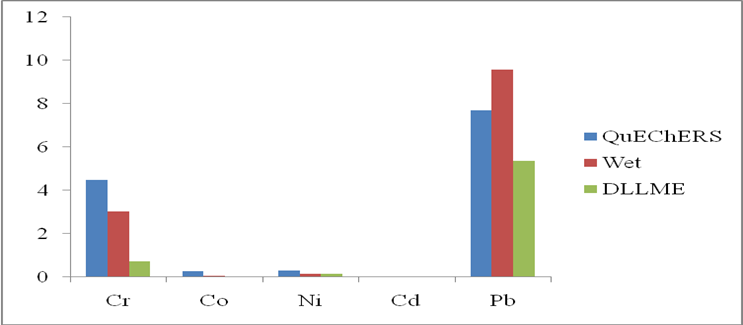
This study compares three sample preparation techniques—QuEChERS (Quick, Easy, Cheap, Effective, Rugged, and Safe), Dispersive Liquid-Liquid Microextraction (DLLME), and conventional wet digestion— for the determination of heavy metals (Nickel, Cobalt, Chromium, Cadmium, and Lead) in sweet potato tubers (Ipomoeabatatas) from Bakori, Katsina State, Nigeria. The extracted metals were quantified using Atomic Absorption Spectrophotometry (AAS). The results revealed distinct performance differences among the methods. QuEChERS yielded the highest recovered concentrations for Cr (4.480 ± 0.0021 ppm), Co (0.271 ± 0.0009 ppm), Ni (0.300 ± 0.0014 ppm), and Cd (0.032 ± 0.0008 ppm). Wet digestion produced the highest value for Pb (9.59 ± 0.0012 ppm) but lower results for the other four metals compared to QuEChERS. DLLME consistently provided the lowest extraction efficiencies for all metals except Pb, where it was intermediate. The elevated levels of certain metals, particularly Cr and Pb, highlight potential public health concerns, as concentrations exceeding safe limits may pose risks through dietary exposure. The modified QuEChERS method is superior by its efficient disruption of the sample matrix. Its advantages including speed, ease of use, safety, minimization of loss, reduced reagent consumption and effective chelation—make QuEChERS a highly effective and practical technique for routine monitoring of heavy metals in food crops like sweet potato.
References
Akilu, A., & Lawal, A. (2025). Review on the recent sample preparation methods for the analysis of toxic heavy metals in foods and beverages. FUDMA Journal of Sciences, 9(9), 353 - 358. https://doi.org/10.33003/fjs-2025-0909-3815
Ali, H., Khan, E., & Ilahi, I. (2019). Environmental chemistry and ecotoxicology of hazardous heavy metals: Environmental persistence, toxicity, and bioaccumulation. Journal of Chemistry, 2019. https://doi.org/10.1155/2019/6730305
Amde, M., Tan, Z.-Q., Liu, R., & Liu, J.-F. (2016). Methods and recent advances in speciation analysis of mercury in environmental samples: A review.Chemical Speciation & Bioavailability,31 (1), 51–65. https://doi.org/10.1080/09542299.2016.1164019
Anastassiades, M., Lehotay, S. J., Štajnbaher, D., & Schenck, F. J. (2003). Fast and easy multiresidue method employing acetonitrile extraction/partitioning and "dispersive solid-phase extraction" for the determination of pesticide residues in produce. Journal of the Association of Official Analytical Chemists International,86 (2), 412–431. https://doi.org/10.1093/jaoac/86.2.412
Ataee, M., Ahmadi-Jouibari, T., & Fattahi, N. (2016). Application of modified QuEChERS method for extraction of some heavy metals from food samples. Journal of Food Composition and Analysis,54, 8–15. https://doi.org/10.1016/j.jfca.2016.09.002
Bakirdere, S., Bora, S., Bakirdere, E. G., Aydin, F., Arslan, Y., Komesli, O. T., & Aydin, I. (2020). A novel and rapid digestion method for elemental analysis of specialty polymers by ICP-OES: A green chemistry approach. Microchemical Journal, 159, 105-429. https://doi.org/10.1016/j.microc.2020.105429
Cheng, H., Li, M., Zhao, C., Yang, K., Li, K., & Peng, M. (2018). Concentrations of heavy metals in vegetables and potential health risks assessment in China.Geochemistry and Health,40 (3), 313–322.https://doi.org/10.1007/s10653-017-9909-6
Divya, O., Pillai, S. S., & Gupta, S. (2015). A comparative study of digestion methods for the determination of heavy metals in plant samples. Research Journal of Chemical Sciences, 5(6), 12-17.
Núñez, M., Borrull, F., Fontanals, N., & Pocurull, E. (2022). The QuEChERS approach for the determination of emerging organic contaminants in environmental samples: A review. Journal of Separation Science, 45 (1), 244–269. https://doi.org/10.1002/jssc.202100534
Plotka-Wasylka, J., Szczepańska, N., de la Guardia, M., & Namieśnik, J. (2016). Modern trends in solid phase extraction: New sorbent media. TrAC Trends in Analytical Chemistry, 77, 23–43. https://doi.org/10.1016/j.trac.2015.10.010
Rezaee, M., Assadi, Y., Milani Hosseini, M.-R., Aghaee, E., Ahmadi, F., & Berijani, S. (2006). Determination of organic compounds in water using dispersive liquid–liquid microextraction. Journal of Chromatography A,1116 (1–2), 1–9. https://doi.org/10.1016/j.chroma.2006.03.007
Suleiman, F., Nuhu, A. A., Omoniyi, K. I., & Yashim, Z. I. (2020). Determination of organochlorine pesticide residues in some vegetables and fruit by QuEChERS techniques and gas chromatography / mass spectrometry. FUDMA Journal of Sciences, 4(2), 365–370. https://doi.org/10.33003/fis-2020-0402-223
World Health Organization (WHO) & Food and Agriculture Organization (FAO). (2023). Codex alimentarius: General standard for contaminants and toxins in food and feed. CODEX STAN 193-1995.
Yilmaz, E., & Soylak, M. (2016). Developments and applications of liquid-phase microextraction in metal speciation and analysis of complex matrices. Journal of Analytical Chemistry, 71 (5), 447–456. https://doi.org/10.1134/S1061934816050032
Downloads
Published
Issue
Section
Categories
License
Copyright (c) 2025 Aminu Akilu, Abubakar Lawal, Nura Suleiman Gwaram, Abubakar Sani

This work is licensed under a Creative Commons Attribution 4.0 International License.


