
Uncertainty-Aware Credit Card Fraud Detection Using a Fuzzy Graph Attention Network with Weak-Signal Edge Preservation
DOI:
https://doi.org/10.33003/fjs-2026-1018-5889Keywords:
Fraud detection, Fuzzy graph theory, Graph attention network, Graph neural networks, Class imbalance, Fraudster camouflageAbstract
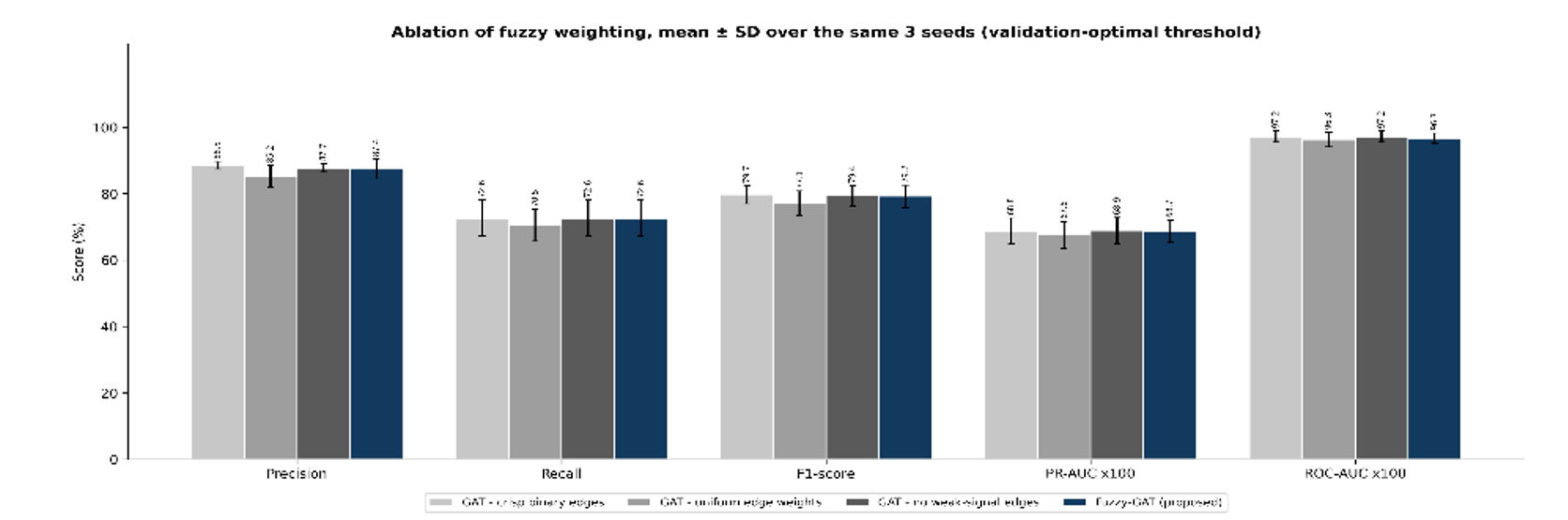
Coordinated card fraud can leave only weak, partial traces between transactions, which crisp graph detectors discard. This study evaluates a Fuzzy Graph Attention Network (Fuzzy-GAT) in which Gaussian edge-membership weights modulate attention, so that weak-signal edges are preserved rather than pruned. Because the public European Credit Card Fraud benchmark contains no account, device or IP identifiers, the graph links each transaction to its ten nearest neighbours in feature space, and no relational entities were synthesised. After removing 1,081 duplicate records (283,726 transactions; 473 frauds), every model was evaluated over five stratified 70/10/20 splits, at both the default and a validation-optimised decision threshold. The Fuzzy-GAT reached an F1-score of 79.3 ± 2.9% and a ROC-AUC of 0.969 ± 0.012. It matched Logistic Regression (79.4 ± 1.8%) and a crisp Graph Convolutional Network (79.9 ± 3.0%), but Random Forest (82.1 ± 3.3%; paired t-test p = 0.014) and XGBoost (82.8 ± 2.4%; p = 0.002) outperformed it. In a three-seed ablation, fuzzy weighting gave no benefit, and preserving weak-signal edges changed F1 by −0.1 percentage points; pruning weak edges at thresholds from 0.05 to 0.80 left F1 unchanged. In a model-agnostic stress test built from perturbed copies of test frauds, no model resisted camouflage: at moderate strength the Fuzzy-GAT detected 47.2% of cases, against 56.4% for Logistic Regression. On this benchmark, fuzzy edge weighting added computational cost without measurable benefit; whether it helps where genuine relational metadata exist remains open.
References
Akakoh, U. I., & Edegbe, G. N. (2026). Mitigating financial fraud: A hybrid SMOTE-Tomek and stacked ensemble model approach. FUDMA Journal of Sciences, 10(14), 210–217. https://doi.org/10.33003/fjs-2026-1014-5398
Bahnsen, A. C., Aouada, D., Stojanovic, A., & Ottersten, B. (2016). Feature engineering strategies for credit card fraud detection. Expert Systems with Applications, 51, 134–142. https://doi.org/10.1016/j.eswa.2015.12.030
Bhattacharyya, S., Jha, S., Tharakunnel, K., & Westland, J. C. (2011). Data mining for credit card fraud: A comparative study. Decision Support Systems, 50(3), 602–613. https://doi.org/10.1016/j.dss.2010.08.008
Bolton, R. J., & Hand, D. J. (2002). Statistical fraud detection: A review. Statistical Science, 17(3), 235–255. https://doi.org/10.1214/ss/1042727940
Branco, P., Torgo, L., & Ribeiro, R. P. (2016). A survey of predictive modelling under imbalanced distributions. ACM Computing Surveys, 49(2), Article 31. https://doi.org/10.1145/2907070
Breiman, L. (2001). Random forests. Machine Learning, 45(1), 5–32. https://doi.org/10.1023/A:1010933404324
Carneiro, N., Figueira, G., & Costa, M. (2017). A data mining based system for credit-card fraud detection in e-tail. Decision Support Systems, 95, 91–101. https://doi.org/10.1016/j.dss.2017.01.002
Charizanos, G., Demirhan, H., & İçen, D. (2024). An online fuzzy fraud detection framework for credit card transactions. Expert Systems with Applications, 252, Article 124127. https://doi.org/10.1016/j.eswa.2024.124127
Chawla, N. V., Bowyer, K. W., Hall, L. O., & Kegelmeyer, W. P. (2002). SMOTE: Synthetic minority over-sampling technique. Journal of Artificial Intelligence Research, 16, 321–357. https://doi.org/10.1613/jair.953
Chen, T., & Guestrin, C. (2016). XGBoost: A scalable tree boosting system. In Proceedings of the 22nd ACM SIGKDD International Conference on Knowledge Discovery and Data Mining (pp. 785–794). ACM. https://doi.org/10.1145/2939672.2939785
Dal Pozzolo, A., Caelen, O., Johnson, R. A., & Bontempi, G. (2015). Calibrating probability with undersampling for unbalanced classification. In Proceedings of the 2015 IEEE Symposium Series on Computational Intelligence (pp. 159–166). IEEE. https://doi.org/10.1109/SSCI.2015.33
Dawaki, M., Mohammed, A., & Ismail, M. (2022). Fraudulent text detection system using hybrid machine learning and natural language processing approaches. International Journal of Innovative Science and Research Technology, 7(10), 1110–1118. https://doi.org/10.5281/zenodo.7313563
Deloitte. (n.d.). Future of financial crime. Deloitte Africa. Retrieved September 3, 2026, from https://www.deloitte.com/za/en/services/consulting/perspectives/future-of-financial-crime.html
Devi, R. R., Raja, J. E., & Chin, Y. B. (2025). Reinforcement learning with graph neural network (RL-GNN) fusion for real-time financial fraud detection: A context-aware community mining approach. Scientific Reports, 15, Article 42953. https://doi.org/10.1038/s41598-025-25200-3
Dietterich, T. G. (1998). Approximate statistical tests for comparing supervised classification learning algorithms. Neural Computation, 10(7), 1895–1923. https://doi.org/10.1162/089976698300017197
Dou, Y., Liu, Z., Sun, L., Deng, Y., Peng, H., & Yu, P. S. (2020). Enhancing graph neural network-based fraud detectors against camouflaged fraudsters. In Proceedings of the 29th ACM International Conference on Information & Knowledge Management (pp. 315–324). ACM. https://doi.org/10.1145/3340531.3411903
FATF, INTERPOL, & Egmont Group. (2023). Illicit financial flows from cyber-enabled fraud. Financial Action Task Force. https://www.fatf-gafi.org/content/dam/fatf-gafi/reports/Illicit-financial-flows-cyber-enabled-fraud.pdf.coredownload.inline.pdf
Fatokun, J. O., Mustapha, S., Balogun, F., & Okorie, D. D. (2025). Fraud detection in Nigerian investment advisory sector using machine learning algorithms. FUDMA Journal of Sciences, 9(10), 5–11. https://doi.org/10.33003/fjs-2025-0910-4004
Fawcett, T. (2006). An introduction to ROC analysis. Pattern Recognition Letters, 27(8), 861–874. https://doi.org/10.1016/j.patrec.2005.10.010
Fu, K., Cheng, D., Tu, Y., & Zhang, L. (2016). Credit card fraud detection using convolutional neural networks. In A. Hirose, S. Ozawa, K. Doya, K. Ikeda, M. Lee, & D. Liu (Eds.), Neural Information Processing: ICONIP 2016 (pp. 483–490). Springer. https://doi.org/10.1007/978-3-319-46675-0_53
Huo, M., Lu, K., Zhu, Q., & Chen, Z. (2025). Enhancing customer contact efficiency with graph neural networks in credit card fraud detection workflow. In Proceedings of the 2025 IEEE 7th International Conference on Communications, Information System and Computer Engineering (CISCE) (pp. 320–324). IEEE. https://arxiv.org/abs/2504.02275
Jurgovsky, J., Granitzer, M., Ziegler, K., Calabretto, S., Portier, P.-E., He-Guelton, L., & Caelen, O. (2018). Sequence classification for credit-card fraud detection. Expert Systems with Applications, 100, 234–245. https://doi.org/10.1016/j.eswa.2018.01.037
Juszczak, P., Adams, N. M., Hand, D. J., Whitrow, C., & Weston, D. J. (2008). Off-the-peg and bespoke classifiers for fraud detection. Computational Statistics & Data Analysis, 52(9), 4521–4532. https://doi.org/10.1016/j.csda.2008.03.014
Kipf, T. N., & Welling, M. (2017). Semi-supervised classification with graph convolutional networks. In Proceedings of the 5th International Conference on Learning Representations (ICLR). https://openreview.net/forum?id=SJU4ayYgl
Kirkos, E., Spathis, C., & Manolopoulos, Y. (2007). Data mining techniques for the detection of fraudulent financial statements. Expert Systems with Applications, 32(4), 995–1003. https://doi.org/10.1016/j.eswa.2006.02.016
Liu, F. T., Ting, K. M., & Zhou, Z.-H. (2008). Isolation forest. In Proceedings of the 2008 Eighth IEEE International Conference on Data Mining (pp. 413–422). IEEE. https://doi.org/10.1109/ICDM.2008.17
McNemar, Q. (1947). Note on the sampling error of the difference between correlated proportions or percentages. Psychometrika, 12(2), 153–157. https://doi.org/10.1007/BF02295996
Mordeson, J. N., & Nair, P. S. (2000). Fuzzy graphs and fuzzy hypergraphs. Physica-Verlag. https://doi.org/10.1007/978-3-7908-1854-3
Ngai, E. W. T., Hu, Y., Wong, Y. H., Chen, Y., & Sun, X. (2011). The application of data mining techniques in financial fraud detection: A classification framework and an academic review of literature. Decision Support Systems, 50(3), 559–569. https://doi.org/10.1016/j.dss.2010.08.006
Nilson Report. (2019, November). Payment card fraud losses reach $27.85 billion [Press release]. HSN Consultants. https://www.prnewswire.com/news-releases/payment-card-fraud-losses-reach-27-85-billion-300963232.html
Nilson Report. (2020, December). Card fraud losses reach $28.65 billion (Issue 1187). HSN Consultants. https://nilsonreport.com/articles/card-fraud-losses-reach-28-65-billion/
Ohwomado, K. O., Akazue, M. I., & Ojugo, A. A. (2026). A systematic ablation-based optimisation protocol for convolutional neural networks in electronic banking fraud detection. FUDMA Journal of Sciences, 10(12), 79–84. https://doi.org/10.33003/fjs-2026-1012-5285
Ojo, O. F., Otaru, P. O., Job, O. E., & Onoghojobi, B. (2026). Comparative performance of machine learning models for credit card fraud detection on imbalanced data: A study using SMOTE and the Kaggle European dataset. FUDMA Journal of Sciences, 10(3), 102–108. https://doi.org/10.33003/fjs-2026-1003-4745
Okikiola, F. M., Arogundade, T. S., Onadokun, I., Oladiboye, O. E., & Sodiq, A. K. (2026). Strengthening financial integrity: The role of cybersecurity in mitigating financial fraud in Nigeria's banking sector. FUDMA Journal of Sciences, 10(2), 175–183. https://doi.org/10.33003/fjs-2026-1002-4491
Oono, K., & Suzuki, T. (2020). Graph neural networks exponentially lose expressive power for node classification. In Proceedings of the 8th International Conference on Learning Representations (ICLR). https://openreview.net/forum?id=S1ldO2EFPr
Phua, C., Lee, V., Smith, K., & Gayler, R. (2010). A comprehensive survey of data mining-based fraud detection research. arXiv. https://arxiv.org/abs/1009.6119
Pourhabibi, T., Ong, K.-L., Kam, B. H., & Boo, Y. L. (2020). Fraud detection: A systematic literature review of graph-based anomaly detection approaches. Decision Support Systems, 133, Article 113303. https://doi.org/10.1016/j.dss.2020.113303
Rosenfeld, A. (1975). Fuzzy graphs. In L. A. Zadeh, K. S. Fu, & M. Shimura (Eds.), Fuzzy sets and their applications to cognitive and decision processes (pp. 77–95). Academic Press. https://doi.org/10.1016/B978-0-12-775260-0.50008-6
Saito, T., & Rehmsmeier, M. (2015). The precision-recall plot is more informative than the ROC plot when evaluating binary classifiers on imbalanced datasets. PLOS ONE, 10(3), Article e0118432. https://doi.org/10.1371/journal.pone.0118432
Sha, Q., Tang, T., Du, X., Liu, J., Wang, Y., & Sheng, Y. (2025). Detecting credit card fraud via heterogeneous graph neural networks with graph attention. arXiv. https://arxiv.org/abs/2504.08183
Shi, X., Wang, X., Zhang, Y., Zhang, X., Yu, M., & Zhang, L. (2025). Innovative novel regularized memory graph attention capsule network for financial fraud detection. PLOS ONE, 20(5), Article e0317893. https://doi.org/10.1371/journal.pone.0317893
Tian, Y., Liu, G., Wang, J., & Zhou, M. (2023). Transaction fraud detection via an adaptive graph neural network. arXiv. https://arxiv.org/abs/2307.05633
Veličković, P., Cucurull, G., Casanova, A., Romero, A., Liò, P., & Bengio, Y. (2018). Graph attention networks. In Proceedings of the 6th International Conference on Learning Representations (ICLR). https://openreview.net/forum?id=rJXMpikCZ
Wang, Q., Shen, Y., & Dong, H. (2025). Hypergraph-based contrastive learning for enhanced fraud detection. Frontiers in Artificial Intelligence, 8, Article 1703135. https://doi.org/10.3389/frai.2025.1703135
West, J., & Bhattacharya, M. (2016). Intelligent financial fraud detection: A comprehensive review. Computers & Security, 57, 47–66. https://doi.org/10.1016/j.cose.2015.09.005
Xiang, S., Zhang, G., Cheng, D., & Zhang, Y. (2025). Enhancing attribute-driven fraud detection with risk-aware graph representation. IEEE Transactions on Knowledge and Data Engineering, 37(5), 2501–2512. https://doi.org/10.1109/TKDE.2025.3543887
Zadeh, L. A. (1965). Fuzzy sets. Information and Control, 8(3), 338–353. https://doi.org/10.1016/S0019-9958(65)90241-X
Downloads
Published
Issue
Section
Categories
License
Copyright (c) 2026 Mustapha Ismail, Saadatu Zakariyyah, Ahmed Mohammed

This work is licensed under a Creative Commons Attribution 4.0 International License.


