
Spatial and Temporal Variation of Indoor Environmental Quality and Occupancy across a Five-Node Office Sensor Network
DOI:
https://doi.org/10.33003/fjs-2026-1011-5339Keywords:
Indoor environmental quality, Occupancy, Sensor network, Smart Buildings, Spatial VariabilityAbstract
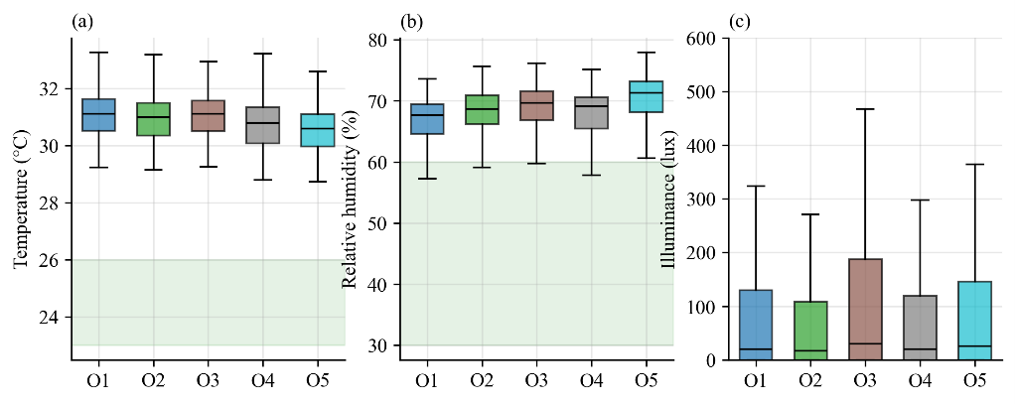
Indoor environmental quality (IEQ) and occupancy are usually characterized for a single room, yet real buildings comprise many zones that may differ substantially, with direct consequences for zoned heating, ventilation and air-conditioning control. This study quantified the spatial and temporal variation of IEQ and occupancy across a five-node, low-cost sensor network deployed in five offices. Each node logged temperature, humidity, illuminance, motion and a fused occupancy state every minute, yielding 56,173 validated records over 8 days, from which the apparent temperature (heat index) and thermal-comfort compliance were derived. Differences between offices were tested with one-way analysis of variance, the non-parametric Kruskal–Wallis test and Tukey honestly-significant-difference post-hoc comparisons, and the offices were grouped by Ward hierarchical clustering. All four variables differed significantly between offices (p < 0.001). Temperature differed in 10 of 10 pairwise comparisons, mean temperature spanned 30.5–31.1 °C and occupancy ranged from 54% to 75% of the time. Temperature and humidity were strongly anti-correlated (r = -0.78). No office met the conventional comfort envelope for an appreciable share of the time, and the heat index exceeded the caution threshold almost throughout. Clustering separated one low-occupancy office from the rest. The results show that single-zone assumptions are unsafe and that spatially resolved monitoring is required for effective, zone-aware building management.
References
Adoga, H. U., Ogbonoko, J. F., & Dauda, A. (2025). An edge-cloud task offloading framework for heterogeneous smart home IoT networks. FUDMA Journal of Sciences, 9(10), 154–159. https://doi.org/10.33003/fjs-2025-0910-3918
ASHRAE. (2017). ANSI/ASHRAE Standard 55-2017: Thermal environmental conditions for human occupancy. American Society of Heating, Refrigerating and Air-Conditioning Engineers. https://pdfcoffee.com/ansiashrae-standard-55-2017-thermal-environmental-conditions-for-human-occupancy-pdf-free.html
Candanedo, L. M., & Feldheim, V. (2016). Accurate occupancy detection of an office room from light, temperature, humidity and CO2 measurements using statistical learning models. Energy and Buildings, 112, 28–39. https://doi.org/10.1016/j.enbuild.2015.11.071
Chen, Z., Jiang, C., & Xie, L. (2018). Building occupancy estimation and detection: A review. Energy and Buildings, 169, 260–270. https://doi.org/10.1016/j.enbuild.2018.03.084
de Dear, R., & Brager, G. S. (2002). Thermal comfort in naturally ventilated buildings: Revisions to ASHRAE Standard 55. Energy and Buildings, 34(6), 549–561. https://doi.org/10.1016/S0378-7788(02)00005-1
Dinmohammadi, F., Farook, A. M., & Shafiee, M. (2025). Improving energy efficiency in buildings with an IoT-based smart monitoring system. Energies, 18(5), 1269. https://doi.org/10.3390/en18051269
Esrafilian-Najafabadi, M., & Haghighat, F. (2021). Occupancy-based HVAC control systems in buildings: A state-of-the-art review. Building and Environment, 197, 107810. https://doi.org/10.1016/j.buildenv.2021.107810
Ghahramani, A., Zhang, K., Dutta, K., Yang, Z., & Becerik-Gerber, B. (2016). Energy savings from temperature setpoints and deadband: Quantifying the influence of building and system properties on savings. Applied Energy, 165, 930–942. https://doi.org/10.1016/j.apenergy.2015.12.115
Gunay, H. B., O'Brien, W., & Beausoleil-Morrison, I. (2013). A critical review of observation studies, modeling, and simulation of adaptive occupant behaviors in offices. Building and Environment, 70, 31–47. https://doi.org/10.1016/j.buildenv.2013.07.020
Halhoul Merabet, G., Essaaidi, M., Ben Haddou, M., Qolomany, B., Qadir, J., Anan, M., Al-Fuqaha, A., Abid, M. R., & Benhaddou, D. (2021). Intelligent building control systems for thermal comfort and energy-efficiency: A systematic review. Renewable and Sustainable Energy Reviews, 144, 110969. https://doi.org/10.1016/j.rser.2021.110969
Hong, T., Taylor-Lange, S. C., D'Oca, S., Yan, D., & Corgnati, S. P. (2016). Advances in research and applications of energy-related occupant behavior in buildings. Energy and Buildings, 116, 694–702. https://doi.org/10.1016/j.enbuild.2015.11.052
Metallidou, C. K., Psannis, K. E., & Egyptiadou, E. A. (2020). Energy efficiency in smart buildings: IoT approaches. IEEE Access, 8, 63679–63699. https://doi.org/10.1109/ACCESS.2020.2984461
Minoli, D., Sohraby, K., & Occhiogrosso, B. (2017). IoT considerations, requirements, and architectures for smart buildings—Energy optimization and next-generation building management systems. IEEE Internet of Things Journal, 4(1), 269–283. https://doi.org/10.1109/JIOT.2017.2647881
Mirakhorli, A., & Dong, B. (2016). Occupancy behavior based model predictive control for building indoor climate—A critical review. Energy and Buildings, 129, 499–513. https://doi.org/10.1016/j.enbuild.2016.07.036
Mohammed, A., Sarban Singh, R. S., Aslam, S., Wong, Y. C., Anand, T. J. S., & Ahmed, M. K. (2026). Next generation solar photovoltaic monitoring systems: A scoping review on techniques, technologies, usability and security issues. Jurnal Kejuruteraan, 38(2), 779–796. https://doi.org/10.17576/jkukm-2026-38(2)-25
Naylor, S., Gillott, M., & Lau, T. (2018). A review of occupant-centric building control strategies to reduce building energy use. Renewable and Sustainable Energy Reviews, 96, 1–10. https://doi.org/10.1016/j.rser.2018.07.019
Pang, Z., Chen, Y., Zhang, J., O'Neill, Z., Cheng, H., & Dong, B. (2021). How much HVAC energy could be saved from the occupant-centric smart home thermostat: A nationwide simulation study. Applied Energy, 283, 116251. https://doi.org/10.1016/j.apenergy.2020.116251
Park, J. Y., & Nagy, Z. (2018). Comprehensive analysis of the relationship between thermal comfort and building control research – A data-driven literature review. Renewable and Sustainable Energy Reviews, 82, 2664–2679. https://doi.org/10.1016/j.rser.2017.09.102
Pérez-Lombard, L., Ortiz, J., & Pozo, C. (2008). A review on buildings energy consumption information. Energy and Buildings, 40(3), 394–398. https://doi.org/10.1016/j.enbuild.2007.03.007
Rafsanjani, H. N., Ghahramani, A., & Nabizadeh, A. H. (2020). iSEA: IoT-based smartphone energy assistant for prompting energy-aware behaviors in commercial buildings. Applied Energy, 266, 114892. https://doi.org/10.1016/j.apenergy.2020.114892
Rocha, P., Siddiqui, A., & Stadler, M. (2015). Improving energy efficiency via smart building energy management systems: A comparison with policy measures. Energy and Buildings, 88, 203–213. https://doi.org/10.1016/j.enbuild.2014.11.077
Rothfusz, L. P. (1990). The heat index equation (NWS Technical Attachment SR/SSD 90-23). National Weather Service, NOAA.
Saha, H., Florita, A. R., Henze, G. P., & Sarkar, S. (2019). Occupancy sensing in buildings: A review of data analytics approaches. Energy and Buildings, 188–189, 278–285. https://doi.org/10.1016/j.enbuild.2019.02.030
Sahar, M. N. H., Sulaiman, N. A., & Kassim, M. (2026). Small scale IoT-based energy monitoring system. Jurnal Kejuruteraan, 38(1), 181–188. https://doi.org/10.17576/jkukm-2026-38(1)-17
Salimi, S., & Hammad, A. (2019). Critical review and research roadmap of office building energy management based on occupancy monitoring. Energy and Buildings, 182, 214–241. https://doi.org/10.1016/j.enbuild.2018.10.007
Schiavon, S., Hoyt, T., & Piccioli, A. (2014). Web application for thermal comfort visualization and calculation according to ASHRAE Standard 55. Building Simulation, 7(4), 321–334. https://doi.org/10.1007/s12273-013-0162-3
Sensirion AG. (2022). Datasheet SHT4x: Humidity and temperature sensor. Sensirion AG.
Shaikh, P. H., Nor, N. B. M., Nallagownden, P., Elamvazuthi, I., & Ibrahim, T. (2014). A review on optimized control systems for building energy and comfort management of smart sustainable buildings. Renewable and Sustainable Energy Reviews, 34, 409–429. https://doi.org/10.1016/j.rser.2014.03.027
Sowmya, K. V., Teju, V., Pavan, T. N. V. S., Prasad, G. S. D., & Krishna, P. V. (2021). IoT based energy monitoring in smart home using mobile application. In 2021 3rd International Conference on Advances in Computing, Communication Control and Networking (ICACCCN). IEEE. https://doi.org/10.1109/ICAC3N53548.2021.9725622
Sun, K., Zhao, Q., & Zou, J. (2020). A review of building occupancy measurement systems. Energy and Buildings, 216, 109965. https://doi.org/10.1016/j.enbuild.2020.109965
Tien, P. W., Wei, S., Darkwa, J., Wood, C., & Calautit, J. K. (2022). Machine learning and deep learning methods for enhancing building energy efficiency and indoor environmental quality – A review. Energy and AI, 10, 100198. https://doi.org/10.1016/j.egyai.2022.100198
Usman, A. S., Abubakar, N., Adua, A. M., & Jarere, U. M. (2025). A low cost IoT-based smart energy monitoring and load management system for residential and small scale applications: A case study at Abdullahi Fodio University of Science and Technology, Aliero. FUDMA Journal of Sciences, 9(10), 122–124. https://doi.org/10.33003/fjs-2025-0910-3999
Verma, A., Prakash, S., Srivastava, V., Kumar, A., & Mukhopadhyay, S. C. (2019). Sensing, controlling, and IoT infrastructure in smart building: A review. IEEE Sensors Journal, 19(20), 9036–9046. https://doi.org/10.1109/JSEN.2019.2922409
Vishay Semiconductors. (2019). VEML7700: High accuracy ambient light sensor with I2C interface (Document 84286). Vishay Intertechnology.
Yang, L., Yan, H., & Lam, J. C. (2014). Thermal comfort and building energy consumption implications – A review. Applied Energy, 115, 164–173. https://doi.org/10.1016/j.apenergy.2013.10.062
Zhang, W., Wu, Y., & Calautit, J. K. (2022). A review on occupancy prediction through machine learning for enhancing energy efficiency, air quality and thermal comfort in the built environment. Renewable and Sustainable Energy Reviews, 167, 112704. https://doi.org/10.1016/j.rser.2022.112704.
Downloads
Published
Issue
Section
Categories
License
Copyright (c) 2026 Ahmed Mohammed, Mustapha Ismail, Abdulhamid Ibrahim Nafada, Muhammad Dawaki, Mohammed Ajuji

This work is licensed under a Creative Commons Attribution 4.0 International License.


