
Bivariate Spatial Modeling of Malnutrition among Under Five Children in Nigeria. A Bayesian Hierarchical Modelling Approach
DOI:
https://doi.org/10.33003/fjs-2026-1014-5679Keywords:
Childhood Malnutrition, Bayesian Hierarchical Modeling, Bivariate Spatial Modeling, Differential Effects, Stunting, Underweight Wasting, Temperature, PrecipitationAbstract
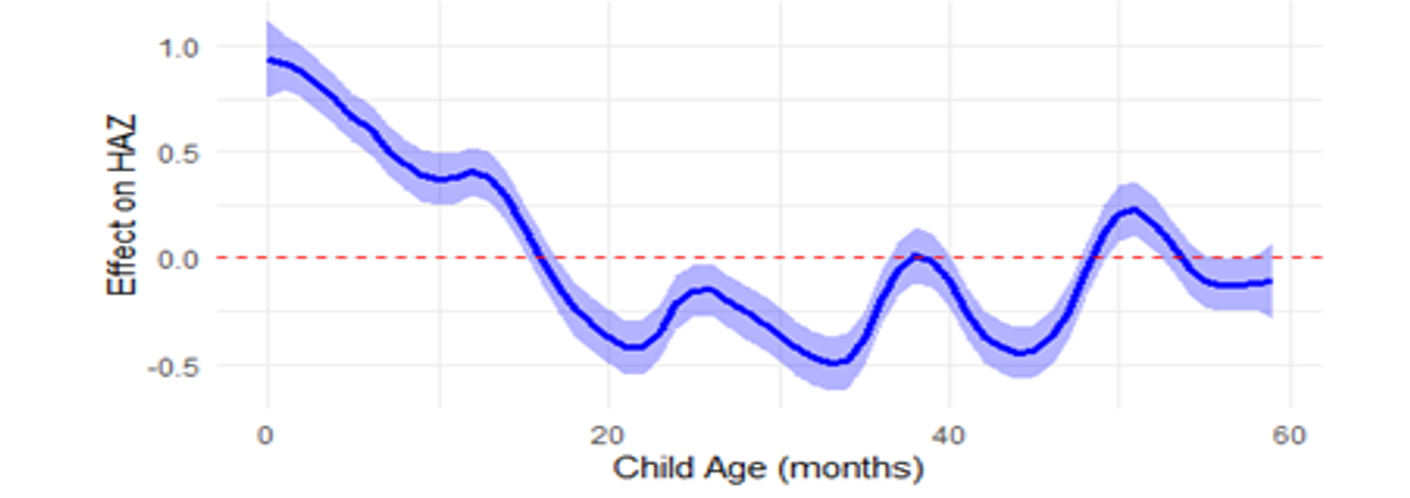
Childhood malnutrition continues to be a serious public health concern in Nigeria, with persistent geographic disparities and limited understanding of the joint spatial pattern of malnutrition indicators. This study examined the spatial distribution and determinants of childhood malnutrition in Nigeria using a two-stage Bayesian hierarchical modeling approach. The data were extracted from the 2024 Nigeria Demographic and Health Survey (NDHS). Separate univariate spatial models were fitted for stunting, underweight and wasting, incorporating fixed effects, nonlinear age effects, cluster-specific random effects, and spatial dependence. Spatial effects were extracted to evaluate pairwise correlations and estimate covariate differential fixed effects utilizing a stacked bivariate model. All models were estimated within the Integrated Nested Laplace Approximation (INLA) techniques. The study revealed that the prevalence of stunting, underweight, and wasting was 36.14%, 25.13%, and 8.27%, respectively. Maternal education exhibited the strongest protective effect across all indicators, while household wealth index, child gender, and climatic factors are also identified as significant risk factors. Differential effects analysis showed that maternal education had stronger protective effects on underweight than stunting, while temperature and precipitation showed significant differential effects across malnutrition outcomes. The study also identified strong clustering of stunting and underweight in northern states while wasting exhibited a more dispersed pattern. The findings highlight the need for geographically targeted and outcome-specific interventions that prioritize poverty alleviation programmes, maternal education and climate adaptation to improve child nutrition in Nigeria.
References
World Health Organization (WHO), United Nations Children's Fund (UNICEF), & World Bank Group. (2025). Levels and trends in child malnutrition: Key findings of the 2025 edition of the Joint Child Malnutrition Estimates. Geneva, Switzerland: World Health Organization. WHO/UNICEF/World Bank Joint Child Malnutrition Estimates 2025
United Nations Children's Fund (UNICEF). (2025). Malnutrition in Nigeria: Current situation and response. Abuja, Nigeria: UNICEF Nigeria. UNICEF Nigeria Malnutrition Updates
Aminu Ibrahim, Rasheed Alani Adeyemi, Abubakar Usman, Nasiru Usman Adabara (2025).Weighted Random Effect Multinomial Model With Application Anaemia and Malnutrition Comorbidity among Under Five Children in Nigeria. Asian Journal of Probability and Statistics, 27(1), 29-42.
Amare, M., & Balana, B. (2026). Climate-Induced Agricultural Productivity Shocks Undermine Child Nutritional Outcomes: Evidence from Nigeria. The Journal of Development Studies, 1–20.
Amegbor, P. M., Lapurga, K., Carr, E., & Guerrero, M. (2025). Exploring the effect of early-life climate anomalies on child growth in Sub-Saharan African context: Insight from the demographic & health survey. Science of The Total Environment, 983, 179658.
Bachwenkizi, J., He, C., Zhu, Y., Mugisha, A., Tlou, B., Moshiro, C., Mwambi, H., Madzorera, I., Chen, R., Kan, H., & Fawzi, W. W. (2026). Predicting the effects of temperature variability on nutritional status of children under five in Sub-Saharan Africa using machine learning. Scientific Reports, 16, 8055. https://doi.org/10.1038/s41598-026-39659-1
World Health Organization (2013). Guideline: updates on the management of severe acute malnutrition in infants and children. World Health Organization.
World Health Organization (2020). UNICEF/WHO/the World Bank group joint child malnutrition estimates: levels and trends in child malnutrition: key findings of the 2020 edition. https://www.who.int/publications/i/item/9789240003576
Kandala, N. B., Madungu, T. P., Emina, J. B. O., Nzita, K. P. D., & Cappuccio, F. P. (2011). Malnutrition among children under the age of five in the Democratic Republic of Congo (DRC): Does geographic location matter? BMC Public Health, 11, 261. https://doi.org/10.1186/1471-2458-11-261
Khatab K. (2010). Childhood malnutrition in Egypt using geoadditive gaussian and latent variable models. American Journal of Tropical Medicine and Hygiene, 82(4), 653–663.
Amusa, L. B., Yahya, W. B., & Bengesai, A. V. (2023). Spatial variations and determinants of malnutrition among under-five children in Nigeria: A population-based cross-sectional study. PLoS ONE, 18(4), e0284270. https://doi.org/10.1371/journal.pone.0284270
Gayawan, E., Adebayo, S. B., Komolafe, A. A., & Akomolafe, A. A. (2019). Spatial distribution of malnutrition among children under five in Nigeria: A Bayesian quantile regression approach. Applied Spatial Analysis and Policy, 12(2), 229–254.
Egbon, O., Somo-Aina, O., & Gayawan, E. (2021). Spatial weighted analysis of malnutrition among children in Nigeria: A Bayesian approach. Statistical Biosciences, 35(4), 1–29.
Egbon, O. A., Belachew, A. M., & Bogon, M. A. (2022). Risk factors of concurrent malnutrition among children in Ethiopia: A bivariate spatial modeling approach. All Life, 15(1), 512–536. https://doi.org/10.1080/26895293.2022.20672
Aminu Ibrahim, Rasheed Alani Adeyemi, Abubakar Usman, Nasiru Usman Adabara (2024). Spatially Weighted Multinomial Modelling of Disease Co-morbidity among under five children in Nigeria. Qeios, (16 pages)
Ibrahim A., Adeyemi R.A, Usman A., Musa A,O. (2024). Bayesian Geo-Additive Modelling of State-Level Heterogeneity in Anaemia Prevalence and Risk Factors among Under-Five Children in Nigeria. Confluence University Journal of Science and Technology, Vol. 1, No. 2.
Adeyemi, R. A., Zewotir, T., & Ramroop, S. (2019). Joint spatial mapping of childhood anemia and malnutrition in Sub-Saharan Africa: A cross-sectional study of small-scale geographical disparities. African Health Sciences, 19(3), 2692–2712.
Lopez, A. D., Mathers, C. D., Ezzati, M., Jamison, D. T., & Murray, C. J. L. (2006). Global burden of disease and risk factors. Oxford University Press. https://doi.org/10.1596/978-0-8213-6262-4
Hailu, B. A., Bogale, G. G., & Beyene, J. (2020). Spatial heterogeneity and factors influencing stunting and severe stunting among under-5 children in Ethiopia: Spatial and multilevel analysis. Scientific Reports, 10(1), 1–10.
Takele K, Zewotir T, Ndanguza D. (2020).Spatial jointmodelling of children under-five malnutrition in Ethiopia. J Hum Ecol. 70(1-3):132–142.
Ibrahim, J. G., Chen, M.-H., & Sinha, D. (2014). Bayesian survival analysis. Springer.
Louzada, F., Nascimento, D. C., & Egbon, O. A. (2021). Spatial statistical models: An overview under the Bayesian approach. Axioms, 10(4), 307.
Lindgren, F., & Rue, H. (2008). On the second-order random walk model for irregular locations. Scandinavian Journal of Statistics, 35(4), 691–700.
R Core Team. (2019). R: A language and environment for statistical computing [Computer software]. R Foundation for Statistical Computing. https://www.R-project.org/
Palmi-Perales, F., Gomez-Rubio, V., & Martinez-Beneito, M. A. (2019). Bayesian multivariate spatial models for lattice data with INLA. Journal of Statistical Software, 98(2), 1–29.
Blangiardo, M., Cameletti, M., Baio, G., & Rue, H. (2013). Spatial and spatio-temporal models with R-INLA. Spatial and Spatio-temporal Epidemiology, 4, 33–49.
Ibrahim, A., Adeyemi, R. A., Usman, A., Raji, M., Bashiru, S. O., Adaji, I., & Musa, A. O. (2025). Shared component model for childhood anaemia, diarrhoea, and fever comorbidities in Nigeria: A geospatial perspective. International Journal of Advanced Mathematical Sciences, 11(2), 74–82.
Fagbohungbe T., Gayawan E., Orunmoluyi O.S. (2020). Spatial prediction of childhood malnutrition across space in Nigeria based on point-referenced data: an SPDE approach. J Public Health Policy 41(4):464 480
Freni-Sterrantino, A., Ventrucci, M., & Rue, H. (2018). A note on intrinsic conditional autoregressive models for disconnected graphs. Spatial and Spatio-temporal Epidemiology, 26, 25–34.
WHO Regional Office for Africa. (2025). Progress report on the implementation of the strategic plan to reduce the double burden of malnutrition in the African Region (2019-2025) (AFR/RC75/INF.DOC/14). World Health Organization. https://www.afro.who.int/
United Nations. (2015). Transforming our world: The 2030 Agenda for Sustainable Development. United Nations. https://sdgs.un.org/2030agenda
Downloads
Published
Issue
Section
Categories
License
Copyright (c) 2026 Aminu Ibrahim, Muhammed Raji, Isaac Adaji, Bashiru Sule, Aisha Musa, Rasaq Olayiwola, Balikis Yekeen, Baba Abdul Abdullahi

This work is licensed under a Creative Commons Attribution 4.0 International License.


