
Phytoremediation Potential of Cucumber (Cucumis sativus L.) For Barium (Ba) Uptake Under a Hydroponic System
DOI:
https://doi.org/10.33003/fjs-2026-1011-5525Keywords:
Barium, Heavy Metal Contamination, Phytoremediation, Hydroponic System, Reactive Oxygen SpeciesAbstract
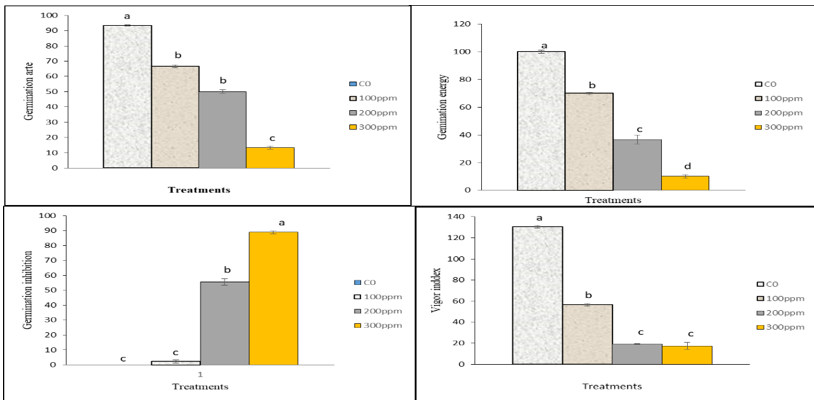
This research examined how Cucumber (Cucumis sativus L.) responds physiologically, biochemically, and through phytoremediation to barium (Ba) stress in a controlled hydroponic environment. Various metrics were assessed, including seed germination rates, growth factors like root and shoot height, levels of photosynthetic pigments, phytohormones, markers of oxidative stress, antioxidant defenses, and metal accumulation at concentrations of 0 (control), 100, 200, and 300 ppm Ba, using a fully randomized design. The presence of barium significantly reduced the seed germination rate, germination energy, and vigor index by 28.57–60.78%, 30.00–79.00%, and 86.67–88.10%, respectively, compared to the control group. At 300 ppm Ba, both shoot and root lengths decreased by more than 60%, alongside a reduction of over 65% in fresh and dry biomass. The levels of chlorophyll a, chlorophyll b, carotenoids, and SPAD values were markedly lower, with chlorophyll a decreasing by as much as 5.08 times at 300 ppm Ba. Additionally, the concentrations of auxin (IAA) and gibberellic acid dropped by 1.59–3.83-fold and 1.87–3.38-fold, respectively. Ba caused oxidative stress, raising malondialdehyde and hydrogen peroxide levels by up to 75.75% and 39.07%, respectively, while the activities of antioxidant enzymes (SOD, CAT, APX) significantly increased, with SOD activity surging over 24 times at 300 ppm. The bioaccumulation study indicated higher Ba retention in the roots (BAF > 1) but low translocation factors (< 0.5), suggesting a potential for phytostabilization.
References
Abdullahi, A., Mohammed, S., and Bello, A. (2024). Heavy metal–induced oxidative stress and antioxidant responses in spinach (Spinacia oleracea). Journal of Environmental Biology, 45(2), 215–224.
Abdullahi, M., Abubakar, A., and Sadiq, M. (2020). Assessment of heavy metal contamination in irrigation water and vegetables from Challawa and Jakara Rivers, Kano State, Nigeria. Journal of Environmental Chemistry and Ecotoxicology, 12(3), 45–56.
Adesodun, J. K., Atayese, M. O., and Agbaje, T. A. (2014). Bioaccumulation of heavy metals in edible crops cultivated on contaminated soils in southwestern Nigeria. African Journal of Environmental Science and Technology, 8(2), 102–109.
Akinyemi, O., and Ogunfowokan, A. O. (2013). Growth responses of selected vegetables to barium contamination in agricultural soils. Journal of Applied Sciences and Environmental Management, 17(1), 89–96.
Ali, H., Khan, E., and Ilahi, I. (2019). Environmental chemistry and ecotoxicology of hazardous heavy metals: Environmental persistence, toxicity, and bioaccumulation. Journal of Chemistry, 2019, Article 6730305.
Ali, H., Khan, E., and Sajad, M. A. (2014). Phytoremediation of heavy metals—Concepts and applications. Chemosphere, 91, 869–881.
Al-Hashimi, O., Hashim, K. S., Loffill, E., and Kot, P. (2021). A comprehensive review for groundwater contamination and remediation. Molecules, 26(19), 5913.
Audu, A. A., and Lawal, A. O. (2016). Variation in metal contents of plants in vegetable gardens around Kano Metropolis. Journal of Applied Sciences and Environmental Management, 10(2), 105–109.
Bhagyawant, S. S., Gupta, N., and Srivastava, N. (2019). Free radical scavenging activity of antioxidant compounds using DPPH assay. Journal of Pharmacognosy and Phytochemistry, 8(3), 399–403.
Chaudhry, U. K., Khan, A. A., and Ahmad, R. (2016). Effects of heavy metals on seed germination and early seedling growth of crop plants. Environmental Monitoring and Assessment, 188, 567.
Chaves, M. M., Flexas, J., and Pinheiro, C. (2009). Photosynthesis under drought and salt stress: Regulation mechanisms from whole plant to cell. Annals of Botany, 103(4), 551–560.
DaCosta, M., and Huang, B. (2007). Changes in antioxidant enzyme activities and lipid peroxidation in creeping bentgrass under heat stress. Plant Science, 172(1), 124–135.
Demidchik, V., and Maathuis, F. J. M. (2007). Physiological roles of K⁺ channels in plants under stress conditions. Plant Physiology, 143(2), 557–564.
Demidchik, V., Shabala, S., Isayenkov, S., Cuin, T. A., Pottosin, I., and Maathuis, F. J. M. (2014). Reactive oxygen species–regulated ion transport in plants. Plant Physiology, 166(2), 331–343.
Ghaferah, H. A., Al-Hazmi, G. H., and Al-Gaashani, R. (2022). Bioaccumulation and translocation of heavy metals in plants: Implications for phytoremediation. International Journal of Environmental Analytical Chemistry, 102(15), 3681–3696.
Itri, R., Junqueira, H. C., Mertins, O., Baptista, M. S., and Pessoa, A. (2014). Oxidative stress and membrane damage in plants exposed to heavy metals. Plant Stress, 8, 1–9.
Lairini, S., Khamar, M., Kabbaj, M., and Benyoussef, A. (2017). Sensitivity of seed germination and early plant growth stages to heavy metal stress. Journal of Materials and Environmental Science, 8(9), 3252–3261.
Mohamed, A. A., Hassan, F. A., Ali, E. F., and Abd El-Gawad, H. G. (2025). Protein oxidation and enzyme inactivation under heavy metal stress in plants. Environmental Toxicology, 40(1), 112–121.
Mushtaq, F., Ahmad, M., Khan, Z., Siddiqui, A. J., and Alreshidi, M. M. (2022). Preparation, properties, and applications of gelatin-based hydrogels and antioxidant defense under stress. International Journal of Biological Macromolecules, 218, 601–633.
Pompelli, M. F., Martins, S. C. V., Antunes, W. C., Chaves, A. R. M., and DaMatta, F. M. (2013). Photosynthetic responses and chlorophyll degradation under heavy metal stress. Photosynthetica, 51(3), 343–355.
Sharma, P., and Dubey, R. S. (2017). Heavy metal toxicity in plants: Mechanisms and mitigation. Plant Science, 254, 17–32.
Sharma, N., Kumar, A., and Singh, S. (2018). Quantification of gibberellic acid in plants under abiotic stress. Journal of Plant Growth Regulation, 37(1), 122–130.
Song, M., Liu, J., Zhang, R., Yu, W., and Wang, H. (2023). Synthesis of hydrogels for environmental remediation and antimicrobial application. Gels, 9(1), 16.
Tamás, L., Mistrík, I., Huttová, J., and Zelinová, V. (2010). Hydrogen peroxide accumulation in plants exposed to heavy metals. Plant Growth Regulation, 61(1), 27–38.
Tchounwou, P. B., Yedjou, C. G., Patlolla, A. K., and Sutton, D. J. (2012). Heavy metal toxicity and the environment. EXS, 101, 133–164.
Wang, Y., Wang, J., Guo, J., and Xiong, Z. (2015). Altered auxin distribution under heavy metal stress in plants. Plant Cell Reports, 34(2), 173–184.
Yusuf, A. A., Arowolo, T. A., and Bamgbose, O. (2015). Antioxidant responses of vegetables grown on heavy metal–polluted soils in northern Nigeria. Environmental Monitoring and Assessment, 187, 411.
Downloads
Published
Issue
Section
Categories
License
Copyright (c) 2026 Sani Shuaibu Kafin Hausa, Zainab Saleh Maigana, Dannene Abubakar Tukur, Abdulhadi Yakubu, Abubakar Yusuf Abubakar, Usman Yusuf Bello

This work is licensed under a Creative Commons Attribution 4.0 International License.


