
SATELLITE-BASED ESTIMATION AND TREND ANALYSIS OF PM₂.₅ CONCENTRATION USING MODIS MAIAC AEROSOL OPTICAL DEPTH OVER THE UNIVERSITY OF BENIN, NIGERIA
DOI:
https://doi.org/10.33003/fjs-2026-1007-5261Keywords:
Aerosol Optical Depth, PM₂.₅, MODIS MAIAC, Harmattan, Trend Analysis, Remote SensingAbstract
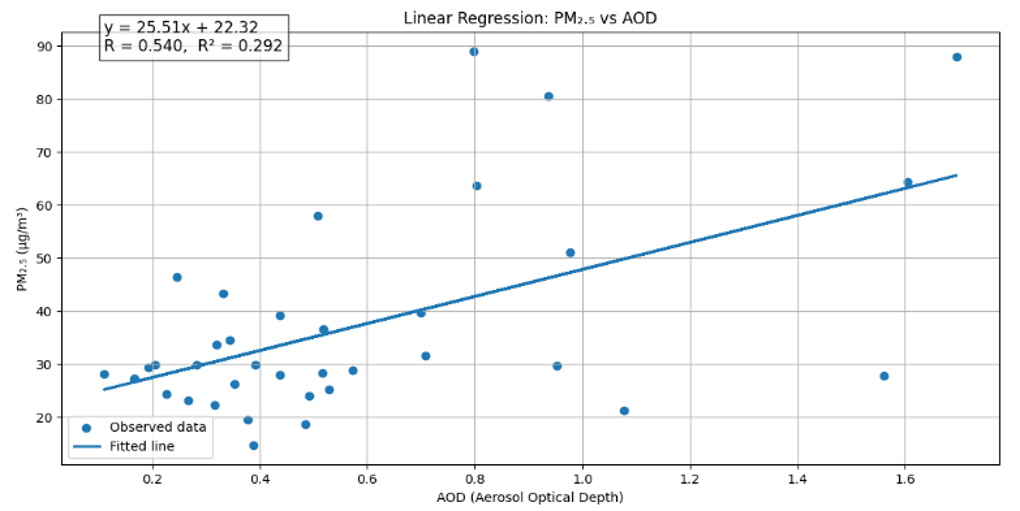
Atmospheric aerosol pollution remains a major environmental and public health concern in rapidly urbanizing regions with limited air-quality monitoring infrastructure. This study developed a satellite-based framework for estimating and analyzing PM₂.₅ concentration over the University of Benin, Nigeria, using MODIS MAIAC Aerosol Optical Depth (AOD) data integrated with ground-based observations. High-resolution AOD data spanning 2015–2024 were processed within Google Earth Engine and calibrated using monthly PM₂.₅ measurements from two monitoring locations. A linear regression model produced a moderate positive relationship between AOD and PM₂.₅ (R = 0.54; R² = 0.29), indicating that approximately 29% of PM₂.₅ variability could be explained by aerosol loading. Although the explanatory power is moderate, such behaviour is common in humid tropical environments where cloud cover, aerosol mixing, atmospheric humidity, and boundary-layer dynamics weaken the AOD–PM₂.₅ relationship. Seasonal Mann–Kendall analysis revealed a statistically significant decreasing Harmattan AOD trend (p = 0.0031) with a Sen’s slope of −0.046 AOD per season. Estimated PM₂.₅ concentrations also exhibited decreasing seasonal trends ranging from approximately −0.997 to −1.20 µg/m³ per season across calibration approaches. The study demonstrates that satellite observations, when locally calibrated, can support seasonal aerosol monitoring and long-term environmental assessment in data-scarce tropical environments. The framework further highlights the potential of low-cost satellite-based air-quality surveillance for campus-scale environmental management and exposure assessment.
References
Attey-Yeboah, P., Afful, C., Yeboah, K., Korkpoe, C. H., Coker, E. S., Subramanian, R., & Amegah, A. K. (2025). Utility of low-cost sensor measurement for predicting ambient PM₂.₅ concentrations: Evidence from a monitoring network in Accra, Ghana. Environmental Science: Atmospheres, 5, 517–529. https://doi.org/10.1039/D4EA00140K
Bodhaine, B. A., Wood, N. B., Dutton, E. G., & Slusser, J. R. (1999). On Rayleigh optical depth calculations. Journal of Atmospheric and Oceanic Technology, 16(11), 1854–1861.
Chauhan, B. V. S., Verma, S., Rahman, B. M. A., & Wyche, K. P. (2025). Deep learning in airborne particulate matter sensing and surface plasmon resonance for environmental monitoring. Atmosphere, 16(4), 359. https://doi.org/10.3390/atmos16040359
Chew, B. N., Campbell, J. R., Hyer, E. J., Salinas, S. V., Reid, J. S., Welton, E. J., Holben, B. N., & Liew, S. C. (2016). Relationship between aerosol optical depth and particulate matter over Singapore. Aerosol and Air Quality Research, 16(11), 2818–2830. https://doi.org/10.4209/aaqr.2015.07.0457
Chylek, P., Henderson, B. G., & Lesins, G. (2005). Aerosol optical depth retrieval over NASA Stennis Space Center. IEEE Transactions on Geoscience and Remote Sensing, 43(9), 1978–1983.
Draper, N. R., & Smith, H. (1998). Applied regression analysis (3rd ed.). John Wiley & Sons.
Eckhardt, C. M., & Wu, H. (2021). Environmental exposures and lung aging. Current Environmental Health Reports, 8(4), 281–293.
Gavrouzou, M., Hatzianastassiou, N., Gkikas, A., Korras-Carraca, M.-B., & Mihalopoulos, N. (2021). Global climatology of dust aerosols. Remote Sensing, 13(3), 359.
Giles, D. M., et al. (2019). AERONET Version 3 database. Atmospheric Measurement Techniques, 12, 169–209.
Gupta, P., & Christopher, S. A. (2009). PM estimation using satellite and meteorological data. Journal of Geophysical Research: Atmospheres, 114.
Holben, B. N., et al. (1998). AERONET aerosol monitoring network. Remote Sensing of Environment, 66(1), 1–16.
Hu, Z., & Rao, K. R. (2009). Air pollution and heart disease. Environmental Health, 8, 26.
Kasten, F., & Young, A. T. (1989). Optical air mass tables. Applied Optics, 28(22), 4735–4738.
Kendall, M. G. (1975). Rank correlation methods (4th ed.). Charles Griffin.
Li, T., Wang, Y., & Wu, J. (2024). Satellite PM₂.₅ estimation using ML. npj Climate and Atmospheric Science, 7, 138.
Logothetis, S.-A., et al. (2024). Machine learning AOD retrieval. Remote Sensing, 16(7), 1132.
Lyapustin, A., Wang, Y., Korkin, S., & Huang, D. (2018). MODIS MAIAC algorithm. Atmospheric Measurement Techniques, 11, 5741–5765.
Ma, Y., Xin, J., Zhang, W., Liu, Z., Ma, Y., Kong, L., Wang, Y., Deng, Y., Lin, S., & He, Z. (2019). Long-term variations of the PM2.5 concentration identified by MODIS in the tropical rain forest, Southeast Asia. Atmospheric Research, 219, 140–152. Doi: https://doi.org/10.1016/j.atmosres.2018.12.024
Mann, H. B. (1945). Non-parametric test against trend. Econometrica, 13(3), 245–259. Doi: https://doi.org/10.2307/1907187
Montgomery, D. C., Peck, E. A., & Vining, G. G. (2012). Introduction to linear regression analysis (5th ed.).
National Aeronautics and Space Administration (NASA., 2026). MODIS missions and measurements. Retrieved May 15, 2025. From https://www.earthdata.nasa.gov/data/instruments/modis
Ogunjo, S., Olaniyan, O., Olusegun, C. F., Kayode, F., Okoh, D., & Jenkins, G. (2022). The role of meteorological variables and aerosols in the transmission of COVID-19 during harmattan season. GeoHealth, 6, e2021GH000521. Doi: https://doi.org/10.1029/2021GH000521
Pham-Duc, B., Nguyen, H., Phan, H., & Tran-Anh. (2023). Trends and applications of Google Earth Engine in remote sensing and earth science research: A bibliometric analysis using Scopus database. Earth Science Informatics, 16, 2355–2371. Doi: https://doi.org/10.1007/s12145-023-01035-2
Rahal, F. (2020). Low-cost air quality sensors. Clean Air Journal, 30(2), 1–2.
Ramírez, O., Hernández-Cuellar, B., & de la Rosa, J. D. (2023). Air quality monitoring on university campuses as a crucial component to move toward sustainable campuses: An overview. Urban Climate, 52, 101694. Doi: https://doi.org/10.1016/j.uclim.2023.101694
Sen, P. K. (1968). Estimates of the regression coefficient based on Kendall’s tau. Journal of the American Statistical Association, 63(324), 1379–1389. Doi: https://doi.org/10.1080/01621459.1968.10480934
United Nations Environment Programme. (2021). Global environment outlook for cities.
van Donkelaar, A., Martin, R. V., Brauer, M., Kahn, R., Levy, R., Verduzco, C., & Villeneuve, P. J. (2010). Global estimates of ambient fine particulate matter concentrations from satellite-based aerosol optical depth: Development and application. Environmental Health Perspectives, 118(6), 847–855. https://doi.org/10.1289/ehp.0901623
Zhang, M., Huang, B., & He, Q. (2017). An evaluation of four MODIS Collection 6 aerosol products in a humid subtropical region. Remote Sensing, 9(11), 1173. https://doi.org/10.3390/rs9111173
Downloads
Published
Issue
Section
Categories
License
Copyright (c) 2026 Stephen Olushola Oladosu, Tolulope Samuel Fawale, Kelvin Akere Moses, Rachael Omoniyepe Oladosu, Godsent Efosa Felix, Enobore Kelly Igbinidu, Mabel Eghemenrior Alenkhe

This work is licensed under a Creative Commons Attribution 4.0 International License.


