
A REVIEW OF PHYTOPHTHORA MEGARKAYA IN COCOA PRODUCTION AND THE RESISTANCE OF COCOA AGAINST THE PATHOGEN
DOI:
https://doi.org/10.33003/fjs-2026-1008-5025Keywords:
Theobroma cacao, Phytophthora megakarya, black pod disease, host resistance, disease managementAbstract
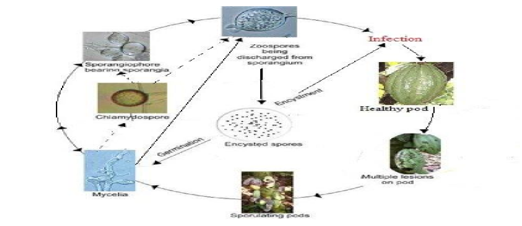
Cocoa (Theobroma cacao L.) is an important tropical crop with production limited by black pod disease caused by Phytophthora megakarya in West and Central Africa. Here, we review the biology, infection process, environmental interactions, and pathogenic variability of Phytophthora megakarya, and the resistance mechanisms of cocoa to this pathogen. The life cycle of Phytophthora megakarya involves fast asexual reproduction, formation of motile zoospores, and survival in the form of chlamydospores, which allows the pathogen to persist and spread over long distances in humid conditions. Environmental factors such as high rainfall, temperature, and canopy density affect disease development, while genetic variability within populations of Phytophthora megakarya complicates disease management by increasing virulence and adaptability. The review also points out that host resistance is a possible sustainable control strategy and that it is quantitative and polygenic; cocoa resistance is a multilayered process that includes genetic, morphological, biochemical, and physiological mechanisms such as activation of defense-related enzymes, accumulation of phenolic compounds, and structural barriers such as thicker pod husks. Tolerant cocoa varieties have been bred using advances in molecular breeding and identification of resistance-associated traits, but pathogen diversity and environmental effects can limit the durability of resistance. The study emphasizes that host resistance must be combined with cultural and environmentally friendly management practices for effective and sustainable control of black pod disease in cocoa production systems.
References
Akrofi, A. Y. (2015). Phytophthora megakarya: A review on its status as a pathogen on Cacao in West Africa. 23(1):67–87.
Carlos, N., Koutoua, S., Mah, E., Zoh Lys Ange Desirée, B., Yao Wilfried Junior, Y., N’Guessan Anthelme Jocelin, N., and Diallo Hortense, A. (2025). Antifungal activity of three plant extracts on Phytophthora sp., responsible for brown rot of cocoa pods (Theobroma cacao L.). International Journal of Agricultural and Natural Sciences. 18(2):149–161.
Ebaiarrey, H. E., Ngonkeu, E. L. M., Djoah, Y. T. & Efombagn, I. B. M. (2024). Assessing the Tolerance of Cocoa (Theobroma cacao L.) Progenies to the Black Pod Disease Caused by Phytophthora megakarya Bras. and Griff. Journal of Applied Life Sciences International. 27(2):13-28.
Enoch, B.R. (2021). Characterisation of Phytophthora pod rot of cocoa (Theobroma cacao L.) and management with host plant resistance in Southwestern Nigeria (Doctoral dissertation).
Kamga, V. A. M. S., Ayong, M. N. A., Talla, C. F., Pamela, K. N., Tchameni, S. N. & Jazet, P. M. D. (2022). Microbicidal Effect of Thyme (Thymus vulgaris) essential oil against Phytophthora megakarya, the causative agent of cocoa black pod disease. American Journal of Microbiological Research. 10(1):17-22.
Kumar, S., & Singh, A. (2024). In silico analysis to understand genetic variability, phylogenetic and phylogeographic relationships between Phytophthora capsici isolates infecting various crops. Archives of Phytopathology and Plant Protection, 57(5), 405-426.
Mahob, R. J., Taliedje, D. M., Mahot, H. C., Ngah, I. M., Enama, S. E., Cilas, C. & Bilong, C. B. (2021). Biocontrol of the brown cocoa mirids using neem oil and an ethanolic extract from neem under laboratory conditions. African Entomology. 29(2):507-521.
Maledy, O. G., Adengoyo, R., Nkeng, M. N., & Bedimo, J. A. M. (2022). Adaptation strategies for the adverse effects of climate disruptions on coffee and cocoa trees productivity in Cameroon. International Journal of Biological and Chemical Sciences, 16(6), 2516-2535.
Membang, G., Tchoumi, J. M. T., Ntsefong, G. N., Ela, E. Y. M., Dida, S. L. L., Tsango, L. T. & Tabi, F. O. (2024). Assessing the Efficacy of Lemongrass (Cymbopogon citratus) and Sambong (Blumea balsamifera) Extracts in Combating Black Pod Disease: Sustainable Solutions for Controlling Phytophthora megakarya in Cameroon Cocoa Plantations. American Journal of Plant Sciences. 15(07):519-537.
Neeraja, B., Prasanna Kumari, V., Gopal, K., Madhu, G.S., Vijay Kumar, K., Madhumathi, T., Chalapathi Rao, N.B.V., and Sayiprathap, B.R. (2025). Indigenous plant growth-promoting rhizobacteria for cocoa growth enhancement and Phytophthora pod rot management. BMC Plant Biology. 25:1258.
Nembot, C.G., Takam Soh, P., Ambang, Z., Ten Hoopen, G. M., & Dumont, Y. (2017). On the use of Mathematical Modelling to study the impact of phytosanitation on cocoa black pod disease caused by Phytophthora megakarya. ICCO.
Olaomi, A.A. (2023). Potential of crude aqueous extract of Chromolaena odorata (Siam weed) as biofungicide in modern cocoa farming. Ela Academics Book. 12:172–187.
Septiani, P., Pramesti, Y., Ningsih, D.U., Pancaningtyas, S., and Meitha, K. (2024). Identification of self- and pathogen-targeted miRNAs from resistant and susceptible cacao varieties to black pod disease. Scientific Reports. 14:3272.
Simamora, A. V., Hahuly, M. V. & Henuk, J. B. (2021). Endophytic fungi as potential biocontrol agents of Phytophthora palmivora in the cocoa plant. Biodiversitas: Journal of Biological Diversity. 22(5).
Youassi-Youassi, Y.O., Ambata-Ambata, H.T., Jiogue, M. B., Dikongue-Ndondoni, F.J., Ntah, A., Ayong, M., Bedine-Boat, M.A. and Sameza, M.L. (2024). The potential of Trichoderma asperellum organic extract and its emulsion to inhibit cocoa (Theobroma cacao L.) black pod disease and induce biochemical defenses against Phytophthora megakarya. Journal of Plant Protection Research. 19-28.
Downloads
Published
Issue
Section
Categories
License
Copyright (c) 2026 Adeyemi Afeez Olaomi, Mohammed Nasirudeen Suleiman, Gbenga Alege, Gbolabo Odewale

This work is licensed under a Creative Commons Attribution 4.0 International License.


