
Influence of Cowdung Fertilization And Spacing On Growth And Yield Of Cowpea (Vigna Unguiculata L. Walp) Varieties In Teaching And Research Farm Of Federal University, Dutsin-Ma, Nigeria
DOI:
https://doi.org/10.33003/fjs-2026-1017-6109Keywords:
Cowpea Varieties, Cowdung Fertilization, Intra-Row Spacing, Sudan SavannahAbstract
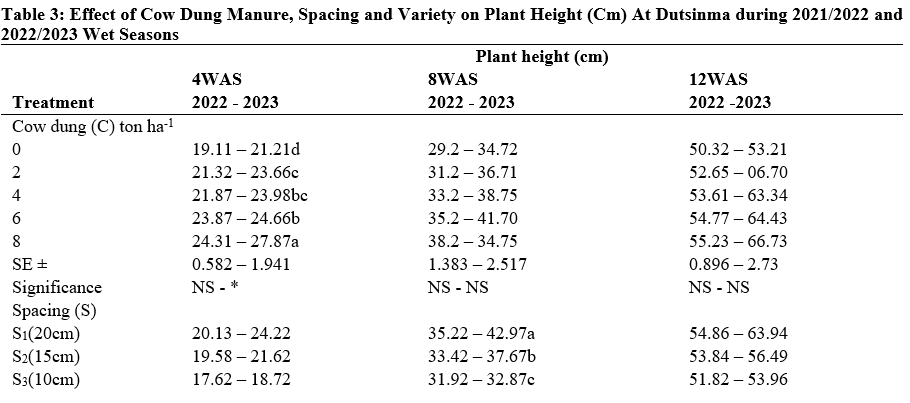
Field trials were conducted during 2021/2022 and 2022/2023 wet seasons at Teaching and Research Farm of Federal University, Dutsin-Ma, Katsina State to evaluate the growth, Yield and Yield Components of Cowpea varieties as influenced by cowdung fertilization and spacing in n Teaching and Research Farm of Federal University Dutsin-Ma, Nigeria. The treatments consisted of five cowdung fertilizer rates (0 ton ha-1, 5 ton ha-1, 10 ton ha-1, 15 ton ha-1 and 20 ton ha-1), three intra intra-row Spacings (10cm, 15cm and 20cm) and two cowpea varieties (SAMPEA 11 and SAMPEA 12). Treatments were laid out in Split plot design with three replications. The Growth and Yield attributes measured in the field include plant height, number of leaves, number of branches and biomass yield. Others include number of pods plant-1, 100 seed weight, pod weight kg plot-1 and grain yield kg ha-1. Data collected were analyzed using ANOVA procedures and means were separated using Duncan Multiple Range Test (DMRT) at 5% level of probability using SAS package. The results indicated that cowdung manure at 20 ton ha-1 significantly outperformed other rates applied in terms of all growth and yield parameters evaluated and 20 cm spacing performed better on almost all growth and yield parameters than other spacings evaluated. SAMPEA 12 had performed significantly better than SAMPEA 11 in terms of plant height, number of leaves, number of branches, Biomass Yield, others are number of pods plant-1, 100 seed weight, pod weight kg plot-1 and Grain Yield kg ha-1.
References
Umoetok, S.B.A., Uko, A.E., Archibong, B.E., Ukeh, D.A. and Udo, I.A. 2007. Effect of application of inorganic fertilizer and poultry manure on insect pests and yield of soybean (Glycine max L.) in the forest zone of Nigeria. J. Food Agric. Environ., 5(2): 149-152
Singh, B.B. (2007). Cowpea (Vigna unguiculata L Walp). In: Sigh, R.J., Jauhar, P.P. (eds). Genetic Resources and Chromosomes Engineering and Crop Important. Vol. 1 CRC press, Boca Rafor, FL, USA, pp. 117-162
IITA, (2009). Research to Nourish Africa. http://www.iita.ag/cowpea;jsessionid=BE63A757EB3FF44903468.
Ishiyaku, M. F., O. O. Olufajo, M. Umar, O. Boukar, C. A. Fatokun, E. Makeri and R. Adeleke (2013). Proposal for release of Cowpea (Vigna unguiculata) varieties, SAMPEA 16 (IT07K-292-10) and SAMPEA 17 (IT07K-318-33). Institute for Agricultural Research, Zaria, Nigeria and International Institute for Tropical Agriculture (IITA) Ibadan, Nigeria.
Ecocrop database. FAO. Web. http://ecocrop.fao.org/ecocrop/srv/en/home. Citation key. Ecocrop, 2009. Datasheets. African yam bean (Sphenostylis stenocarpa).
Black, C.A. (1965). Methods of Soil Analysis II Chemical and Microbiological Properties. American Society of Agronomy, Madison Wisconsin: 1572
Bhangou, M.S. Day, K.S. Sudanagunta, W.R and Petrucci; V.E (1998): Application of Poultry manure: Influence Thompson seedless grape production and soil properties. Horticultural Society. 23 (6) 1010-1012
Haruna, I. M., (2011). Dry matter partititioning and grain yield potential in sesame (Sesamum indicum.L.) as influenced by poultry manure, nitrogen and phosphorus at Samaru, Nigeria. Journal of Agricultural Technology. 7: 1571-1577
Howard, GM. and Albregth, E.F. (2003): Effect of poultry dung on strawberry fruiting response,soil nutrient changes and leaching. Journal of America. Society, 106: 295-298
Kolawole, G.O., Tinan, G, and Singh, B.B (2002) Differential response of cowpea lines to application of phosphorus fertilizers. In challenging and opportunities for enhancing sustainable cowpea production. Edited by Fatokun.
Food and Agricultural Organization (2006). Grassland species index. (Vigna unguiculata). http://www.fao.org/ag/AGP/AGPC/doc/Gbase/data/ pf000090.htm
FAO (2012). Cowpea (Vigna unguiculata) production database for Nigeria, 2011 -2012. Food and Agricultural Organization, http://www.faostat.fao.org/
Futuless,K.N and Bake, I.D. (2009) Evaluation of yield and yield attributes of some cowpea (Vigna unguiculata (L). Walp) varieties in northern Guinea Savanna. Journal of American Science, 6(8) 12-17
FAO (2017). Cowpea production database for Nigeria, 2015 -2016. Food and Agricultural Organization, http://www.faostat.fao.org/.
Tran Thi Thu Ha (2003). Effect of Phosphorous Fertilizer on Groundnut (Arachis hypogea L) Yield in Poor Alluvial and Sandy Soils of Thua Thien Hue, Better Crops International, 17(2). November, 2003.
Kamara, A.Y., Ekeleme, F., Kwari, J.D., Omoigui, L.O. and Chikoye, D. (2018). Phosphorous effects on Growth and Yield of Groundnut Varieties in Tropical Savannah of Northeast Nigeria. Journal of Tropical Agriculture, 53(1-2)25-30.
IITA, (2019). Research to Nourish Africa. http://www.iita.ag/cowpea;jsessionid=BE63A757EB3FF44903468
Duncan, D.B. (1955). Multiple Range and Multiple F-test. Biometrics 11:1-42.
Gomez, K.A. and Gomez, A.A. (1984). Statistical Procedures for Agricultural Research. 2nd Edition, John Willey and Sons, New York, 680pp.
Deepa Joshi, K.M. Gediya, J.S. Patel, M.M. Birari and Shivangini Gupta, (2016). Effect of Organic Manures on Growth and Yield of Summer Cowpea (Vigna unguiculata L. Walp) under Middle Gujarat Conditions. Agric.sci. Digest, 36(2): 134137.
Itelima, J.U., Ogbonna, A.I., Onyimba, I.A., Nwadiaro, P.O., Nyam, M.A. and Agbala, C.C. (2015). Growth and yield response of cowpea (Vigna unguiculata) to bio-fertilizers produced from Aspergillus niger and animal waste materials. Proc. of the third international conference on advances in bio-informatics, bio-technology and environmental engineering-ABBE pp.47-51
Muhammed AA, Oumar SK, Mukhtar AA, Sharifai AI, Kura HN (2013). Response of cowpea (Vigna unguiculata (L) Walp) varieties to Difference Sowing Dates and Irrigation at Kadawa. In 13th National Irrigation and Drainage Seminar, A.B.U. Zaria. Pp. 49-51.
Ndor E., Dauda, N., Abimuku, E., Azagatu, D., Anzaku, H., (2012). Effect of phosphorus fertilizer and spacing on growth, nodulation count and yield of cowpea (Vigna unguiculata (L.) Walp) in southern guinea savannah of Nigeria. Asian J. Agric. Sci., 4: 254-257.
Nkaa FA, Nwokeocha OW, Ihuoma O (2014). Effects of Phosphorus fertilizer on growth and yield of cowpea (Vigna unguiculata (L.) Walp). IOSR Journal of Biological. Sciences. 9(5): 74-82.
Subbarao GV, Renard CR, Payne WA, Batiano AB (2014). Long term effects of tillage, P fertilization and crop rotation on pearl millet/cowpea productivity in West Africa. Experimental Agriculture. 36: 243-264.
Downloads
Published
Issue
Section
Categories
License
Copyright (c) 2026 Ladan Kabir Muhammad, Kauthar Kabir, Muhammad Abubakar Ghana

This work is licensed under a Creative Commons Attribution 4.0 International License.