
EFFECT OF WEED CONTROL TECHNIQUES ON BAMBARA GROUNDNUT (Vigna subterranea (L.) Verdc) VARIETIES IN SEMI-ARID ENVIRONMENT OF NIGERIA
DOI:
https://doi.org/10.33003/fjs-2026-1011-5500Keywords:
Bambara Groundnut, weed, varieties, semi-arid environmentAbstract
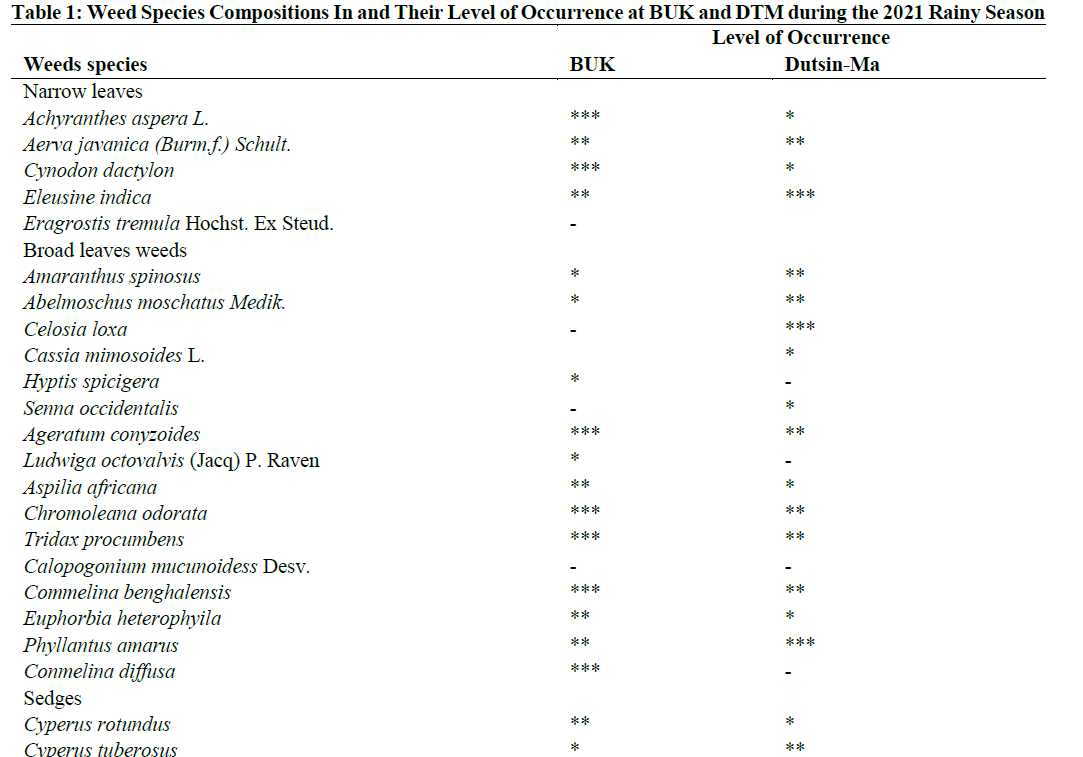
Multi-locational field trials were conducted during the 2021 growing season at Teaching and Research Farm Faculty of Agriculture of BUK and FUDMA to study the herbicidal potentials of Tithonia diversifolia (hemsley) a. gray on weed component of bambara groundnut (Vigna subterrenea (l.) verdc) genotypes in Semi-arid zone of Nigeria. The experiment consisted of three (3) Bambara groundnut genotype (Hawayen Zaki, Idon Bazawara and Red) and nine (9) (w1, w2, w3, w4, w5, w6, w7, w8, w9) weed control methods which were factorially combined in three replications, and were laid out in a split plot design with genotypes at the main plot while weed control methods at the sub-plot. The gross plot size consisted of 6 ridges, 0.75 m apart and 3 m long (11.25m2). The net plot contained four (4) inner ridges of 3m long (9 m2), and the last two border rows served as discard. Data on weed parameters were collected and subjected to analysis of variance for Split Plot Design (SPD). F-test was used to test for the level of significance, mean comparison was done using Student Newmans’ Keul (SNK) at P < 0.05, Statistical analysis Software (SAS) version 9.1 was used to analyze the generated data. The findings indicated that the Weed Specie Composition shows Digitaria nuda Schumach was present in the DTM but not in the BUK while Eragrostis tremula Hochst. Ex Steud was present at BUK with a high occurrence level, but was not found at DTM
References
Anderson, J. M., & Ingram, J. S. I. (1993). Tropical soil biology and fertility: A handbook of methods (2nd ed.). CAB International.
Azman H., R., Barkla, B. J., Mayes, S. and King, G. J. (2019). The potential of the underutilized pulse bambara groundnut (Vigna subterranea (L.) Verdc.) for nutritional food security. Journal of Food Composition and Analysis, 77*, 47–59. https://doi.org/10.1016/j.jfca.2018.12.008
Bouyoucos, G. J. (1951). A recalibration of the hydrometer method for making mechanical analysis of soils. Agronomy Journal, 43(9); 434–438. https://doi.org/10.2134/agronj1951.00021962004300090007x
Bray, R. H., & Kurtz, L. T. (1945). Determination of total, organic, and available forms of phosphorus in soils. Soil Science, 59(1); 39–46. https://doi.org/10.1097/00010694-194501000-00006
Hillocks, R. J., Bennett, C. and Mponda, O. M. (2012). Bambara nut: A review of utilisation, market potential and crop improvement. African Crop Science Journal, 20(1); 1–16. https://www.ajol.info/index.php/acsj/article/view/78601
Hua, X., Liu, X., Li, J., & Zhang, Y. (2005). Allelopathic effects of Tithonia diversifolia on the growth of selected crops. Allelopathy Journal, 16(1); 45–52.
Komboik, J. M., Dzomeku, I. K., & Lamptey, S. (2003). Evaluation of weed infestation and control methods in legume-based cropping systems. Ghana Journal of Agricultural Science, 36(2); 123–131.
Kumar, A. and Yadav, D. S. (2005). Weed management in pulse crops: A review. Agricultural Reviews, 26(4); 257–267.
Mayes, S., Ho, W. K., Chai, H. H., Gao, X., Kundy, A. C., Mateva, K. I., Zahrulakmal, M., Hahiree, M. K. I. M., Kendabie, P., Licea, L. C. S., Massawe, F., Modi, A. T., Mayes, K. and Mabhaudhi, T. (2019). Bambara groundnut: An exemplar underutilised legume for resilience under climate change. Planta, 250(3); 803–820. https://doi.org/10.1007/s00425-019-03191-6
Mbosso, C., Boulay, B., Padulosi, S., Meldrum, G., Mohamadou, Y., and Niang, A. B. (2020). Fonio and bambara groundnut value chains in Mali: Issues, needs, and opportunities for their sustainable promotion. Sustainability, 12(11); 4766. https://doi.org/10.3390/su12114766
Mubaiwa, J., Fogliano, V., Chidewe, C., Bakker, E. J. and Linnemann, A. R. (2018). Utilization of bambara groundnut (Vigna subterranea (L.) Verdc.) for sustainable food and nutrition security in semi-arid regions of Zimbabwe. PLOS ONE, 13(10): e0204817. https://doi.org/10.1371/journal.pone.0204817
Muibat, A. O. (2009). Critical period of weed interference in Bambara groundnut. Nigerian Journal of Weed Science, 22(1), 25–31.
Ohiambo, J., and Stomph, T.J. (2005). Weed competition in bambara groundnut. LEISA Magazine, 21(4); 20-21.
Paliwal, R., Abberton, M., Faloye, B., and Olaniyi, O. (2020). Developing the role of legumes in West Africa under climate change. Current Opinion in Plant Biology, 56*, 242–258. https://doi.org/10.1016/j.pbi.2020.05.002
Temegne, N., Gouertoumbo, W., Wakem, G., Nkou, F., Youmbi, E., and Ntsomboh-Ntsefong, G. (2018). Origin and ecology of bambara groundnut (Vigna subterranea (L.) Verdc): A review. Journal of Ecology and Natural Resources, 2(4); 000140. https://doi.org/10.23880/JENR-16000140
Downloads
Published
Issue
Section
Categories
License
Copyright (c) 2026 Muhammad Musa, Stephen Mark Shekari, Muhammad Kabir Ladan, Kauthar Kabir

This work is licensed under a Creative Commons Attribution 4.0 International License.


