Thermo-physical Characterization and Performance Evaluation of Castor Oil as a Sensible Heat Storage Medium in a Box-Type Solar Cooker
DOI:
https://doi.org/10.33003/fjs-2026-1022-6102Keywords:
Box-Type Solar Cooker, Castor Oil, Sensible Heat Storage, Thermal Energy Storage, Thermo-Physical Properties, Solar Cooking, Thermal Efficiency, Heat RetentionAbstract
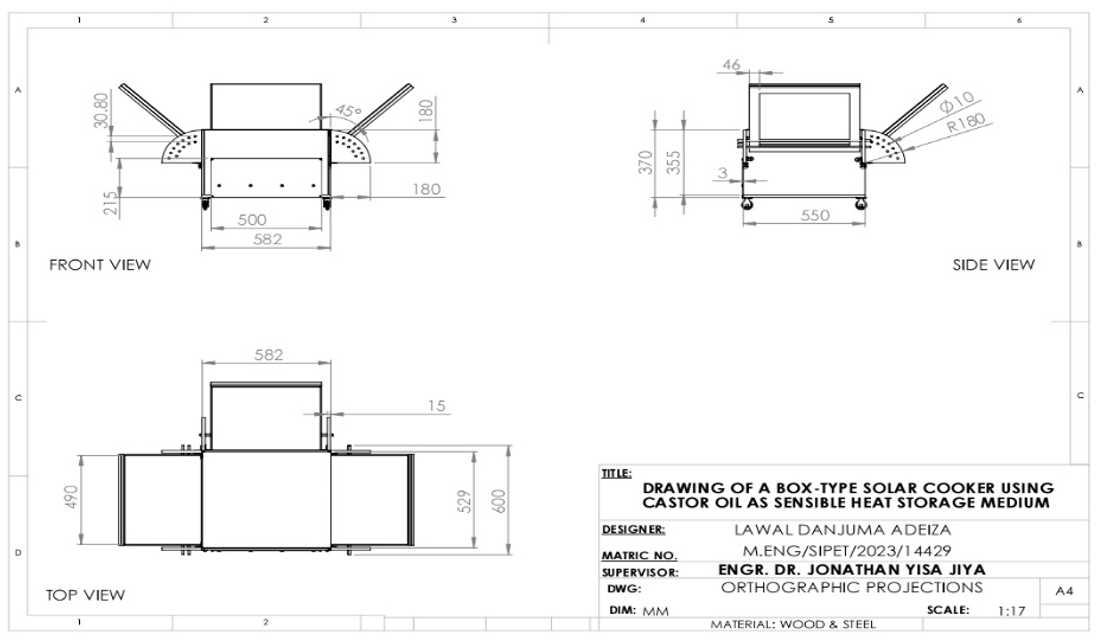
Box-type solar cookers (BSCs) provide a clean alternative to conventional biomass fuels, but their operation is limited by intermittent solar radiation. This study investigated castor oil as a sensible heat storage (SHS) medium for improving thermal performance and post-solar heat retention. The castor oil had a density of 956 kg/m³, specific heat capacity of 1900 J/kg K, thermal conductivity of 0.168–0.175 W/m K, and kinematic viscosities of 298.94 and 22.42 mm²/s at 40 and 100°C, respectively. Thermo-gravimetric analysis indicated thermal stability up to approximately 250–280°C, followed by major decomposition between 280 and 350°C. The cooker was fabricated and tested at the Federal University of Technology Minna, Nigeria, during February–March 2026 under outdoor solar irradiance of 615–790 W/m². Experiments were conducted in triplicate. During stagnation testing, the absorber plate reached a maximum temperature of 101.6°C, while the castor oil attained 74.8°C. The calculated thermal efficiency was 50.7%, based on 115.98 kJ of useful energy output from 228.76 kJ of solar energy input. During post-solar testing, 1 kg of water was heated from 30.0°C to 75.6°C within 60 minutes without solar input, demonstrating the heat-retention capability of the castor oil. However, the study did not compare the cooker with an equivalent system without castor oil. Therefore, claims of improved performance and extended cooking capability should be interpreted cautiously. Overall, the results demonstrate the potential of castor oil as a locally accessible and biodegradable SHS medium for extending solar cooking beyond sunshine hours, while further comparative and field-scale studies are recommended.
References
Abdulrahim, A. T., Mustapha, A., & Suleiman, M. A. (2020). Performance evaluation of a solar oven using kapok wool as insulation material. Nigerian Journal of Technological Development, 17(2), 78–83.
Bala, P., Compernolle, T., & Vanierschot, M. (2025). Experimental assessment of thermal energy storage using sunflower oil in Kenya. CONSOLFOOD 2025 – International Conference on Advances in Solar Thermal Food Processing, Marseille, France, 5-7 May, 2025.
Çengel, Y. A., & Ghajar, A. J. (2015). Heat and Mass Transfer: Fundamentals and Applications (5th ed.). McGraw-Hill Education.
Gawande, T. K., & Ingole, D. S. (2019). Review paper comparative study of heat storage and transfer system for solar cooking. SN Applied Sciences, 1 (12), 1676.
Martínez, J. D., Silva Lora, E. E., & Andrade, R. V. (2024). Thermal stability and heat retention characteristics of vegetable oils for solar thermal applications. Renewable Energy, *215*, 118987.
Mawire, A., Lentswe, K., & Owusu, P. (2022). Performance of two solar cookingstorage pots using parabolic dish solar concentrators during solar and storage cooking periods with different heating loads. Results in Engineering, 13, 100336.
Misra, A., Garg, S., & Pathak, M. (2023). Box-type solar cookers: An overview of technological advancement, energy, and environmental benefits. Energies, 16(4), 1697 https://doi.org/10.3390/en16041697
Nydal, O. J. (2023). Heat storage for cooking: A discussion on requirements and concepts. Energies, 16 (18), 6619.
Sharishoy, A. K., Kihedu, J. H., Kimambo, C. Z. M., & Nydal, O. J. (2025). Comprehensive review of sensible thermal storage systems for cooking applications. Tanzania Journal of Engineering and Technology, 44 (2), 239-255.
Vishwakarma, A., & Sinha, S. (2024). Box type solar cooker with thermal storage: An overview. Energy Systems, 15(3), 1015-1055.
Downloads
Published
Issue
Section
Categories
License
Copyright (c) 2026 Danjuma Adeiza Lawal, Jonathan Yisa Jiya, Samuel Ndukwe, Nicholas Musa Akhaze

This work is licensed under a Creative Commons Attribution 4.0 International License.