
Design, Fabrication and Preliminary Performance Evaluation of a Locally Manufactured Personal Flotation Device for Calm-Water Applications
DOI:
https://doi.org/10.33003/fjs-2026-1019-6106Keywords:
Personal Flotation Device, Buoyancy, Flotation Stability, Drowning Prevention, Safety EngineeringAbstract
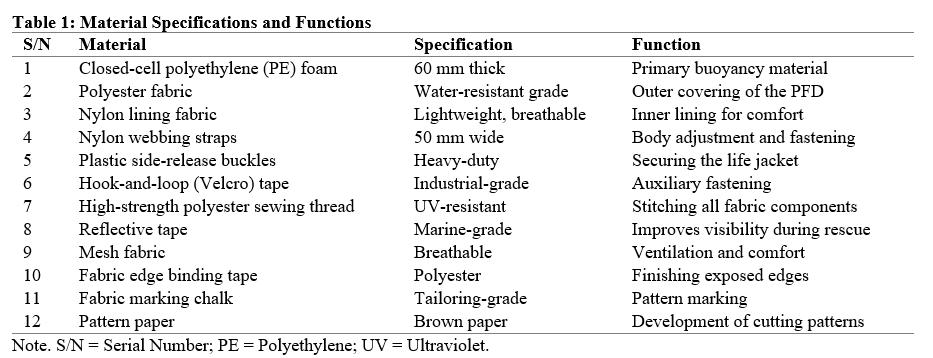
This study presents the design, fabrication, and preliminary experimental evaluation of a locally manufactured vest-type Personal Flotation Device (PFD) for adults weighing 75–80 kg under controlled calm-water conditions. The prototype used locally available closed-cell polyethylene foam, polyester fabric, nylon webbing, plastic buckles, mesh fabric, and reinforced stitching. It measured 0.63 m × 0.59 m × 0.06 m. Analytical calculations yielded a bounding volume of 0.0223 m³ and an upper-bound buoyancy estimate of 218.76 N. A simplified stability analysis estimated a metacentric height of 0.40 m, while the fastening system had a calculated design load of approximately 2,280 N. These values were treated as design estimates rather than measured performance or strength. Experimental evaluation involved 10 adult participants at Alova Hotel Swimming Pool, Minna, Nigeria. All participants maintained flotation for 15 min, with head clearance of 9–11 cm and a mean of 10.2 cm. Mean ratings were 4.60 ± 0.52/5 for buoyancy, 4.40 ± 0.52/5 for stability, and 4.30 ± 0.48/5 for comfort. Following a controlled 90° rotational disturbance, participants could assist recovery using normal arm and body movements; mean recovery time was 2.95 ± 0.16 s. PFD mass increased from 1.85 to 1.92 kg after immersion and draining, representing a 3.78% increase. No visible damage affecting fastening or flotation function was observed. The findings indicate preliminary feasibility for calm-water applications but do not establish certification, standards compliance, or structural strength. Further research should include direct buoyancy measurement, tensile testing, replicated trials, participant-level data, and broader environmental testing.
References
Barwood, M. J., Long, G. M., Lunt, H., & Tipton, M. J. (2014). Inherent work suit buoyancy distribution: Effects on lifejacket self-righting performance. Aviation, Space, and Environmental Medicine, 85(9), 960–964. https://doi.org/10.3357/ASEM.3991.2014
International Maritime Organization. (2022). International life-saving appliance (LSA) code and revised recommendations on testing of life-saving appliances. IMO Publishing.
International Organization for Standardization. (2020a). ISO 12402-4:2020: Personal flotation devices—Part 4: Lifejackets, performance level 100—Safety requirements. ISO. https://www.iso.org/standard/56684.html
International Organization for Standardization. (2020b). ISO 12402-5:2020: Personal flotation devices—Part 5: Buoyancy aids (level 50)—Safety requirements. ISO. https://www.iso.org/standard/56685.html
International Organization for Standardization. (2020c). ISO 12402-9:2020: Personal flotation devices—Part 9: Evaluation. ISO. https://www.iso.org/standard/56688.html
Koo, J., & Kim, Y. (2021). Wearable technology for maritime safety: Enhancing rescue operations through smart flotation devices. Marine Technology Society Journal, 55(2), 43–55.
Liang, H., Zhou, Y., & Sun, P. (2021). Smart wearable systems for water safety: Integrating technology with personal flotation devices. Sensors, 21(18), 6175.
Lincoln, J. M., Lucas, D. L., Somervell, P., & Teske, T. (2012). Worker satisfaction with personal flotation devices (PFDs) in the fishing industry: Evaluations in actual use. Applied Ergonomics, 43(4), 747–752. https://doi.org/10.1016/j.apergo.2011.11.008
Lunt, H., White, D., Long, G., & Tipton, M. (2014). Wearing a crotch strap on a correctly fitted lifejacket improves lifejacket performance. Ergonomics, 57(8), 1256–1264. https://doi.org/10.1080/00140139.2014.914579
Oporia, F., Jagnoor, J., Mumbya, J., Balugaba, B. E., Businge, O., Agenonga, J., Walekhwa, A. W., Isunju, J. B., & Kobusingye, O. (2024). Lifejackets or just jackets? Seaworthiness of lifejackets sold at landing sites of Lake Albert, Uganda. International Journal of Occupational Safety and Ergonomics, 30(2), 343–350. https://doi.org/10.1080/10803548.2023.2298147
Pérez-Rosés, J., & Bastida, A. (2022). Safety by design: Engineering perspectives on flotation devices. Safety Science, 147, 105569.
Rahman, A., Biswas, R. K., & Linnan, M. (2022). Drowning prevention and the role of personal flotation devices in South Asia. BMC Public Health, 22(1), 1439.
Shattuck, N. L., & Carhart, C. (2021). Lifejacket wear and risk reduction in maritime transport: A safety perspective. Journal of Safety Research, 79, 245–252.
Su, H., & Cheng, Y. (2023). Eco-friendly materials in personal flotation device development: Progress and challenges. Journal of Cleaner Production, 385, 135648.
Wang, Z., Liu, C., & Yang, D. (2022). Environmental challenges of personal flotation devices: Towards sustainable flotation materials. Journal of Cleaner Production, 335, 130337.
World Health Organization. (2021). Global report on drowning: Preventing a leading killer. World Health Organization.
World Health Organization. (2022). Global health estimates: Leading causes of death and disability worldwide. World Health Organization.
World Health Organization. (2024). Global report on drowning prevention. World Health Organization.
Downloads
Published
Issue
Section
Categories
License
Copyright (c) 2026 Samuel Ndukwe, Nicholas Akhaze Musa Akhaze, Olawale James Okegbile Olawale

This work is licensed under a Creative Commons Attribution 4.0 International License.