
Thermofluid Analysis and Biostatistical Modelling of Thermal Exposure Among Workers in Gas-Fired Power Plants
DOI:
https://doi.org/10.33003/fjs-2026-1015-5946Keywords:
Gas-Fired Power Plant, Thermo-fluid Analysis, Occupational Heat Stress, Wet-Bulb Globe Temperature, Logistic Regression, Thermal ExposureAbstract
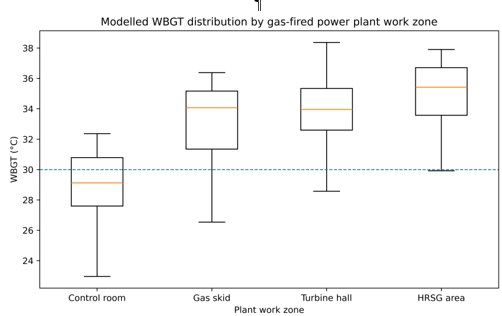
Thermal exposure in gas-fired power plants is shaped by combustion-related heat release, hot equipment surfaces, radiation, ventilation, humidity, workload, clothing, and the duration of task exposure, making a single ambient temperature measurement insufficient for evaluating worker heat strain. This study presents a scenario-based thermofluid and biostatistical modelling framework for quantifying thermal exposure in representative gas-fired combined-cycle power plant work zones. The thermofluid component uses steady energy balances, convective heat transfer, radiative exchange, humidity effects, wet-bulb globe temperature (WBGT), metabolic heat production, and clothing adjustment to characterise worker-facing thermal conditions. A synthetic worker-shift dataset of 300 observations was generated from the modelled exposure ranges to demonstrate logistic regression for heat-strain probability. Three learning-outcome objectives were specified: to quantify zone-level thermal exposure; to estimate the association between thermal-workload variables plus modelled heat strain; to evaluate predictive behaviour across exposure scenarios. Modelled mean WBGT ranged from 28.9 °C in the control room to 34.9 °C around the heat-recovery steam generator (HRSG), while the HRSG zone produced the highest modelled maximum of 37.9 °C. In the synthetic demonstration dataset, each 1 °C increase in WBGT was associated with 38.4% higher odds of modelled heat strain (OR 1.384, 95% CI 1.234–1.552, p < .001). Metabolic rate also showed a positive association (OR 1.006 per W, p = .022). The findings demonstrate how thermofluid outputs can be translated into worker-level risk estimates, while emphasising that the statistical results are illustrative until validated against measured occupational data.
References
Abbasi, M., Golbabaei, F., Yazdanirad, S., Dehghan, H., & Ahmadi, A. (2023). Validity of eighteen empirical heat stress indices in predicting the physiological parameters of workers under various occupational and climatic conditions. Urban Climate, 52, 101708. https://doi.org/10.1016/j.uclim.2023.101708
Bernard, T. E., Flach, J. W., & Ashley, C. D. (2023). Group outcomes for time-weighted averaging in WBGT-based heat stress exposure assessment. Annals of Work Exposures and Health, 67(3), 345–353. https://doi.org/10.1093/annweh/wxac083
Chaiprakarn, S., Sakulthaew, C., Ratcha, M., & Saengseedam, P. (2024). Assessment of occupational heat exposure among power plant workers in the context of climate change.
Cheveldayoff, P., Chowdhury, F., Shah, N., Burow, C., Figueiredo, M., Nguyen, N., Talbo, M., Jamasi, R., Katz, A., Pasquale, C., & Hill, L. (2023). Considerations for occupational heat exposure: A scoping review. PLOS Climate, 2(9), e0000202. https://doi.org/10.1371/journal.pclm.0000202
Dasgupta, S., Robinson, E. J. Z., Shayegh, S., Bosello, F., Park, R. J., & Gosling, S. N. (2024). Heat stress and the labour force. Nature Reviews Earth & Environment, 5, 859–872. https://doi.org/10.1038/s43017-024-00606-1
Han, S., Dong, L., Weng, Y., & Xiang, J. (2024). Heat exposure and productivity loss among construction workers: A meta-analysis. BMC Public Health, 24, 3252. https://doi.org/10.1186/s12889-024-20744-x
Hess, H. W., Hite, M. J., Heikkinen, M. E., Tarr, M. L., Tourula, E., Johnson, B. D., Hostler, D., & Schlader, Z. J. (2025). Critical assessment of the recommended alert limit curves for occupational heat exposure. American Journal of Industrial Medicine, 68(11), 1004–1012. https://doi.org/10.1002/ajim.70022
Dehdashti, A., Fatemi, F., & Poureghtedar, N. (2025). Impact of individual and work factors on the heat-related consequences among power plant workers in a hot region. International Journal of Environmental Health Research, 35(1), 116–128. https://doi.org/10.1080/09603123.2024.2346559
Ioannou, L. G., Foster, J., Morris, N. B., Piil, J. F., Havenith, G., Mekjavic, I. B., Kenny, G. P., Nybo, L., & Flouris, A. D. (2022). Occupational heat strain in outdoor workers: A comprehensive review and meta-analysis. Temperature, 9(1), 67–102. https://doi.org/10.1080/23328940.2022.2030634
Li, M., Meng, B., Geng, Y., Tong, F., Gao, Y., Yamano, N., Lim, S., Guilhoto, J., Uno, K., & Chen, X. (2025). Inequitable distribution of risks associated with occupational heat exposure driven by trade. Nature Communications, 16, 537. https://doi.org/10.1038/s41467-024-55483-5
Meng, X., Xue, S., An, K., & Cao, Y. (2022). Physiological indices and subjective thermal perception of heat stress-exposed workers in an industrial plant. Sustainability, 14(9), 5019. https://doi.org/10.3390/su14095019
Ojha, A., Shayesteh, S., Sharifironizi, A., Liu, Y., & Jebelli, H. (2024). Worker-centric heat strain analysis: Integrating physiological signals with ensemble learning and domin adaptation. Automation in learning in Construction, 166,1005670. https://doi.org/10.1016/j.autcon.2024.105670
Bartman, N. E., Vargas, N. T., Cavuoto, L. A., Hostler, D., & Pryor, R. R. (2024). Heat strain differences walking in hot-dry and warm-wet environments of equivalent wet bulb globe temperature.Temperature,11(4),333–349. https://doi.org/10.1080/23328940.2024.2384185
Surase, R. S., Konjeti, R., & Chopade, R. P. (2024). Thermal performance analysis of gas turbine power plant using soft computing techniques: A review Engineering Application of Computational Fluid Mechanics, 18(1).
https://doi.org/10.1080/19942060.2024.2374317
Yang, Y., Nikolaidis, T., Jafari, S., & Pilidis, P. (2024). Gas turbine engine transient performance and heat transfer effect modelling: A comprehensive review, research challenges, and exploring the future. Applied Thermal Engineering, 236, 121523. https://doi.org/10.1016/j.applthermaleng.2023.121523
Downloads
Published
Issue
Section
Categories
License
Copyright (c) 2026 Samuel Ndukwe, Danjuma Adeiza Lawal; Akhaze Musa Nicholas; Obedience Okoji Ndukwe

This work is licensed under a Creative Commons Attribution 4.0 International License.