Heavy-Metal Contamination and Depth-Wise Distribution in Industrial and Auto-Mechanic Workshop Soils in Anwai, Delta State, Nigeria
DOI:
https://doi.org/10.33003/fjs-2026-1022-6090Keywords:
Heavy metal contamination, Auto-mechanic workshop, Depth-wise distribution, Asaba, Soil pollution, Contamiination factorAbstract
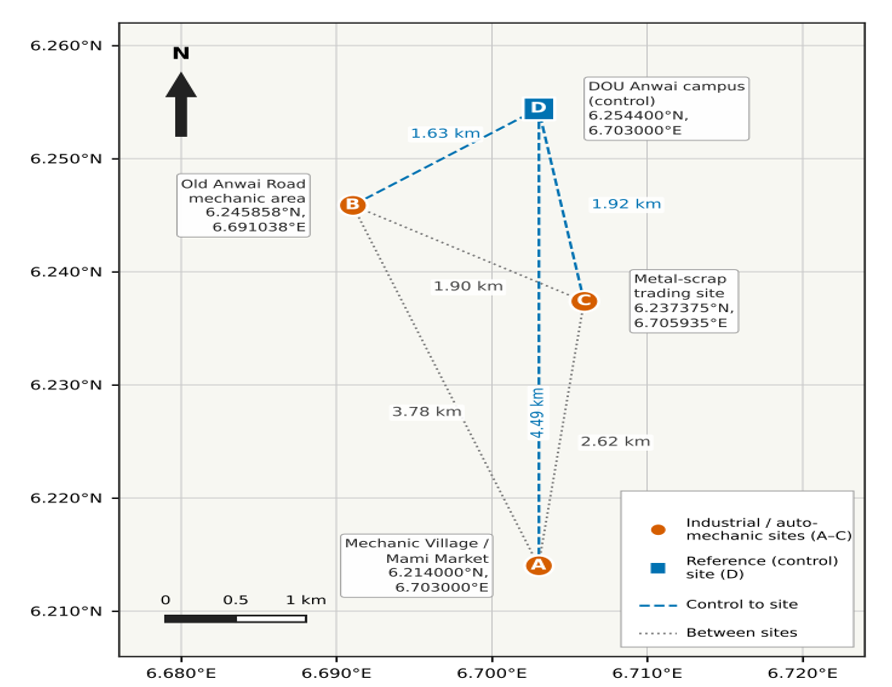
One of the most significant, unregulated sources of soil heavy metal pollution in developing areas is from the disposal of industrial and automotive workshop waste. Moreover, there is limited baseline information for many hotspots in Nigeria. This study evaluated the levels of copper, chromium, cadmium, lead and zinc, along with pH and electrical conductivity, in soils of three industrial / auto-mechanic workshop sites (A, B, C) and one control site (D) in Anwai, Delta State, Nigeria. It employed three independent composites per site and depth (0-30, 30-60cm). Soil pH values ranged from 6.67–8.24. The levels of the five metals were significantly elevated at industrial sites as compared to control (p < 0.001). Two-way ANOVA showed significant side effects for all metals and higher subsoil than topsoil concentrations of copper, chromium, cadmium and lead, whereas zinc showed no overall depth effect. Contamination factors relative to the control ranked cadmium (6.9–10.2, very high) above zinc and copper (about 5, considerable), lead (3.4–4.0) and chromium (2.4–3.1). At all the industrial sites, cadmium, lead and copper exceeded the Nigerian DPR (EGASPIN) soil target values, while chromium and zinc did not exceed the intervention values. The higher subsoil concentrations indicate possible vertical redistribution, which requires confirmation with groundwater and geochemical data. These results suggested site-specific, metal-specific contamination from industrial sources, notably, from cadmium. Therefore, regular soil and groundwater monitoring, analytical validation with certified reference materials, and more rigorous waste-disposal regulation are required in the Anwai area of Asaba.
References
Abdullahi, A., Lawal, M. A., & Salisu, A. M. (2021). Heavy metals in contaminated soil: source, accumulation, health risk and remediation process. Bayero Journal of Pure and Applied Sciences, 14(1), 1–12. https://doi.org/10.4314/bajopas.v14i1.1
Ahmed, N., Zhang, B., Chachar, Z., Li, J., Xiao, G., Wang, Q., Hayat, F., Deng, L., Narejo, M.-N., Bozdar, B., & Tu, P. (2024). Micronutrients and their effects on horticultural crop quality, productivity and sustainability. Scientia Horticulturae, 323, 112512. https://doi.org/10.1016/j.scienta.2023.112512
Alloway, B. J. (Ed.). (2013). Heavy metals in soils: Trace metals and metalloids in soils and their bioavailability (3rd ed.). Springer. https://doi.org/10.1007/978-94-007-4470-7
Ameh, E. G., Shuaibu, A. M., & Muranah, K. A. (2023). Assessment of heavy metal pollution and contamination in waste dumpsites within Gusau area, Northwest Nigeria. FUDMA Journal of Sciences, 7(5), 165–172. https://doi.org/10.33003/fjs-2023-0705-2006
Apuyor, S. E., Apuyor, K. E., Okorodudu, E. O., Onofuevure, A. O., & Okonyia, A. C. (2025). Chemometric evaluation of moss (Fissidens grandifolius) as a bioindicator of heavy metal pollution in an urban-industrial environment (Asaba, Nigeria). Innovations, 82, 1082–1087.
Briffa, J., Sinagra, E., & Blundell, R. (2020). Heavy metal pollution in the environment and their toxicological effects on humans. Heliyon, 6(9), e04691. https://doi.org/10.1016/j.heliyon.2020.e04691
Chokor, A. A. (2016). Soil profile distribution of heavy metals in automobile workshops in Sapele, Nigeria. International Journal of Basic Science and Technology, 2(1), 30–38.
Department of Petroleum Resources [DPR]. (2002). Environmental guidelines and standards for the petroleum industry in Nigeria (EGASPIN) (Revised ed.). Department of Petroleum Resources.
Duru, S. C., Echiegu, E. A., Anyadike, C. C., Alaneme, G. U., & Okechukwu, M. E. (2024). Spatial variability of heavy metals concentrations in soil of auto-mechanic workshop clusters in Nsukka, Nigeria. Scientific Reports, 14, 9681. https://doi.org/10.1038/s41598-024-60044-3
Emolade, M. O., Anozie, J. A., Adinkwu, O. M., Isoje, A. O., Aphiar, A. E., Okere, O. L., Balogun, K. I., Ehiwario, N. J., Orogu, J. O., Okobia, U. B., & Ukolobi, O. (2025). Assessment of heavy metal contamination in soils around auto-mechanic workshops in Ozoro, Delta State, Nigeria. Advances in Research, 26(3), 342–350.
Håkanson, L. (1980). An ecological risk index for aquatic pollution control: A sedimentological approach. Water Research, 14(8), 975–1001. https://doi.org/10.1016/0043-1354(80)90143-8
Ibrahim, D., Abdullahii, S. U., Adamu, I. U., Dazi, L. L., Salihu, A. I., & Simon, I. A. (2019). Heavy metal contamination of soil and ground water at automobile mechanic workshops in Borno State, Nigeria. Nigerian Research Journal of Chemical Sciences, 7, 197–211.
Ihejirika, C. E., Njoku-Tony, R., Ebe, T., Enwereuzoh, U., Izunobi, L., Asheigbu, D., & Verla, N. (2016). Anthropogenic impact and geo-accumulation of heavy metal levels of soils in Owerri, Nigeria. British Journal of Applied Science and Technology, 12(1), 1–9.
Isukuru, E. J., Opha, J. O., Isaiah, O. W., Orovwighose, B., & Emmanuel, S. S. (2024). Nigeria's water crisis: Abundant water, polluted reality. Cleaner Water, 2, 100026. https://doi.org/10.1016/j.clwat.2024.100026
Kabata-Pendias, A. (2011). Trace elements in soils and plants (4th ed.). CRC Press. https://doi.org/10.1201/b10158
Kiogora, N. M., Timamy, M. K., & Chenje, M. (2023). Environmental analysis of heavy metal pollution in Mtondia dumpsite, Kilifi County, Kenya. Journal of Agriculture, Science and Technology, 23(1), 88–114. https://doi.org/10.4314/jagst.v23i1.7
Luo, X., Bing, H., Luo, Z., Wang, Y., & Jin, L. (2019). Impacts of atmospheric particulate matter pollution on environmental biogeochemistry of trace metals in soil-plant system: A review. Environmental Pollution, 255, 113138. https://doi.org/10.1016/j.envpol.2019.113138
Mitra, S., Chakraborty, A. J., Tareq, A. M., Emran, T. B., Nainu, F., Khusro, A., Idris, A. M., Khandaker, M. U., Osman, H., Alhumaydhi, F. A., & Simal-Gandara, J. (2022). Impact of heavy metals on the environment and human health: Novel therapeutic insights to counter the toxicity. Journal of King Saud University – Science, 34(3), 101865. https://doi.org/10.1016/j.jksus.2022.101865
Muze, N. E., Opara, A. I., Ibe, F. C., & Njoku, O. C. (2020). Assessment of the geo-environmental effects of activities of auto-mechanic workshops at Alaoji Aba and Elekahia Port Harcourt, Niger Delta, Nigeria. Environmental Analysis, Health and Toxicology, 35(2), e2020005. https://doi.org/10.5620/eaht.e2020005
Ogonegbu, A. C., Evuen, U. F., Isoje, A. O., Okorodudu, E. O., Ekejiuba, K. V., Unoka, E. C., & Oshiokpu, M. N. (2026). Heavy metal accumulation in common green leafy vegetables marketed at Ogbogonogo Market, Asaba, Nigeria: Concentrations, FAO/WHO compliance, and dietary health risk assessment. African Journal of General Agriculture, 4(1), 121–128.
Ojiego, B. O., Madu, J., Ehiobu, J. M., & Ogu, G. I. (2025). Impact of soils contaminated by automobile servicing waste on seed germination and seedling development in Lokoja, Kogi State. Sahel Journal of Life Sciences FUDMA, 3(3), 451–461. https://doi.org/10.33003/sajols-2025-0303_59
Olatunde, K., Oyebola, J., Bada, B., Taiwo, A., & Ojekunle, Z. (2022). Assessment of heavy metal pollution of wetland soils in Ijokodo, Oyo State, Nigeria. Journal of Meteorology and Climate Science, 19(1), 22–28. https://www.ajol.info/index.php/jmcs/article/view/221023
Onwuka, J., Jasper, E., & Onwuka, G. (2024). Ecological risk assessment of potentially toxic metals in arable soils around Adudu lead–zinc mine, North-Central Nigeria. Journal of the Turkish Chemical Society Section A: Chemistry, 11(2), 467–482.
Onwuka, J. C., Egyegbola, D. A., Danjuma, B., Ambo, A. I., Ishaq, B., Jasper, E. E., Onwuka, G. N., Agho, L. O., Usman, A., & Onyema, A. M. (2026a). Ecological health risk evaluation of potentially toxic metals in saline soils used for table salt production in Awe salt mining community of Nasarawa State. Lafia Journal of Scientific and Industrial Research, 4(1), 81–92. https://doi.org/10.62050/ljsir2026.v4n1.754
Onwuka, J. C., Usman, A., Ambo, A. I., Aremu, M. O., Jasper, E. E., Onwuka, G. N., Egyegbola, D. A., Agho, L. O., Ishaq, B., Omotehinwa, F. H., & Onyema, A. M. (2026b). Human health risk assessment of potentially toxic metals and natural radionuclides in unrefined edible salts from salt mining communities of Nasarawa State, Nigeria. Biological Trace Element Research, 1–26. https://doi.org/10.1007/s12011-026-05133-2
Orji, C. N., Abdulrahman, F. W., & Isu, N. R. (2018). Assessment of heavy metal pollution in soil from an automobile mechanic workshop in Abuja. Asian Journal of Environment & Ecology, 6(1), 1–14.
Ossai, E. K. (2014). Heavy metal distribution in the vicinity of automobile scrap sites in Agbor, Nigeria. Journal of Applied Sciences and Environmental Management, 18(2), 261–265. https://doi.org/10.4314/jasem.v18i2.17
Ovwighose, O. F., Mamuyovwi, O., Uchenna, U. E., Ikechukwu, C. A., James, O. U., & Kesena, U. (2026). Geochemical assessment and spatial variability of heavy metals in urban mechanic-workshop soils in Asaba, Southern Nigeria. Asian Journal of Advances in Research, 9(1), 10–20. https://doi.org/10.56557/ajoair/2026/v9i1551
Uche, E., Isoje, A. O., Usifo, O. R., Obadoni, I. A., & Obi, F. O. (2026). Assessment of heavy metal nephrotoxicity and metal–metal interactions in the natural and mimicked water from the Onuebum axis of River Nun, Nigeria. Scientia Africana, 25(1), 95–112. https://doi.org/10.4314/sa.v25i1.8
Udo, M. W., Egboduku, W. O., Okonigbo, B. D., Micheal, O., Obogbayiro, I. O., Domma, O. P., Chukwuka, P. I., & Agbogidi, O. M. (2025). Heavy metal status of soils impacted with palm oil wastes in Abraka, Delta State, Nigeria. FUDMA Journal of Sciences, 9(12), 59–62. https://doi.org/10.33003/fjs-2025-0912-4377
VROM (Ministry of Housing, Spatial Planning and the Environment). (2000). Circular on target values and intervention values for soil remediation. Directorate-General for Environmental Protection, The Hague.
Yadav, K. K., Gupta, N., Kumar, V., Khan, S. A., Kumar, A., Kumar, P., & Cabral-Pinto, M. M. S. (2024). Heavy metals in the environment: Sources, toxicity, and management. Heliyon, 10(5), e29042. https://doi.org/10.1016/j.heliyon.2024.e29042
Yu, X., Xiong, L., Zhao, S., Li, Z., Xiang, S., Cao, Y., Zhou, C., Dong, J., & Qiu, J. (2023). Effect of lead, calcium, iron, zinc, copper and magnesium on anemia in children with elevated blood lead levels. Journal of Trace Elements in Medicine and Biology, 78, 127192. https://doi.org/10.1016/j.jtemb.2023.127192
Downloads
Published
Issue
Section
Categories
License
Copyright (c) 2026 Uduenevwo Francis Evuen, Augustine Chukwunedum Ogonegbu, Abigail Okezi Isoje, Emmanuel Oghenetega Okorodudu, Edith Chinyere Unoka, Oghenetega Efetobo, Eunice Amarachi Dibor

This work is licensed under a Creative Commons Attribution 4.0 International License.