Contribution of the Hadejia-Nguru Wetlands to Rural Livelihoods and Perceived Household Food Security in Northeastern Nigeria
DOI:
https://doi.org/10.33003/fjs-2026-1019-6076Keywords:
Climate change, Ecosystem services, Rural livelihoods, Wetland resources, Willingness to payAbstract
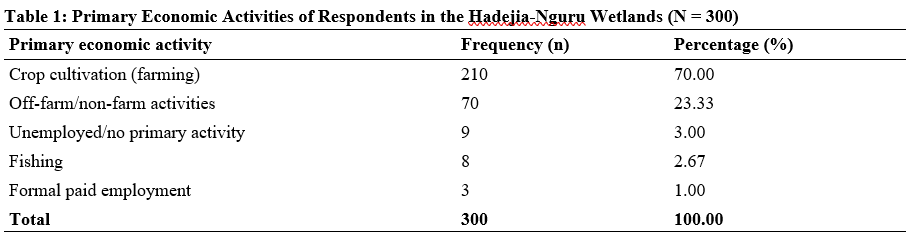
The Hadejia-Nguru Wetlands (HNWs) provide diverse ecosystem resources that support rural livelihoods and food-related needs in northeastern Nigeria. Increasing climatic variability, hydrological alteration and intensifying resource use may, however, affect the availability and sustainability of these resources. This study assessed the contribution of the HNWs to rural livelihoods and perceived household food-security status among wetland-fringe communities. A mixed-methods design combined a cross-sectional household survey with key informant interviews, focus group discussions and direct field observations. Of 350 questionnaires administered, 300 adequately completed questionnaires were retained for analysis, representing an 85.7% usable response rate. Quantitative data were analyzed using frequencies, percentages, mean ranks and Kendall's coefficient of concordance, while qualitative data were thematically analyzed. Crop cultivation was the predominant primary economic activity (70.0%), followed by off-farm and non-farm activities (23.33%). The leading wetland-dependent activities were dry-season irrigation farming (34.67%), fishing (24.00%) and sedge/reed collection and weaving (22.67%). Overall, 95.0% reported direct household dependence on wetland resources for cash income. Climate change ranked highest among factors influencing wetland utilization, with significant agreement among respondents (Kendall's W = 0.426, p < 0.001). For perceived food-security status, 79.0% classified their households as secure or very secure, whereas 5.33% classified them as insecure or very insecure. Additionally, 98.33% regarded wetland resources as important sources of dietary protein. Stated willingness-to-pay (WTP), expressed as respondents' reported monetary valuation of selected wetland goods, varied across resources; medicinal herbs recorded the highest mean value (₦31.95 per bucket).
References
Abubakar, M. I., Ibrahim, B. U., & Gana, U. (2022). Challenges and prospects of wetland conservation in Nigeria: A review. Wetlands Ecology and Management, 30(2), 187–200. https://doi.org/10.1007/s11273-021-09846-9
Adekola, O., & Mitchell, G. (2021). The role of wetlands in sustainable livelihoods in West Africa. Environmental Development, 37, 100575. https://doi.org/10.1016/j.envdev.2020.100575
Adekola, O., Mitchell, G., & Grainger, A. (2012). Inequality and ecosystem services: The case of the Hadejia-Nguru Wetlands, Nigeria. Ecological Economics, 78, 132–143. https://doi.org/10.1016/j.ecolecon.2012.04.009
Ahmed, S. D., Agodzo, S. K., Adjei, K. A., Deinmodei, M., & Ameso, V. C. (2018). Preliminary investigation of flooding problems and the occurrence of kidney disease around Hadejia-Nguru wetlands, Nigeria and the need for an ecohydrology solution. Ecohydrology & Hydrobiology, 18(2), 212–224. https://doi.org/10.1016/j.ecohyd.2017.11.005
Ayeni, A. O., Ogunsesan, A. A., & Adekola, O. A. (2019). Provisioning ecosystem services provided by the Hadejia Nguru Wetlands, Nigeria: Current status and future priorities. Scientific African, 5, e00124. https://doi.org/10.1016/j.sciaf.2019.e00124
Barbier, E. B., Adams, W. M., & Kimmage, K. (1997). Economic valuation of wetland benefits: The Hadejia-Jama'are floodplain, Nigeria. Geographical Journal, 163(2), 123–137. https://doi.org/10.2307/3059998
Braun, V., & Clarke, V. (2006). Using thematic analysis in psychology. Qualitative Research in Psychology, 3(2), 77–101. https://doi.org/10.1191/1478088706qp063oa
Bukar, Y., Monguno, A. K., & AbdulRahman, A. T. (2022). Environmental change and livelihood activities in Hadejia-Nguru Wetlands of Yobe State, North East Nigeria. Journal of Geography and Geology, 13(1), 1–14. https://doi.org/10.5539/jgg.v13n1p1
Carson, R. T., & Groves, T. (2007). Incentive and informational properties of preference questions. Environmental and Resource Economics, 37(1), 181–210. https://doi.org/10.1007/s10640-007-9124-5
Chiwaula, L. S., & Waibel, H. (2009). The role of shocks and risks for the livelihoods of small-scale fishing communities of Hadejia-Nguru Wetlands in Nigeria (Proceedings of the German Development Economics Conference, Frankfurt, No. 3). University of Hannover.
Coates, J., Swindale, A., & Bilinsky, P. (2007). Household Food Insecurity Access Scale (HFIAS) for measurement of food access: Indicator guide (v. 3). Food and Nutrition Technical Assistance Project (FANTA), Academy for Educational Development.
Creswell, J. W., & Creswell, J. D. (2018). Research design: Qualitative, quantitative, and mixed methods approaches (5th ed.). SAGE Publications.
Davidson, N. C., Finlayson, C. M., & Gardner, R. C. (2023). Emerging threats and management challenges for wetlands. Aquatic Conservation: Marine and Freshwater Ecosystems, 33(1), 5–21. https://doi.org/10.1002/aqc.3885
Field, A. (2005). Discovering statistics using SPSS (2nd ed.). SAGE Publications.
Ibrahim, U. A., Dan’azumi, S., Aldrees, A., Abba, S. I., Chiroma, M. J., & Bdliya, H. H. (2025). Water management strategies for climate change mitigation in the Hadejia-Nguru wetlands, Northern Nigeria. Applied Water Science, 15, Article 176. https://doi.org/10.1007/s13201-025-02545-8
IPBES. (2018). The assessment report on land degradation and restoration. Intergovernmental Science-Policy Platform on Biodiversity and Ecosystem Services.
Rebelo, L. M., Johnston, R., & McCartney, M. (2018). Wetlands in sub-Saharan Africa: Management, opportunities and challenges for development. Water Resources Management, 32(4), 1121–1137. https://doi.org/10.1007/s11269-017-1859-4
Scoones, I. (2021). Wetlands in drylands: Key resources for agricultural and pastoral production in Africa. Land Use Policy, 103, 105300. https://doi.org/10.1016/j.landusepol.2021.105300
Soneye, A. S. O., Ayeni, A. O., & Aborisade, A. G. (2021). Ecosystem services and socio-economic dynamics in the Hadejia-Nguru Wetlands, Nigeria. Journal of Environmental Management and Planning, 45(2), 112–126.
Yamane, T. (1967). Statistics: An introductory analysis (2nd ed.). Harper & Row.
Downloads
Published
Issue
Section
Categories
License
Copyright (c) 2026 Mohammed Bello Abdullahi, Abubakar Jamal Abdulmajid, Sani Umar, Nura Ahmed Garkuwa

This work is licensed under a Creative Commons Attribution 4.0 International License.