
A Hybrid Deep Learning and Remote Sensing Framework for Climate-Smart Livestock Grazing in Semi-Arid Nigeria
DOI:
https://doi.org/10.33003/fjs-2026-1012-4962Keywords:
Climate-Smart Agriculture, Livestock Grazing Optimization,, hybrid Deep Learning, Remote Sensing, GIS-Based Decision Support SystemAbstract
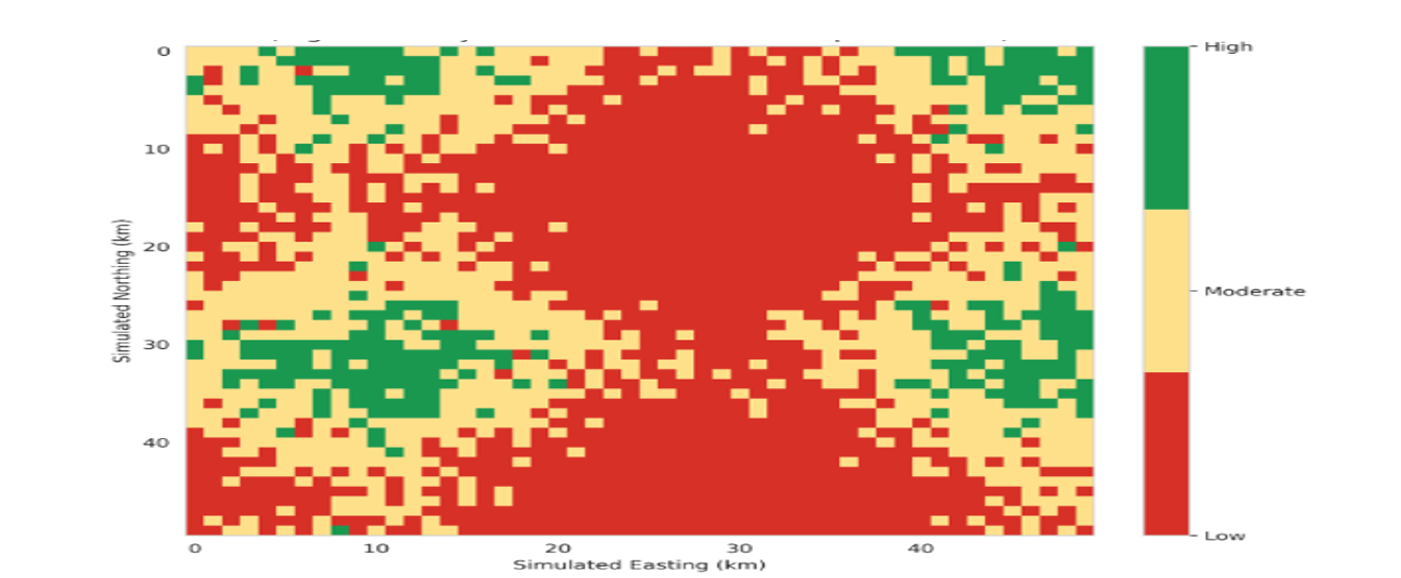
The agricultural sector in Nigeria plays a vital role in ensuring food security and providing jobs, particularly in rural areas like Adamawa State, where many families depend on livestock for their livelihoods. Today, however, farmers are struggling more than ever to sustain livestock production because of climate change, which brings unpredictable rainfall, degraded land, and shrinking grazing areas. This study develops a practical data-driven framework that utilizes hybrid deep learning and remote sensing to support climate-smart livestock grazing in Adamawa State. Information from multiple sources (Sentinel‑2 and Landsat satellite images, climate data, and field observations) was integrated to assess how suitable different regions are for grazing. A hybrid ConvLSTM (Convolutional Neural Network and Long Short‑Term Memory) model was used to capture how vegetation and environmental conditions change over space and time, and to classify grazing suitability into three levels (low, moderate, and high). The model performs excellently by achieving 90.1% overall accuracy with balanced recall, precision, and F1‑scores. We then translated these results into GIS-based grazing suitability maps for Fufore and Mubi South Local Government Areas, which revealed realistic environmental conditions that are consistent with field observations. The resulting prototype offers a practical decision-support tool that can aid farmers and herders in using resources more efficiently, which will improve grazing management and reduce climate-related risks, thereby contributing to more sustainable livestock production in semi-arid regions.
References
Adedeji, O., Olusola, A. James, G., Shaba, H. A., Orimoloye, I. R., Singh, S. K., & Adelabu, S. (2020). Early warning systems development for agricultural drought assessment in Nigeria. Environmental monitoring and assessment, 192(12), 798 - 798 ISSN 0167-6369.
Ba, A. M., Isah, M., Mohammed, S. A, & Modibbo, M.A. (2024). Detection of Change in Forest and Trees Outside Forest Using Normalized Difference Vegetation Index Techniques in Adamawa Central, Adamawa State Nigeria. J. Appl. Sci. Environ. Manage, 28 (7) 2115-2123. E-ISSN 2659-1499.
Bambara, G. T., Kiema, A., Bougouma-Yameogo, V., Sanfo, A., & Some, W. (2024). Development of a model for estimating the biomass of pastures using normalized difference vegetation index (NDVI): The case of the Niassa pastoral zone in Burkina Faso. GSC Advanced Research and Reviews, 20(02), 157–166
Cai, T., Chang, C., Zhao, Y., Wang, X., Yang, J., Dou, P., Otgonbayar M., Zhang, G., Zeng, Y., & Wang, J. (2024). Within-season estimates of 10 m aboveground biomass based on Landsat, Sentinel-2 and PlanetScope data. Scientific Data, 11(1267). https://doi.org/10.1038/s41597-024-04120-3
Dickson, S.M., Simon, H., Danwaki, J.A. Umar, S., Hussein, A. M., Aliyu, S.M., & Moko, A.B. (2025). Optimized Internet of Thingd Model for Smart Agriculture and Irrigation Water Management in Nigeria. East African Scholars Journal of Engineering and Computer Sciences, 8(5), 99-113. DOI: https://doi.org/10.36349/easjecs.2025.v08i05.002
Dzarma, D. J.& Hamawa, M. I. (2020). Economics of Cattle Marketing In Mubi Area of Adamawa State, Nigeria. World Journal of Innovative Research. 8(5), 97–103.
FAO. (2013). Climate-smart agriculture sourcebook. Rome: Food and Agriculture Organization of the United Nations.
Kim, J., Lee, J., Park, E., & Han, J. (2020). A deep learning model for detecting mental illness from user content on social media. Scientific Reports, 1–6. https://doi.org/10.1038/s41598-020-68764-y
Kraft, B. Jung, M., Korner, M., Mesa, C. R., Cortés, J., Reichstein, M. (2019). Identifying Dynamic Memory Effects on Vegetation State Using Recurrent Neural Networks. Front Big Data, 2(31). https://doi.org/10.3389/fdata.2019.00031
Li, J. & Kong, H. (2024). Medical image identification methods: A review. Computers in Biology and Medicine. URL: https://www.sciencedirect.com/topics/computer-science/deeplearning#:~:text=Deep%20learning%20is%20a%20complex%20machine%20learning,such%20as%20CNN%2C%20LSTM%2C%20RNN%2C%20and%20GAN
Malo, A. R. & Nicholson, S. E. (1990). A Study of Rainfall and Vegetation Dynamics in the African Sahel using Normalized Difference Vegetation Index. Journal of Arid Environments, 19(1), 1990, 1-24.
Noa-Yarasca, E., , Leyton, J. M. O., Angerer, J. P. (2024). Deep Learning Model Effectiveness in Forecasting Limited-Size Aboveground Vegetation Biomass Time Series: Kenyan Grasslands Case Study. Advances in Crop Simulation Modeling, 14(2), 349, DOI: https://doi.org/10.3390/agronomy14020349
Olateru, E. J. (2023). The livestock challenge in Nigeria. The International Livestock Research Institute (ILRI). https://www.ilri.org/where-we-work/west-africa/nigeria
Saka, A. A., Awodola-Peters, O. O., Olaniyi, T. A., Adedeji, O. Y., Bolarinwa, M. O., Yahaya, M. O., Adebisi, G. L., Popoola, M. A. (2021). Climate change and its impact on livestock: A review. Nigerian Journal of Animal Production, 48(4), 185- 193. DOI: https://doi.org/10.51791/njap.v48i4.2993
Werner, J.P.S., Belgiu, M., Bueno, I.T., Dos-Reis, A.A., Toro, A.P.S.G.D., Antunes, J.F.G., Stein, A., Lamparelli, R.A.C., Magalhães, P.S.G., Coutinho, A.C., (2024). Mapping Integrated Crop–Livestock Systems Using Fused Sentinel-2 and PlanetScope Time Series and Deep Learning. Remote Sensing, 16, 1421. DOI: https://doi.org/10.3390/rs16081421
Yola, A. A. (2025, January 10). Mubi market generates N29bn annually, supplies 29 million animals to Lagos. Daily Trust News. URL: https://dailytrust.com/mubi-livestock-market-generates-n29bn-annually-gov-fintiri/
Downloads
Published
Issue
Section
Categories
License
Copyright (c) 2026 Hyellamada Simon, Solomon Makasda Dickson, Suleiman Muhammad Aliyu, Aisha Muhammad Hussein, Sani Umar, Mbaya Yusuf Arhyel

This work is licensed under a Creative Commons Attribution 4.0 International License.


