
Evaluation of the Comparative Quality and Safety of Selected Commercial Vegetable Oils in Lokoja, Kogi State, Nigeria: Integrating Physicochemical, Nutritional, and Microbiological Assessments
DOI:
https://doi.org/10.33003/fjs-2026-1016-5961Keywords:
Edible Oils, Quality Assessment, Oxidative Rancidity, Microbial Contamination, Food Safety, NigeriaAbstract
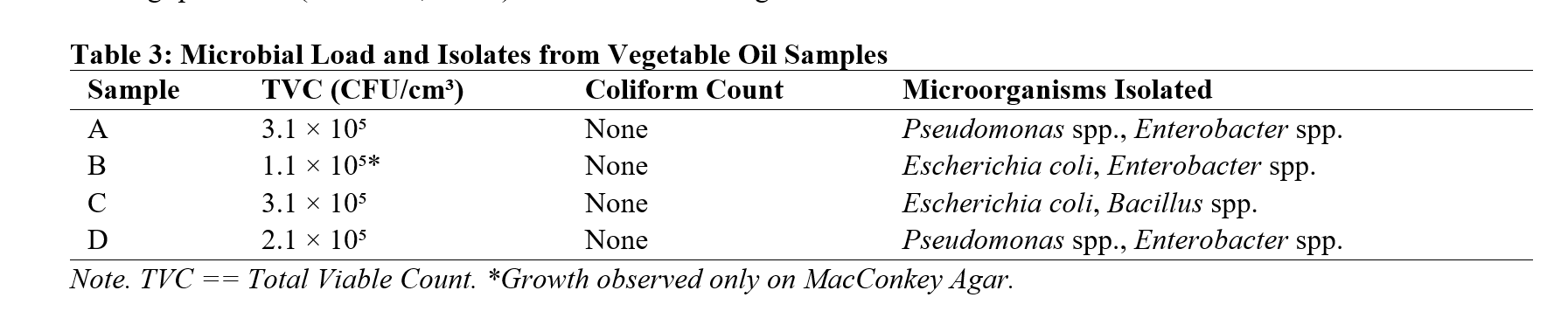
The nutritional integrity and safety of commercially available vegetable oils is an important food-safety concern, particularly where regulatory monitoring and market surveillance may be inconsistent. This study evaluated four branded vegetable oils (Activa, Kings, Power, and Terra) marketed in Lokoja, Nigeria, using proximate, physicochemical, microbiological, and heavy-metal analyses. Standard analytical procedures were used for proximate composition, specific gravity, acid value (AV), peroxide value (PV), iodine value (IV), saponification value (SV), microbial load, and concentrations of lead (Pb), cadmium (Cd), and arsenic (As). Fat content ranged from 96.98% to 97.26%, whereas moisture content ranged from 0.42% to 0.86%. PV ranged from 5.95 to 23.76 meq/kg, with Activa exceeding the Codex benchmark of 10 meq/kg. AV ranged from 4.88 to 13.44 mg KOH/g and exceeded the reported benchmark of 0.6 mg KOH/g in all samples. IV ranged from 36.22 to 68.94 g I₂/100 g, while SV ranged from 167.96 to 202.58 mg KOH/g. Total viable counts ranged from 1.1 × 10⁵ to 3.1 × 10⁵ CFU/cm³, and Escherichia coli was isolated from Kings and Power samples. Cadmium and arsenic were not detected (<0.001 ppm), while lead occurred at 0.001-0.002 ppm. Overall, the results indicate that the oils had high lipid content and low detectable heavy-metal contamination but exhibited important quality deficiencies, particularly elevated acid values and, in one sample, peroxide value, together with microbial contamination. These findings support strengthened market surveillance, improved processing and storage hygiene, and continued monitoring of commercial edible oils in Lokoja.
References
Association of Official Analytical Chemists. (2016). Official methods of analysis of AOAC International (20th ed.). AOAC International.
Association of Official Analytical Chemists. (2023). Official Method 940.28: Fatty acids (free) in crude and refined oils: Titration method. In Official methods of analysis of AOAC International (22nd ed.). AOAC International.
Akinyemi, B. T., Olayanju, T. M. A., & Akinoso, R. (2021). Effect of storage on the quality of vegetable oils: A review. Journal of Food Quality, 2021, Article 5538027. https://doi.org/10.1155/2021/5538027
Choe, E., & Min, D. B. (2007). Chemistry of deep-fat frying oils. Journal of Food Science, 72(5), R77-R86. https://doi.org/10.1111/j.1750-3841.2007.00352.x
Codex Alimentarius Commission. (2024). Standard for named vegetable oils (CXS 210-1999). Food and Agriculture Organization of the United Nations & World Health Organization.
Gunstone, F. D. (Ed.). (2011). Vegetable oils in food technology: Composition, properties and uses (2nd ed.). Wiley-Blackwell. https://doi.org/10.1002/9781444339925
Ibrahim, J. I., & Abdel-Hakiem, E. H. (2010). Quality assessment of edible vegetable oils for presence of some toxic heavy metals. Assiut Veterinary Medical Journal, 56(124), 36-45.
International Organization for Standardization. (2013). ISO 4833-1:2013: Microbiology of the food chain-Horizontal method for the enumeration of microorganisms-Part 1: Colony count at 30 °C by the pour plate technique. ISO.
Joint FAO/WHO Expert Committee on Food Additives. (2011). Safety evaluation of certain food additives and contaminants (WHO Food Additives Series No. 64). World Health Organization.
Jolayemi, O. S., & Muritala, Y. (2022). Confirmatory assessments of putative quality and nutritional properties of branded and unbranded commercial edible oils. Measurement: Food, 7, 100055. https://doi.org/10.1016/j.meafoo.2022.100055
Mba, O. I., Dumont, M. J., & Ngadi, M. (2015). Palm oil: Processing, characterization and utilization in the food industry. Food Bioscience, 10, 26-41. https://doi.org/10.1016/j.fbio.2015.01.003
Naz, S., Sheikh, H., Siddiqi, R., & Sayeed, S. A. (2004). Oxidative stability of olive, corn and soybean oil under different conditions. Food Chemistry, 88(2), 253-259. https://doi.org/10.1016/j.foodchem.2004.01.042 (ScienceDirect)
O'Brien, R. D. (2009). Fats and oils: Formulating and processing for applications (3rd ed.). CRC Press.
Onyeaka, H., Tamasiga, P., Nwauzoma, U. M., Miri, T., Hart, A., & Greathead, H. (2022). Food safety and security in Nigeria: The role of analytical chemistry. ACS Food Science & Technology, 2(7), 1088-1103. https://doi.org/10.1021/acsfoodscitech.2c00146
U.S. Food and Drug Administration. (2020). Bacteriological Analytical Manual, Chapter 4: Enumeration of Escherichia coli and the coliform bacteria. Center for Food Safety and Applied Nutrition.
U.S. Food and Drug Administration. (2026). Bacteriological Analytical Manual, Chapter 3: Aerobic plate count. Center for Food Safety and Applied Nutrition.
Wang, X., Li, X., Hui, J., Huang, H., Sun, D., Chu, B., & Zhao, H. (2024). The formation approaches of volatile compounds in Chinese traditional hot-pressed fragrant rapeseed oil. Journal of the American Oil Chemists' Society, 101(11), 1299-1316. https://doi.org/10.1002/aocs.12872
World Health Organization. (2015). WHO estimates of the global burden of foodborne diseases: Foodborne disease burden epidemiology reference group 2007-2015. World Health Organization. https://www.who.int/publications/i/item/9789241565165
Zeb, A. (2020). A comprehensive review on different classes of lipid oxidation. Journal of Food Biochemistry, 44(9), e13316. https://doi.org/10.1111/jfbc.13316
Downloads
Published
Issue
Section
Categories
License
Copyright (c) 2026 Kingsley Adebayo, Ibiejemite, Ayika, Taiwo, Achimugu, Abuede

This work is licensed under a Creative Commons Attribution 4.0 International License.


