
Synthesis and Antibacterial Investigation of Triphenylphosphine-Stabilized Cobalt Schiff Base Complexes
DOI:
https://doi.org/10.33003/fjs-2026-1016-5575Keywords:
Schiff base, triphenylphosphine, co-ligand, antimicrobial activityAbstract
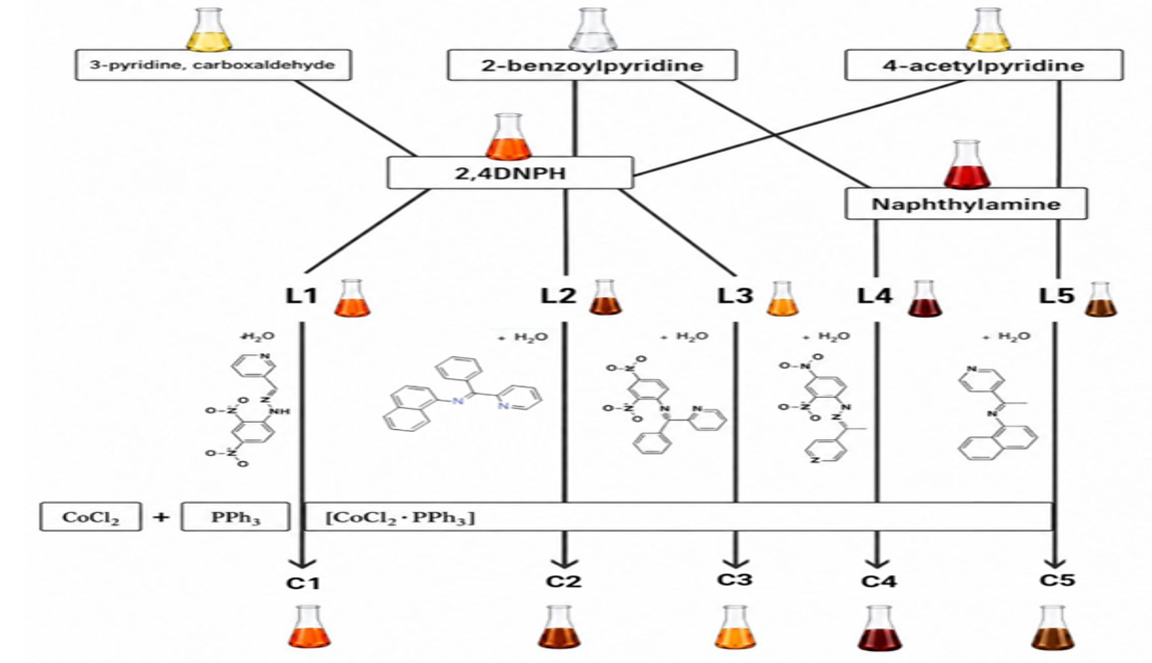
This study reports the preparation, characterisation and antibacterial activity of cobalt (II) Schiff base complexes (C1-C5) bearing triphenylphosphine (PPh3) as a co-ligand. Five Schiff base ligands (L1 to L5) were prepared by condensation of selected aldehydes and ketones with primary amines or hydrazines under acid catalysis in ethanol. The synthesised compounds were characterised by infrared (FTIR) spectroscopy, ultraviolet-visible (UV-Vis) spectroscopy and magnetic susceptibility measurements. In vitro antibacterial screening was carried out using agar well diffusion method against Escherichia coli, Staphylococcus aureus, Klebsiella pneumoniae, and Pseudomonas aeruginosa. FTIR analysis revealed coordination through the azomethine bond with characteristic bands at 1556 and 1684 cm⁻¹ with C–N ν (cm-1) between 1306 and 1338 cm⁻¹, and the C–P ν (cm-1) of the PPh3 observed between 1075 and 1088 cm⁻¹. The UV- Vis absorption peaks of 368, 342, 367 and 377 nm in complexes C1, C2, C3 and C5 respectively were assigned to respective Ligand to Metal Charge Transfer (LMCT). Magnetic susceptibility measurements revealed paramagnetic behaviour in C1, C4 and C5 with chi g values between 1.2 x10 -7 and 1.85x10⁻⁶, while C2, (-6.3 x10 -7) and C3 (-8 x10 -8) were diamagnetic. The antimicrobial results showed that the cobalt (II) complexes were substantially more active than their free-ligand against all four bacterial test organisms. The particularly notable anti-Pseudomonal activity in all five cobalt (II) complexes. The complexes displayed inhibition zone ranging from 20-29 mm, surpassing the standard drug Ofloxacin (23.50 mm) and showing significant enhancement over the free PPh3, ligands and cobalt salt.
References
Aggoun, D., Fernández-García, M., López, D., Bouzerafa, B., Ouennoughi, Y., Setifi, F., & Ourari, A. (2020). New nickel (II) and copper (II) bidentate Schiff base complexes, derived from dihalogenated salicylaldehyde and alkylamine: Synthesis, spectroscopic, thermogravimetry, crystallographic determination and electrochemical studies. Polyhedron, 187, 114640.
Amolegbe, S. A., Adewuyi, S., Akinremi, C. A., Adediji, J. F., Lawal, A., Atayese, A. O., & Obaleye, J. A. (2015). Iron (III) and copper (II) complexes bearing 8-quinolinol with amino-acids mixed ligands: Synthesis, characterization and antibacterial investigation. Arabian Journal of Chemistry, 8(5), 742-747.
Benzerka, S., Bouraiou, A., Bouacida, S., Roisnel, T., Bentchouala, C., Smati, F., & Belfaitah, A. (2012). New 2-phenylquinoline derivatives: Synthesis and preliminary evaluation as antimicrobial agents. Letters in Organic Chemistry, 9(5), 309-313.
Biswas, A., Drew, M. G., & Ghosh, A. (2010). Nickel (II) and copper (II) complexes of unsymmetrical tetradentate reduced Schiff base ligands. Polyhedron, 29(3), 1029-1034.
Çapan, A., Levent, A., Uruş, S., Akbaş, E., & Sönmez, M. (2026a). Mixed-ligand Co (II) and Pd (II) schiff base–phenanthroline complexes: structural, thermal, DNA binding, and catalytic studies. Journal of Coordination Chemistry, 1-29.
Çapan, A., Sogukomerogullari, H. G., Sarıoğlu, A. O., Akkoc, S., Güngör, Ö, Sever, L., Sönmez, M. (2026b). Fe (II), Cu (II), Ni (II) and Co (II) metal complexes of sulfonamide ligand derived from sulfadiazine: synthesis, characterization, cytotoxic activity and DNA/BSA binding properties. Journal of the Iranian Chemical Society, 23(7), 188.
Devi, J., Sharma, S., Kumar, S., Kumar, B., Kumar, D., Jindal, D. K., & Das, S. (2022). Synthesis, characterization, in vitro antimicrobial and cytotoxic studies of Co (II), Ni (II), Cu (II), and Zn (II) complexes obtained from Schiff base ligands of 1, 2, 3, 4‐tetrahydro‐naphthalen‐1‐ylamine. Applied Organometallic Chemistry, 36(8), e6760.
Djekić, T., Zivkovic, Z., van der Ham, A. G., & De Haan, A. (2006). Determination of the stability constants for cobalt, nickel and palladium homogeneous catalyst complexes containing triphenylphosphine ligands. Applied Catalysis A: General, 312, 144-152.
Fernandes, L. d. P., Silva, J. M., Martins, D. O., Santiago, M. B., Martins, C. H., Jardim, A. C., Franca, E. d. F. (2020). Fragmentation study, dual anti-bactericidal and anti-viral effects and molecular docking of cobalt (III) complexes. International Journal of Molecular Sciences, 21(21), 8355.
Fudulu, A., Olar, R., Maxim, C., Scăeţeanu, G. V., Bleotu, C., Matei, L., Badea, M. (2020). New cobalt (II) complexes with imidazole derivatives: antimicrobial efficiency against planktonic and adherent microbes and in vitro cytotoxicity features. Molecules, 26(1), 55.
Genchi, G., Lauria, G., Catalano, A., Carocci, A., & Sinicropi, M. S. (2023). Prevalence of cobalt in the environment and its role in biological processes. Biology, 12(10), 1335.
Ghosh, M., Mandal, S., Fleck, M., Saha, R., Rizzoli, C., & Bandyopadhyay, D. (2018). Synthesis, crystal structure, and antimicrobial activity of a series of cobalt (III) Schiff base complexes. Journal of Coordination Chemistry, 71(24), 4180-4193.
Iaroshenko, V. (2019). Organophosphorus chemistry: from molecules to applications: John Wiley & Sons.
Khalaf, M. M., Abd El-Lateef, H. M., Eltayeb, H., & Abdou, A. (2026). Trace Element-Based Co (II) and Fe (III) Mixed-Ligand Complexes of Phenanthroline and Sulfasalazine: Structural, DFT, Molecular Docking, and Antimicrobial Studies. Journal of Trace Elements in Medicine and Biology, 127945.
Kumah, R. T., Vijayan, P., & Ojwach, S. O. (2021). Synthesis and Applications of (Pyridyl) imine Fe (II) Complexes as Catalysts in Transfer Hydrogenation of Ketones. Catalysis Letters, 151(2), 344-352.
Murray, C. J., Ikuta, K. S., Sharara, F., Swetschinski, L., Aguilar, G. R., Gray, A., Wool, E. (2022). Global burden of bacterial antimicrobial resistance in 2019: a systematic analysis. The lancet, 399(10325), 629-655.
Odulaja, O., Adeleke, A., Adewuyi, S., Ibilunle, A., Sanyaolu, N., Yussuf, S., & Hashimi, A. (2024a). Synthesis, characterisation, DNA and antibacterial activities of cu (I) complexes of bidentate quinolinyl Schiff base having triphenylphosphine ancillary ligand. Scientia Africana, 23(5), 337-348.
Odulaja, O., Adeleke, A., Amolegbe, S., Sanyaolu, N., Yussuf, S., & Hashimi, A. (2024b). Synthesis, Characterisation, and Antibacterial Activities of Cu (I) Complexes Bearing (N^ N) Bidentate Schiff Bases having Triphenylphosphine Ancillary Ligand. FUPRE Journal of Scientific & Industrial Research, 8(3).
Odulaja, O. S., Amolegbe, S. A., & Olusola, M. A. (2026a). Synthesis, structural elucidation, in vitro antibacterial activity of mononuclear Ag (I) complex derived from (E)-N-(4-fluorophenyl)-1-(pyridin-2-yl) methanimine and triphenylphosphine ancillary ligand. Tanzania Journal of Science, 52(2), 1.
Odulaja, O. S., Ayangbesan, C. I., Williams, A. V., Adeleye, C. A., Adeleye, T. F., Olugbile, O. O., Bamiro, E. O. (2026b). Synthesis, Spectroscopic Studies and Biological Activity of Cu (II) Complex of Schiff Base Ligand 3-((2-(2, 4-dinitrophenyl) hydrazineylidene) methyl) pyridine with Triphenylphosphine as Ancillary Ligand. Nigerian Journal of Physics, 35(4), 179-185.
Özçelik, B., Yazıcı, D., & Ekicibil, A. (2013). Structural and magnetic properties of cobalt (II) complexes of triphenylphosphine. Journal of superconductivity and novel magnetism, 26(5), 1599-1605.
Raj, J. G. J. (2015). Metal-organophosphine complexes: structure, bonding, and applications. Reviews in Inorganic Chemistry, 35(1), 25-56.
Yusuf, T. L., Oladipo, S. D., Zamisa, S., Kumalo, H. M., Lawal, I. A., Lawal, M. M., & Mabuba, N. (2021). Design of new Schiff-Base Copper (II) complexes: Synthesis, crystal structures, DFT study, and binding potency toward cytochrome P450 3A4. ACS omega, 6(21), 13704.
Downloads
Published
Issue
Section
Categories
License
Copyright (c) 2026 Olufemi Odulaja, Ruth Oyekanmi, Adeegbe Adetayo, Nelson Kehinde, Christiana Adeleye, Taofeeq Adeleye, Oyinlola Olugbile, Taiwo Abiola, Adejumoke Hashimi, Muritala Olusola, Jeniss Igbruke

This work is licensed under a Creative Commons Attribution 4.0 International License.


