
Mathematical Modeling of Business Growth Dynamics in the Banking Sector: The Role of Customer Acquisition, Conversion, and Retention
DOI:
https://doi.org/10.33003/fjs-2026-1016-5902Keywords:
Business Growth, Mathematical Modeling, Banking Sector, Customer Retention, Conversion Rate, Differential Equation, Churn Rate, Sustainable GrowthAbstract
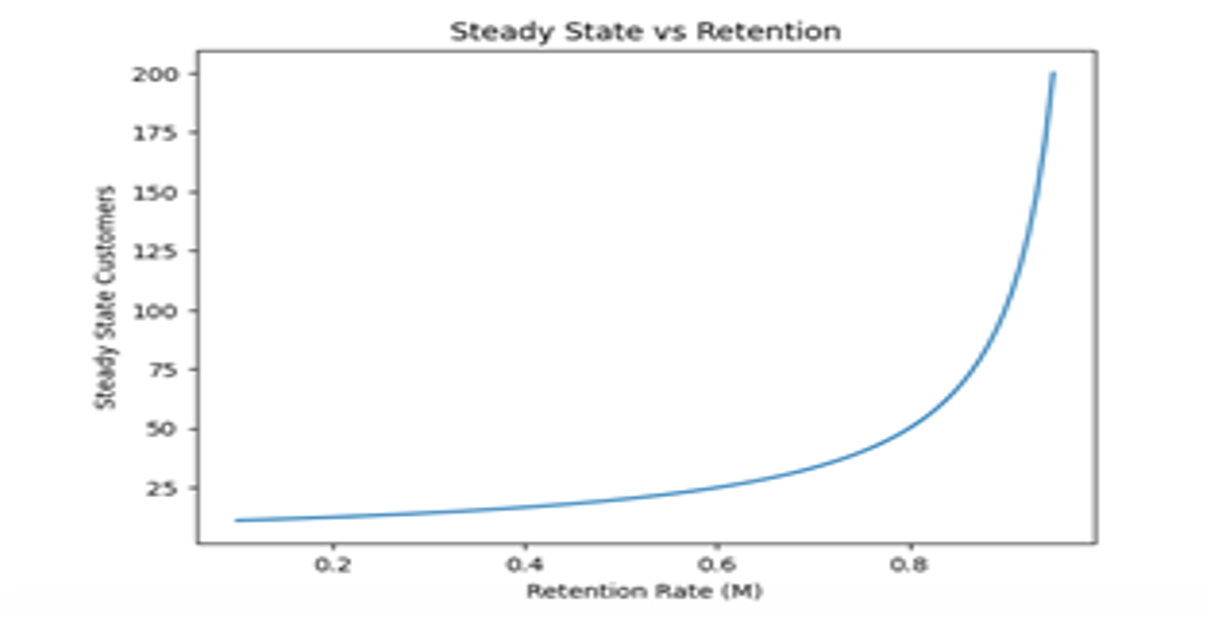
In this paper, we provide a mathematical framework of business development in the banking industry, using three variables, namely, customer acquisition (L), conversion (C) and retention (M). The easiest formula to use is a basic core formula that indicates that growth is a product of these variables where a low score on any will drastically lower the overall performance. The equation is extended into a differential equation to be able to describe the time-dependent development of the customer base with references to the growth and loss (churn) of the customer base. Numerical solution shows that acquisition and conversion can be added to the growth linearly, whereas retention can be added to the sustainability of growth much more significantly. The results highlight that enhancing customer retention by virtue of enhancing service delivery is the most crucial determinant of business growth that is long term and which is therefore most important in profitability and the stability of the organization.
References
Brauer, F., & Castillo-Chavez, C. (2012). Mathematical models in population biology and epidemiology. Springer.
Dahiya, M., & Singh, M. (2024). Examining customer loyalty and retention as drivers of satisfaction in internet banking. International Journal of Scientific Research in Science, Engineering and Technology, 11(3), 428–443. https://doi.org/10.32628/IJSRSET24113152.
Davenport, T. H., Guha, A., Grewal, D., & Bressgott, T. (2020). How artificial intelligence will change the future of marketing. Journal of the Academy of Marketing Science, 48, 24–42.
De Brito, J. B. G., Heldt, R., Silveira, C. S., Bogaert, M., Bucco, G. B., Luce, F. B., Becker, J. L., Zabala, F. J., & Anzanello, M. J. (2025). Potential customer lifetime value in financial institutions: The usage of open banking data to improve CLV estimation. arXiv. https://doi.org/10.48550/arXiv.2506.22711.
Gangrade, S., & Jain, R. K. (2021). Impact of factors affecting customer retention in banking sector. International Journal of Management Studies, 5(3(5)), 32–40.
Gangrade, S., & Loya, A. (2017). Banking customers and their retention: An empirical study of responsible factors. Research Journal of Management Sciences, 6(2), 1–7.
Gomber, P., Koch, J.-A., & Siering, M. (2017). Digital finance and FinTech: Current research and future research directions. Journal of Business Economics, 87(5), 537–580.
Homburg, C., Jozić, D., & Kuehnl, C. (2017). Customer experience management: Toward implementing an evolving marketing concept. Journal of the Academy of Marketing Science, 45(3), 377–401.
Ibitoye, A. O. J., Kolade, O., & Onifade, O. F. W. (2025). Customer retention model using machine learning for improved user-centric quality of experience through personalised quality of service. Journal of Business Analytics. https://doi.org/10.1080/2573234X.2025.2551950.
Kotler, P., & Keller, K. L. (2021). Marketing management (16th ed.). Pearson.
Kumar, V., & Reinartz, W. (2012). Customer relationship management: Concept, strategy, and tools (2nd ed.). Springer.
Latif, S. (2019). Impact of customer relationship management (CRM) through online banking services on customer retention with mediating role of customer perception and satisfaction: A case of Standard Chartered Bank Pakistan. International Journal of Sciences: Basic and Applied Research, 44(1), 14–32.
Lemon, K. N., & Verhoef, P. C. (2016). Understanding customer experience throughout the customer journey. Journal of Marketing, 80(6), 69–96.
Mbithi, W. (2013). Challenges of customer retention in the Kenyan banking sector: A case study of KCB Treasury Square Branch, Mombasa. International Journal of Sciences: Basic and Applied Research, 12(1), 124–132.
Negassa, G. J. (2023). The impact of trust and commitment on customer retention: Evidence from the banking industry. International Journal of Scientific and Research Publications, 13(5), 164–171. https://doi.org/10.29322/IJSRP.13.05.2023.p13721.
Obiyor, M. K. (2021). Customer acquisition and customer retention, cost implication in the banking sector in Umuahia Abia State. Michael Okpara University of Agriculture.
Reichheld, F. F., & Sasser, W. E. (1990). Zero defections: Quality comes to services. Harvard Business Review, 68(5), 105–111.
Silveira, L. J., Pinheiro, P. R., & Junior, L. S. d. M. (2021). A novel model structured on predictive churn methods in a banking organization. Journal of Risk and Financial Management, 14(10), 481. https://doi.org/10.3390/jrfm14100481.
Zeithaml, V. A., Bitner, M. J., & Gremler, D. D. (2018). Services marketing: Integrating customer focus across the firm (7th ed.). McGraw-Hill Education.
Downloads
Published
Issue
Section
Categories
License
Copyright (c) 2026 William Atokolo, Remigius Okeke Aja, Joseph Egbemhenghe, Jeremiah Amos, David Omale

This work is licensed under a Creative Commons Attribution 4.0 International License.


