
Trustworthy Spatio-Temporal Graph Learning for Urban Event Forecasting: A Systematic Survey of Explainability, Fairness, and Their Intersection
DOI:
https://doi.org/10.33003/fjs-2026-1014-5704Keywords:
spatio-temporal graph neural networks, explainable AI, algorithmic fairness, urban computing, trustworthy AI, crime forecasting, traffic forecastingAbstract
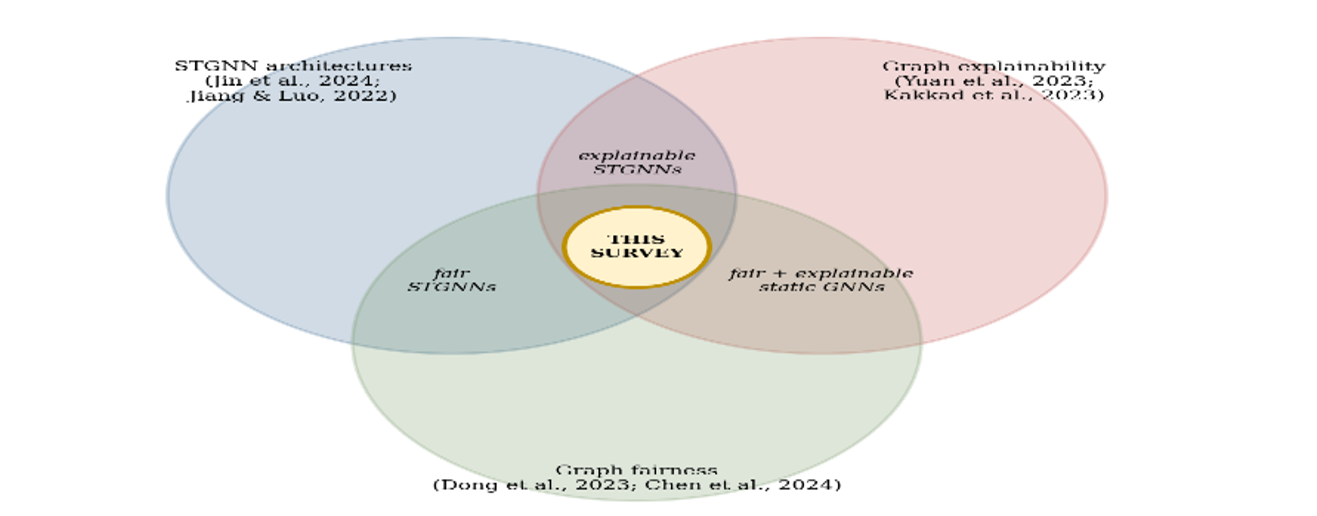
Spatio-temporal graph neural networks (STGNNs) are widely used for urban event forecasting, including traffic prediction, crime hotspot estimation, air-quality monitoring, and epidemic surveillance. However, their adoption in public governance requires both explainability and fairness, in addition to predictive accuracy. Although existing surveys have separately examined STGNN architectures, graph explainability, and graph fairness, their intersection remains largely unexplored. This gap is significant because relational structures can propagate demographic and structural biases, while access to reliable explanations may vary across sensitive groups. Following a systematic review of publications from 2016 to 2026, this study organizes STGNN architectures for urban forecasting, develops a taxonomy of intrinsic and post-hoc explainability methods, and categorizes fairness notions, bias sources, and debiasing strategies for dynamic urban graphs. It also examines joint explainability–fairness approaches, including temporal fairness stability and explanation disparity, and consolidates relevant datasets and evaluation protocols. The findings show that fewer than one in ten fairness-aware or explainable STGNN studies addresses both properties, while none before 2024 optimized them jointly. We conclude with a research agenda addressing temporal explanation benchmarks, dynamic fairness, causal grounding, scalability, and data-sparse Global-South cities.
References
Agarwal, C., Lakkaraju, H., & Zitnik, M. (2021). Towards a unified framework for fair and stable graph representation learning. Proceedings of the 37th Conference on Uncertainty in Artificial Intelligence (UAI), PMLR 161, 2114–2124. https://proceedings.mlr.press/v161/agarwal21b.html
Agarwal, C., Queen, O., Lakkaraju, H., & Zitnik, M. (2023). Evaluating explainability for graph neural networks. Scientific Data, 10, 144. https://doi.org/10.1038/s41597-023-01974-x
Aïvodji, U., Arai, H., Fortineau, O., Gambs, S., Hara, S., & Tapp, A. (2019). Fairwashing: The risk of rationalization. Proceedings of the 36th International Conference on Machine Learning (ICML), PMLR 97, 161–170. https://proceedings.mlr.press/v97/aivodji19a.html
Bai, L., Yao, L., Li, C., Wang, X., & Wang, C. (2020). Adaptive graph convolutional recurrent network for traffic forecasting. Advances in Neural Information Processing Systems, 33, 17804–17815. https://arxiv.org/abs/2007.02842
Barocas, S., Hardt, M., & Narayanan, A. (2019). Fairness and machine learning: Limitations and opportunities. fairmlbook.org. https://fairmlbook.org
Chen, A., Rossi, R. A., Park, N., Trivedi, P., Wang, Y., Yu, T., Kim, S., Dernoncourt, F., & Ahmed, N. K. (2024). Fairness-aware graph neural networks: A survey. ACM Transactions on Knowledge Discovery from Data, 18(6), 1–23. https://doi.org/10.1145/3649142
Dai, E., & Wang, S. (2021). Say no to the discrimination: Learning fair graph neural networks with limited sensitive attribute information. Proceedings of the 14th ACM International Conference on Web Search and Data Mining (WSDM), 680–688. https://doi.org/10.1145/3437963.3441752
Dai, E., Zhao, T., Zhu, H., Xu, J., Guo, Z., Liu, H., Tang, J., & Wang, S. (2024). A comprehensive survey on trustworthy graph neural networks: Privacy, robustness, fairness, and explainability. Machine Intelligence Research, 21, 1011–1061. https://doi.org/10.1007/s11633-024-1510-8
Dong, Y., Liu, N., Jalaian, B., & Li, J. (2022). EDITS: Modeling and mitigating data bias for graph neural networks. Proceedings of the ACM Web Conference (WWW), 1259–1269. https://doi.org/10.1145/3485447.3512173
Dong, Y., Ma, J., Wang, S., Chen, C., & Li, J. (2023). Fairness in graph mining: A survey. IEEE Transactions on Knowledge and Data Engineering, 35(10), 10583–10602. https://doi.org/10.1109/TKDE.2023.3265598
Doshi-Velez, F., & Kim, B. (2017). Towards a rigorous science of interpretable machine learning. arXiv preprint arXiv:1702.08608. https://arxiv.org/abs/1702.08608
Dwork, C., Hardt, M., Pitassi, T., Reingold, O., & Zemel, R. (2012). Fairness through awareness. Proceedings of the 3rd Innovations in Theoretical Computer Science Conference (ITCS), 214–226. https://doi.org/10.1145/2090236.2090255
Edwards, H., & Storkey, A. (2016). Censoring representations with an adversary. International Conference on Learning Representations (ICLR). https://arxiv.org/abs/1511.05897
Ensign, D., Friedler, S. A., Neville, S., Scheidegger, C., & Venkatasubramanian, S. (2018). Runaway feedback loops in predictive policing. Proceedings of the 1st Conference on Fairness, Accountability and Transparency, PMLR 81, 160–171. https://proceedings.mlr.press/v81/ensign18a.html
Ganin, Y., & Lempitsky, V. (2015). Unsupervised domain adaptation by backpropagation. Proceedings of the 32nd International Conference on Machine Learning (ICML), PMLR 37, 1180–1189. https://proceedings.mlr.press/v37/ganin15.html
Gilmer, J., Schoenholz, S. S., Riley, P. F., Vinyals, O., & Dahl, G. E. (2017). Neural message passing for quantum chemistry. Proceedings of the 34th International Conference on Machine Learning (ICML), PMLR 70, 1263–1272. https://proceedings.mlr.press/v70/gilmer17a.html
Guidotti, R., Monreale, A., Ruggieri, S., Turini, F., Giannotti, F., & Pedreschi, D. (2018). A survey of methods for explaining black box models. ACM Computing Surveys, 51(5), 1–42. https://doi.org/10.1145/3236009
Guo, S., Lin, Y., Feng, N., Song, C., & Wan, H. (2019). Attention based spatial-temporal graph convolutional networks for traffic flow forecasting. Proceedings of the AAAI Conference on Artificial Intelligence, 33(1), 922–929. https://doi.org/10.1609/aaai.v33i01.3301922
Hamilton, W. L., Ying, R., & Leskovec, J. (2017). Inductive representation learning on large graphs. Advances in Neural Information Processing Systems, 30, 1024–1034. https://arxiv.org/abs/1706.02216
Hardt, M., Price, E., & Srebro, N. (2016). Equality of opportunity in supervised learning. Advances in Neural Information Processing Systems, 29, 3315–3323. https://arxiv.org/abs/1610.02413
Huang, C., Zhang, J., Zheng, Y., & Chawla, N. V. (2018). DeepCrime: Attentive hierarchical recurrent networks for crime prediction. Proceedings of the 27th ACM International Conference on Information and Knowledge Management (CIKM), 1423–1432. https://doi.org/10.1145/3269206.3271793
Jain, S., & Wallace, B. C. (2019). Attention is not explanation. Proceedings of NAACL-HLT 2019, 3543–3556. https://doi.org/10.18653/v1/N19-1357
Jiang, W., & Luo, J. (2022). Graph neural network for traffic forecasting: A survey. Expert Systems with Applications, 207, 117921. https://doi.org/10.1016/j.eswa.2022.117921
Jin, G., Liang, Y., Fang, Y., Shao, Z., Huang, J., Zhang, J., & Zheng, Y. (2024). Spatio-temporal graph neural networks for predictive learning in urban computing: A survey. IEEE Transactions on Knowledge and Data Engineering, 36(10), 5388–5408. https://doi.org/10.1109/TKDE.2023.3333824
Kakkad, J., Jannu, J., Sharma, K., Aggarwal, C., & Medya, S. (2023). A survey on explainability of graph neural networks. arXiv preprint arXiv:2306.01958. https://arxiv.org/abs/2306.01958
Kipf, T. N., & Welling, M. (2017). Semi-supervised classification with graph convolutional networks. International Conference on Learning Representations (ICLR). https://arxiv.org/abs/1609.02907
Kitchenham, B., Brereton, O. P., Budgen, D., Turner, M., Bailey, J., & Linkman, S. (2009). Systematic literature reviews in software engineering—A systematic literature review. Information and Software Technology, 51(1), 7–15. https://doi.org/10.1016/j.infsof.2008.09.009
Kusner, M. J., Loftus, J., Russell, C., & Silva, R. (2017). Counterfactual fairness. Advances in Neural Information Processing Systems, 30, 4066–4076. https://arxiv.org/abs/1703.06856
Lee, Y.-C., Shin, H., & Kim, S.-W. (2025). Disentangling, amplifying, and debiasing: Learning disentangled representations for fair graph neural networks. Proceedings of the AAAI Conference on Artificial Intelligence, 39(11), 11845–11853. https://doi.org/10.1609/aaai.v39i11.33308
Li, Y., Yu, R., Shahabi, C., & Liu, Y. (2018). Diffusion convolutional recurrent neural network: Data-driven traffic forecasting. International Conference on Learning Representations (ICLR). https://arxiv.org/abs/1707.01926
Lum, K., & Isaac, W. (2016). To predict and serve? Significance, 13(5), 14–19. https://doi.org/10.1111/j.1740-9713.2016.00960.x
Lundberg, S. M., & Lee, S.-I. (2017). A unified approach to interpreting model predictions. Advances in Neural Information Processing Systems, 30, 4765–4774. https://arxiv.org/abs/1705.07874
Luo, D., Cheng, W., Xu, D., Yu, W., Zong, B., Chen, H., & Zhang, X. (2020). Parameterized explainer for graph neural network. Advances in Neural Information Processing Systems, 33, 19620–19631. https://arxiv.org/abs/2011.04573
Ma, J., Guo, R., Wan, M., Yang, L., Zhang, A., & Li, J. (2022). Learning fair node representations with graph counterfactual fairness. Proceedings of the 15th ACM International Conference on Web Search and Data Mining (WSDM), 695–703. https://doi.org/10.1145/3488560.3498391
Madras, D., Creager, E., Pitassi, T., & Zemel, R. (2018). Learning adversarially fair and transferable representations. Proceedings of the 35th International Conference on Machine Learning (ICML), PMLR 80, 3384–3393. https://proceedings.mlr.press/v80/madras18a.html
Mehrabi, N., Morstatter, F., Saxena, N., Lerman, K., & Galstyan, A. (2021). A survey on bias and fairness in machine learning. ACM Computing Surveys, 54(6), 1–35. https://doi.org/10.1145/3457607
Miller, T. (2019). Explanation in artificial intelligence: Insights from the social sciences. Artificial Intelligence, 267, 1–38. https://doi.org/10.1016/j.artint.2018.07.007
Ogar, A. O., Abah, J., Suleiman, M. A., Akande, O. N., & Muhammed, F. O. (2026). Optimising domain-specific neuron activation for efficient multimodal language understanding in cloud AI systems. International Journal of Computer Information Systems and Industrial Management Applications, 18(5s), 816–831. https://doi.org/10.70917/ijcisim-2026-2533
Page, M. J., McKenzie, J. E., Bossuyt, P. M., Boutron, I., Hoffmann, T. C., Mulrow, C. D., Shamseer, L., Tetzlaff, J. M., Akl, E. A., Brennan, S. E., Chou, R., Glanville, J., Grimshaw, J. M., Hróbjartsson, A., Lalu, M. M., Li, T., Loder, E. W., Mayo-Wilson, E., McDonald, S., … Moher, D. (2021). The PRISMA 2020 statement: An updated guideline for reporting systematic reviews. BMJ, 372, n71. https://doi.org/10.1136/bmj.n71
Ribeiro, M. T., Singh, S., & Guestrin, C. (2016). “Why should I trust you?” Explaining the predictions of any classifier. Proceedings of the 22nd ACM SIGKDD International Conference on Knowledge Discovery and Data Mining, 1135–1144. https://doi.org/10.1145/2939672.2939778
Richardson, R., Schultz, J. M., & Crawford, K. (2019). Dirty data, bad predictions: How civil rights violations impact police data, predictive policing systems, and justice. New York University Law Review Online, 94, 15–55. https://www.nyulawreview.org/online-features/dirty-data-bad-predictions-how-civil-rights-violations-impact-police-data-predictive-policing-systems-and-justice/
Rudin, C. (2019). Stop explaining black box machine learning models for high stakes decisions and use interpretable models instead. Nature Machine Intelligence, 1(5), 206–215. https://doi.org/10.1038/s42256-019-0048-x
Sundararajan, M., Taly, A., & Yan, Q. (2017). Axiomatic attribution for deep networks. Proceedings of the 34th International Conference on Machine Learning (ICML), PMLR 70, 3319–3328. https://proceedings.mlr.press/v70/sundararajan17a.html
Tang, J., Xia, L., & Huang, C. (2023). Explainable spatio-temporal graph neural networks. Proceedings of the 32nd ACM International Conference on Information and Knowledge Management (CIKM), 2432–2441. https://doi.org/10.1145/3583780.3614871
Veličković, P., Cucurull, G., Casanova, A., Romero, A., Liò, P., & Bengio, Y. (2018). Graph attention networks. International Conference on Learning Representations (ICLR). https://arxiv.org/abs/1710.10903
Verdone, A., Scardapane, S., & Panella, M. (2024). Explainable spatio-temporal graph neural networks for multi-site photovoltaic energy production. Applied Energy, 353, 122151. https://doi.org/10.1016/j.apenergy.2023.122151
Vu, M. N., & Thai, M. T. (2020). PGM-Explainer: Probabilistic graphical model explanations for graph neural networks. Advances in Neural Information Processing Systems, 33, 12225–12235. https://arxiv.org/abs/2010.05788
Wang, S., Cao, J., & Yu, P. S. (2022). Deep learning for spatio-temporal data mining: A survey. IEEE Transactions on Knowledge and Data Engineering, 34(8), 3681–3700. https://doi.org/10.1109/TKDE.2020.3025580
Wiegreffe, S., & Pinter, Y. (2019). Attention is not not explanation. Proceedings of EMNLP-IJCNLP 2019, 11–20. https://doi.org/10.18653/v1/D19-1002
Wu, J., Abrar, S. M., Awasthi, N., & Frias-Martinez, V. (2024). Improving the fairness of deep-learning, short-term crime prediction with under-reporting-aware models. arXiv preprint arXiv:2406.04382. https://arxiv.org/abs/2406.04382
Wu, Z., Pan, S., Chen, F., Long, G., Zhang, C., & Yu, P. S. (2021). A comprehensive survey on graph neural networks. IEEE Transactions on Neural Networks and Learning Systems, 32(1), 4–24. https://doi.org/10.1109/TNNLS.2020.2978386
Wu, Z., Pan, S., Long, G., Jiang, J., & Zhang, C. (2019). Graph WaveNet for deep spatial-temporal graph modeling. Proceedings of the 28th International Joint Conference on Artificial Intelligence (IJCAI), 1907–1913. https://doi.org/10.24963/ijcai.2019/264
Xu, K., Hu, W., Leskovec, J., & Jegelka, S. (2019). How powerful are graph neural networks? International Conference on Learning Representations (ICLR). https://arxiv.org/abs/1810.00826
Yang, C., Liu, J., Yan, Y., & Shi, C. (2024). FairSIN: Achieving fairness in graph neural networks through sensitive information neutralization. Proceedings of the AAAI Conference on Artificial Intelligence, 38(8), 9241–9249. https://doi.org/10.1609/aaai.v38i8.28776
Ying, R., Bourgeois, D., You, J., Zitnik, M., & Leskovec, J. (2019). GNNExplainer: Generating explanations for graph neural networks. Advances in Neural Information Processing Systems, 32, 9244–9255. https://arxiv.org/abs/1903.03894
Yu, B., Yin, H., & Zhu, Z. (2018). Spatio-temporal graph convolutional networks: A deep learning framework for traffic forecasting. Proceedings of the 27th International Joint Conference on Artificial Intelligence (IJCAI), 3634–3640. https://doi.org/10.24963/ijcai.2018/505
Yuan, H., Yu, H., Gui, S., & Ji, S. (2023). Explainability in graph neural networks: A taxonomic survey. IEEE Transactions on Pattern Analysis and Machine Intelligence, 45(5), 5782–5799. https://doi.org/10.1109/TPAMI.2022.3204236
Yuan, H., Yu, H., Wang, J., Li, K., & Ji, S. (2021). On explainability of graph neural networks via subgraph explorations. Proceedings of the 38th International Conference on Machine Learning (ICML), PMLR 139, 12241–12252. https://proceedings.mlr.press/v139/yuan21c.html
Zemel, R., Wu, Y., Swersky, K., Pitassi, T., & Dwork, C. (2013). Learning fair representations. Proceedings of the 30th International Conference on Machine Learning (ICML), PMLR 28, 325–333. https://proceedings.mlr.press/v28/zemel13.html
Zhao, S., Shao, W., Chan, J., Xu, Z., & Salim, F. (2025). FairDRL-ST: Disentangled representation learning for fair spatio-temporal mobility prediction. arXiv preprint arXiv:2508.07518. https://arxiv.org/abs/2508.07518
Zheng, C., Fan, X., Wang, C., & Qi, J. (2020). GMAN: A graph multi-attention network for traffic prediction. Proceedings of the AAAI Conference on Artificial Intelligence, 34(1), 1234–1241. https://doi.org/10.1609/aaai.v34i01.5477s
Downloads
Published
Issue
Section
Categories
License
Copyright (c) 2026 Joy Onyeje Amafonye, Aliyu Suleiman Muhammed, Yusuf Salisu Ibrahim, Austin Olom Ogar

This work is licensed under a Creative Commons Attribution 4.0 International License.


