
Hallucinations in Multimodal Large Language Models: A Comprehensive Survey of Taxonomy, Causes, Detection Methods, Mitigation Strategies, and Evaluation Benchmarks
DOI:
https://doi.org/10.33003/fjs-2026-1010-5338Keywords:
Multimodal large language models, hallucinations, vision-language models, object hallucination, factual grounding, hallucination detection, hallucination mitigationAbstract
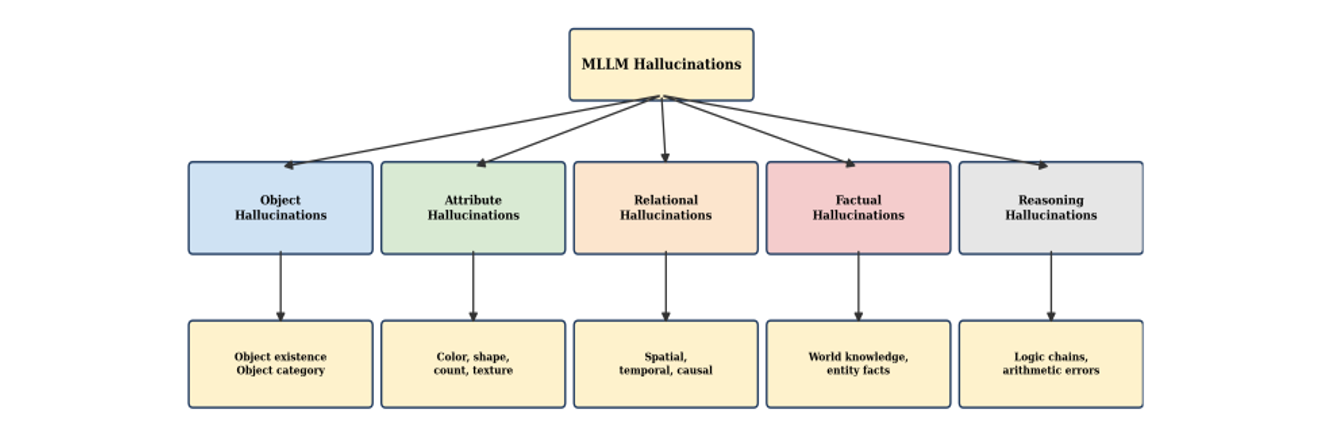
The rapid deployment of multimodal large language models (MLLMs) across healthcare, autonomous systems, document intelligence, and educational applications has been accompanied by a growing recognition that these models routinely produce outputs that are confident, fluent, and incorrect — outputs the literature has converged on calling hallucinations. This survey provides a comprehensive treatment of the field across five interconnected dimensions. First, we propose a unified five-class taxonomy that organizes hallucinations by their failure mode: object, attribute, relational, factual, and reasoning. Second, we trace the principal causes back to four sources: data-related, architecture-related, training-related, and inference-related, and provide representative manifestations for each. Third, we survey detection methods across four method families — internal-state probes, output-consistency checks, external-verification tools, and uncertainty quantification — and report their performance ranges on shared benchmarks. Fourth, we organise mitigation strategies along a five-stage intervention timeline ranging from data curation to post-hoc correction and discuss the cost-effectiveness trade-offs. Fifth, we present an exhaustive comparison of eight leading hallucination evaluation benchmarks and their coverage across the five hallucination classes. The survey covers more than ninety peer-reviewed papers and preprints published between 2022 and 2026, identifies six open research problems that we believe will define the next phase of the field, and concludes with a forward-looking research agenda. The survey is intended for researchers and practitioners building, evaluating, or deploying multimodal AI systems in high-stakes settings where hallucinations carry tangible operational risk.
References
Alfarrarjeh, M., Tahmasbi, M. R., & Cantürk, T. (2025). DriVQA: A gaze-based dataset for visual question answering in driving scenarios. Image and Vision Computing, 156, Article 105430. https://doi.org/10.1016/j.imavis.2025.105430
Bender, E. M., Gebru, T., McMillan-Major, A., & Mitchell, M. (2021). On the dangers of stochastic parrots: Can language models be too big? Communications of the ACM, 64(12), 86-92. https://doi.org/10.1145/3458723
Bills, S., Cammarata, N., Mossing, D., Tillman, H., Gao, L., Goh, G., Sutskever, I., Leike, J., Wu, J., & Saunders, W. (2024). Language model interpretability: A survey of approaches and applications. Computational Linguistics, 50(4), 1153-1198. https://doi.org/10.1162/coli_a_00529
Casper, S., Davies, X., Shi, C., Gilbert, T. K., Scheurer, J., Rando, J., Freedman, R., Korbak, T., Lindner, D., Freire, P., Wang, T., Marks, S., Segerie, C.-R., Carroll, M., Peng, A., Christoffersen, P., Damani, M., Slocum, S., Anwar, U., Hadfield-Menell, D. (2024). Open problems and fundamental limitations of reinforcement learning from human feedback. Transactions on Machine Learning Research. https://openreview.net/forum?id=bx24KpJ4Eb
Du, Y., Liu, Z., Li, J., & Zhao, W. X. (2022). A survey of vision-language pre-trained models. Machine Intelligence Research, 19(4), 287-307. https://doi.org/10.1007/s11633-022-1361-0
European Parliament. (2024). Regulation (EU) 2024/1689 of the European Parliament and of the Council laying down harmonised rules on artificial intelligence (Artificial Intelligence Act). Official Journal of the European Union, L 2024/1689, 1-144. https://eur-lex.europa.eu/eli/reg/2024/1689/oj
Gal, Y., & Ghahramani, Z. (2016). Dropout as a Bayesian approximation: Representing model uncertainty in deep learning. Journal of Machine Learning Research, 48, 1050-1059. https://jmlr.org/proceedings/papers/v48/gal16.html
Guo, C., Pleiss, G., Sun, Y., & Weinberger, K. Q. (2017). On calibration of modern neural networks. Journal of Machine Learning Research, 70, 1321-1330. https://jmlr.org/proceedings/papers/v70/guo17a.html
He, Y., & Xiao, L. (2024). Structured pruning for deep convolutional neural networks: A survey. IEEE Transactions on Pattern Analysis and Machine Intelligence, 46(5), 2900-2919. https://doi.org/10.1109/TPAMI.2023.3334614
Hendrycks, D., Carlini, N., Schulman, J., & Steinhardt, J. (2022). Unsolved problems in ML safety. Communications of the ACM, 65(6), 78-87. https://doi.org/10.1145/3495173
Hoefler, T., Alistarh, D., Ben-Nun, T., Dryden, N., & Peste, A. (2021). Sparsity in deep learning: Pruning and growth for efficient inference and training in neural networks. Journal of Machine Learning Research, 22, Article 241. https://jmlr.org/papers/v22/21-0366.html
Huang, L., Yu, W., Ma, W., Zhong, W., Feng, Z., Wang, H., Chen, Q., Peng, W., Feng, X., Qin, B., & Liu, T. (2025). A survey on hallucination in large language models: Principles, taxonomy, challenges, and open questions. ACM Transactions on Information Systems, 43(2), Article 42. https://doi.org/10.1145/3703155
Izogie, L. E., Akazue, M. I., & Ihama, E. I. (2025). A survey of deep learning model for prostate cancer diagnosis. FUDMA Journal of Sciences, 9(4), 1-12. https://fjs.fudutsinma.edu.ng/index.php/fjs/article/view/4187
Ji, Z., Lee, N., Frieske, R., Yu, T., Su, D., Xu, Y., Ishii, E., Bang, Y. J., Madotto, A., & Fung, P. (2023). Survey of hallucination in natural language generation. ACM Computing Surveys, 55(12), Article 248. https://doi.org/10.1145/3571730
Liang, P. P., Zadeh, A., & Morency, L.-P. (2024). Foundations and trends in multimodal machine learning: Principles, challenges, and open questions. ACM Computing Surveys, 56(10), Article 264. https://doi.org/10.1145/3656580
Lin, T., Wang, Y., Liu, X., & Qiu, X. (2022). A survey of transformers. AI Open, 3, 111-132. https://doi.org/10.1016/j.aiopen.2022.10.001
Lin, T., Wang, Y., Liu, X., & Qiu, X. (2022). A survey of transformers. AI Open, 3, 111-132. https://doi.org/10.1016/j.aiopen.2022.10.001
Lin, Z., Zhang, D., Tao, Q., Shi, D., Haffari, G., Wu, Q., He, M., & Ge, Z. (2023). Medical visual question answering: A survey. Artificial Intelligence in Medicine, 143, Article 102611. https://doi.org/10.1016/j.artmed.2023.102611
Liu, H., Xue, W., Chen, Y., Chen, D., Zhao, X., Wang, K., Hou, L., Li, R., & Peng, W. (2024). A survey on hallucination in large vision-language models. Artificial Intelligence Review, 57(11), Article 309. https://doi.org/10.1007/s10462-024-10884-2
Liu, P., Liu, Z., Gao, Z.-J., Gao, D., Wang, W. Y., Li, Y., & Li, S. (2024). A survey of multimodal large language model from a data-centric perspective. Information Fusion, 113, Article 102604. https://doi.org/10.1016/j.inffus.2024.102604
Liu, Y., Cao, J., Liu, C., Ding, K., & Jin, L. (2024). Datasets for large language models: A comprehensive survey. Knowledge-Based Systems, 302, Article 112376. https://doi.org/10.1016/j.knosys.2024.112376
Rohrbach, A., Hendricks, L. A., Burns, K., Darrell, T., & Saenko, K. (2018). Object hallucination in image captioning. Computational Linguistics, 44(3), 627-651. https://doi.org/10.1162/coli_a_00321
Schwartz, R., Dodge, J., Smith, N. A., & Etzioni, O. (2020). Green AI. Communications of the ACM, 63(12), 54-63. https://doi.org/10.1145/3381831
Wang, L., & Yoon, K.-J. (2022). Knowledge distillation and student-teacher learning for visual intelligence: A review and new outlooks. IEEE Transactions on Pattern Analysis and Machine Intelligence, 44(6), 3048-3068. https://doi.org/10.1109/TPAMI.2021.3055564
Wang, X., He, Y., Yang, J., & Jin, Y. (2024). Mitigating hallucinations in multimodal large language models: A comprehensive review. Science China Information Sciences, 67(12), Article 220105. https://doi.org/10.1007/s11432-024-4251-x
Wang, X., Chen, Y., Huang, S., Yu, J., Liu, S., & Sun, M. (2024). Neuron-level analysis of large language models: A comprehensive review. Neural Networks, 178, Article 106458. https://doi.org/10.1016/j.neunet.2024.106458
Wu, X., Yang, C., Chen, Z., Zhao, Y., Wang, J., Wu, B., & Yu, Z. (2025). Medical multimodal large language models: A systematic review. Computers in Biology and Medicine, 185, Article 109534. https://doi.org/10.1016/j.compbiomed.2025.109534
Yao, Y., Yu, T., Zhang, A., Wang, C., Cui, J., Zhu, H., Cai, T., Chen, C., Li, H., Zhao, W., He, Z., Chen, Q., Zhou, R., Zou, Z., Zhang, H., Hu, S., Zheng, Z., Zhou, J., Cai, J., Han, X., Zeng, G., Li, D., Liu, Z., & Sun, M. (2025). Efficient GPT-4V level multimodal large language model for deployment on edge devices. Nature Communications, 16(1), Article 5509. https://doi.org/10.1038/s41467-025-61040-5
Yin, S., Fu, C., Zhao, S., Li, K., Sun, X., Xu, T., & Chen, E. (2024). A survey on multimodal large language models. National Science Review, 11(12), Article nwae403. https://doi.org/10.1093/nsr/nwae403
Yüksel, S. E., Wilson, J. N., & Gader, P. D. (2012). Twenty years of mixture of experts. IEEE Transactions on Neural Networks and Learning Systems, 23(8), 1177-1193. https://doi.org/10.1109/TNNLS.2012.2200299
Zhang, J., Huang, J., Jin, S., & Lu, S. (2024). Vision-language models for vision tasks: A survey. IEEE Transactions on Pattern Analysis and Machine Intelligence, 46(8), 5625-5644. https://doi.org/10.1109/TPAMI.2024.3369699
Downloads
Published
Issue
Section
Categories
License
Copyright (c) 2026 Olom Ogar Austin, Abah Joshua, Aliyu Suleiman Muhammed, Faruk Obansa Muhammed, Bilkisu Larai Muhammad, Hauwa Ibrahim Aminu

This work is licensed under a Creative Commons Attribution 4.0 International License.


