
An Explainable Hybrid CNN-LSTM-Random Forest Framework for Early Epidemic Outbreak Detection from Multimodal Data, Validated by Real Corpora and Controlled Simulation
DOI:
https://doi.org/10.33003/fjs-2026-1010-5369Keywords:
Epidemic early warning, Hybrid deep learning, Random Forest, Explainable AI, Multimodal data, Simulation ValidationAbstract
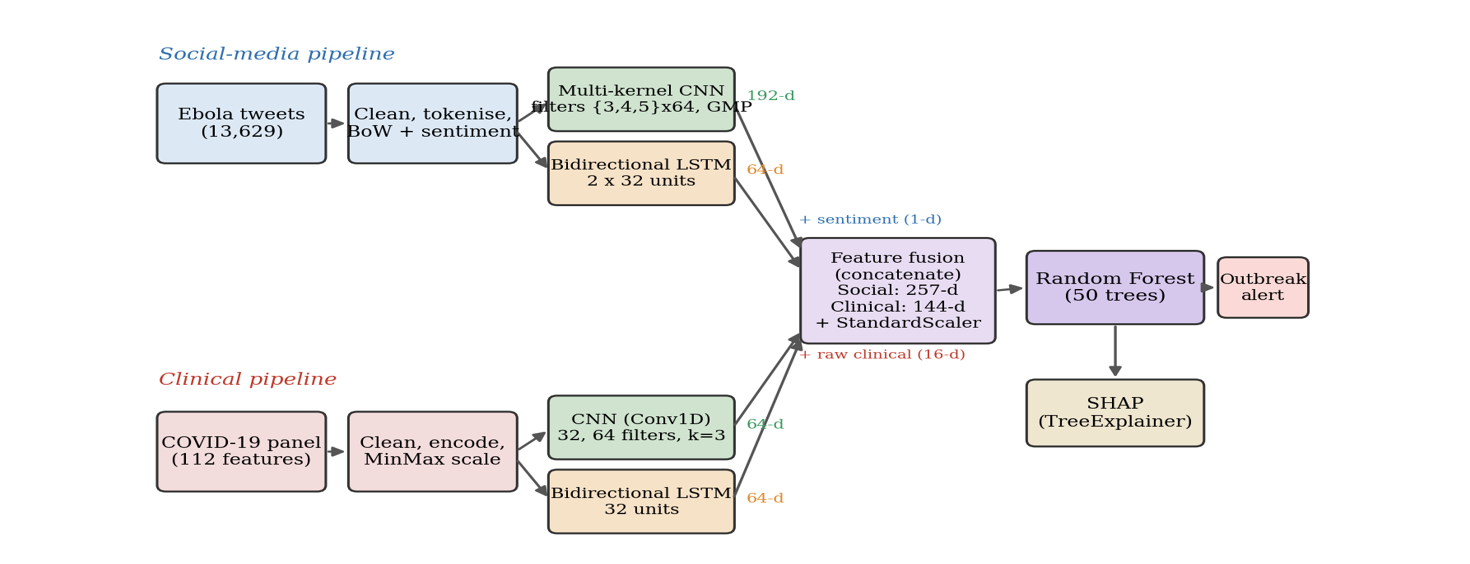
Early detection of epidemic outbreaks is critical for timely intervention, yet machine-learning early-warning systems are limited by low recall on rare early signals, weak integration of heterogeneous data, and poor interpretability. This study develops an explainable hybrid framework in which a Convolutional Neural Network (CNN) and a Bidirectional Long Short-Term Memory (LSTM) network extract features that a Random Forest (RF) classifier uses for decision-making, with SHapley Additive exPlanations (SHAP) providing transparency. The framework is evaluated on two complementary public corpora, 13,629 Ebola-related tweets from the 2022 Ugandan outbreak and 5,644 COVID-19 patient records with 112 clinical features, and its multimodal-fusion mechanism is validated in a controlled simulation in which a stochastic SEIR process generates coupled epidemic and digital signals for the same region-time units under a realistic surveillance blind spot. On the social-media task the proposed CNN-LSTM-RF achieves an accuracy of 0.94, a recall of 0.86, and an F1-score of 0.89, cutting false negatives from 108 to 75. On the clinical task it attains the best recall (0.54) and F1-score (0.56) among compared models; recall and F1 are reported in preference to accuracy because the cohort is strongly imbalanced. SHAP identifies patient age and host-response markers as dominant predictors, consistent with clinical knowledge. In simulation, the fused model attains the highest ROC-AUC (0.943) and PR-AUC (0.851) and alerts on average 2.6 days earlier than a clinical-only model, providing controlled evidence of a genuine, if modest, fusion benefit.
References
Abdallah, R., AbdelGaber, S. A., & Ali Sayed, H. (2024). Disease outbreak/epidemic in public health sector. Proceedings of the 6th International Conference on Computing and Informatics (ICCI 2024), 203–216. https://doi.org/10.1109/ICCI61671.2024.10485007
Abdualgalil, B., Abraham, S., & Ismael, W. M. (2022). Early diagnosis for dengue disease prediction using efficient machine learning techniques based on clinical data. Journal of Robotics and Control, 3(3). https://doi.org/10.18196/jrc.v3i3.14387
Absar, N., Uddin, N., Khandaker, M. U., & Ullah, H. (2022). The efficacy of deep learning based LSTM model in forecasting the outbreak of contagious diseases. Infectious Disease Modelling, 7(1), 170–183. https://doi.org/10.1016/j.idm.2021.12.005
AlArjani, A., Nasseef, M. T., Kamal, S. M., Rao, B. V. S., Mahmud, M., & Uddin, M. S. (2022). Application of mathematical modeling in prediction of COVID-19 transmission dynamics. Arabian Journal for Science and Engineering, 47(8), 10163–10186. https://doi.org/10.1007/s13369-021-06419-4
Aleixo, R., Kon, F., Rocha, R., Camargo, M. S., & De Camargo, R. Y. (2022). Predicting dengue outbreaks with explainable machine learning. Proceedings of the 22nd IEEE/ACM International Symposium on Cluster, Cloud and Internet Computing (CCGrid 2022), 940–947. https://doi.org/10.1109/CCGrid54584.2022.00114
Amin, S., Uddin, M. I., Alsaeed, D. H., Khan, A., & Adnan, M. (2021). Early detection of seasonal outbreaks from Twitter data using machine learning approaches. Complexity, 2021. https://doi.org/10.1155/2021/5520366
Ardabili, S. F., Mosavi, A., Ghamisi, P., Ferdinand, F., Varkonyi-Koczy, A. R., Reuter, U., Rabczuk, T., & Atkinson, P. M. (2020). COVID-19 outbreak prediction with machine learning. Algorithms, 13(10), 1–39. https://doi.org/10.3390/a13100249
Bohm, B. C., de Melo, V. F., Santos, K. C., Frias, D. F. R., & Fonseca, B. A. L. (2024). Utilization of machine learning for dengue case screening. BMC Public Health, 24, 1–9.
Breiman, L. (2001). Random forests. Machine Learning, 45(1), 5–32. https://doi.org/10.1023/A:1010933404324
Chawla, N. V., Bowyer, K. W., Hall, L. O., & Kegelmeyer, W. P. (2002). SMOTE: Synthetic minority over-sampling technique. Journal of Artificial Intelligence Research, 16, 321–357. https://doi.org/10.1613/jair.953
Cho, G., Park, J. R., Choi, Y., Ahn, H., & Lee, H. (2023). Detection of COVID-19 epidemic outbreak using machine learning. Frontiers in Public Health, 11, 1–12. https://doi.org/10.3389/fpubh.2023.1252357
Cramer, E. Y., Ray, E. L., Lopez, V. K., Bracher, J., Brennen, A., Castro Rivadeneira, A. J., Gerding, A., Gneiting, T., House, K. H., Huang, Y., Jayawardena, D., Kanji, A. H., Khandelwal, A., Le, K., Mühlemann, A., Niemi, J., Shah, A., Stark, A., Wang, Y., … Reich, N. G. (2022). Evaluation of individual and ensemble probabilistic forecasts of COVID-19 mortality in the United States. Proceedings of the National Academy of Sciences, 119(15). https://doi.org/10.1073/pnas.2113561119
El Morr, C., Ozdemir, D., Asdaah, Y., Saab, A., El-Lahib, Y., & Sokhn, E. S. (2024). AI-based epidemic and pandemic early warning systems: A systematic scoping review. Health Informatics Journal, 30(3). https://doi.org/10.1177/14604582241275844
Ginsberg, J., Mohebbi, M. H., Patel, R. S., Brammer, L., Smolinski, M. S., & Brilliant, L. (2009). Detecting influenza epidemics using search engine query data. Nature, 457(7232), 1012–1014. https://doi.org/10.1038/nature07634
Giordano, G., Colaneri, M., Di Filippo, A., Blanchini, F., Bolzern, P., De Nicolao, G., Sacchi, P., Colaneri, P., & Bruno, R. (2021). Modeling vaccination rollouts, SARS-CoV-2 variants and the requirement for non-pharmaceutical interventions in Italy. Nature Medicine, 27(6), 993–998. https://doi.org/10.1038/s41591-021-01334-5
Goodfellow, I., Bengio, Y., & Courville, A. (2018). Deep learning. Genetic Programming and Evolvable Machines, 19(1), 305–307. https://doi.org/10.1007/s10710-017-9314-z
Hochreiter, S., & Schmidhuber, J. (1997). Long short-term memory. Neural Computation, 9(8), 1735–1780. https://doi.org/10.1162/neco.1997.9.8.1735
Kapoor, A., Ben, X., Liu, L., Perozzi, B., Barnes, M., Blais, M., & O’Banion, S. (2020). Examining COVID-19 forecasting using spatio-temporal graph neural networks. arXiv. https://arxiv.org/abs/2007.03113
Kermack, W. O., & McKendrick, A. G. (1927). A contribution to the mathematical theory of epidemics. Proceedings of the Royal Society of London A, 115(772), 700–721. https://doi.org/10.1098/rspa.1927.0118
Kirange, D. Y. (2025). Ensemble model for epidemic detection in Maharashtra using machine learning techniques. IOSR Journal of Computer Engineering, 27(2), 31–38. https://doi.org/10.9790/0661-2702013138
Kraemer, M. U. G., Yang, C. H., Gutierrez, B., Wu, C. H., Klein, B., Pigott, D. M., du Plessis, L., Faria, N. R., Li, R., Hanage, W. P., Brownstein, J. S., Layan, M., Vespignani, A., Tian, H., Dye, C., Pybus, O. G., & Scarpino, S. V. (2020). The effect of human mobility and control measures on the COVID-19 epidemic in China. Science, 368(6490), 493–497. https://doi.org/10.1126/science.abb4218
Kumar, P., & Kumar, A. (2022). Early prediction of COVID-19 using ensemble of transfer learning. Computers & Electrical Engineering, 101, 108018. https://doi.org/10.1016/j.compeleceng.2022.108018
Kumar, S., & Kumar, S. (2022). Ensemble multimodal deep learning for early diagnosis and accurate classification of COVID-19. Computers & Electrical Engineering, 103, 108396. https://doi.org/10.1016/j.compeleceng.2022.108396
Lauer, S. A., Grantz, K. H., Bi, Q., Jones, F. K., Zheng, Q., Meredith, H. R., Azman, A. S., Reich, N. G., & Lessler, J. (2020). The incubation period of coronavirus disease 2019 (COVID-19) from publicly reported confirmed cases: Estimation and application. Annals of Internal Medicine, 172(9), 577–582. https://doi.org/10.7326/M20-0504
Lazer, D., Kennedy, R., King, G., & Vespignani, A. (2014). The parable of Google Flu: Traps in big data analysis. Science, 343(6176), 1203–1205. https://doi.org/10.1126/science.1248506
Lim, B., Arik, S. O., Loeff, N., & Pfister, T. (2021). Temporal fusion transformers for interpretable multi-horizon time series forecasting. International Journal of Forecasting, 37(4), 1748–1764. https://doi.org/10.1016/j.ijforecast.2021.03.012
Liscano, Y., Arrieta, L. A. A., Montenegro, J. F., Prieto-Alvarado, D., & Ordonez, J. (2025). Early warning of infectious disease outbreaks using social media and digital data: A scoping review. Digital Health, 11, 1–34.
Lundberg, S. M., & Lee, S. I. (2017). A unified approach to interpreting model predictions. Advances in Neural Information Processing Systems, 30, 4765–4774.
Lundberg, S. M., Erion, G., Chen, H., DeGrave, A., Prutkin, J. M., Nair, B., Katz, R., Himmelfarb, J., Bansal, N., & Lee, S. I. (2020). From local explanations to global understanding with explainable AI for trees. Nature Machine Intelligence, 2(1), 56–67. https://doi.org/10.1038/s42256-019-0138-9
Mahajan, A., Solanki, R., & Sharma, S. (2022). A novel stacking-based deterministic ensemble model for infectious disease prediction. Mathematics, 10(10).
Maharana, K., Mondal, S., & Nemade, B. (2022). A review: Data pre-processing and data augmentation techniques. Global Transitions Proceedings, 3(1), 91–99. https://doi.org/10.1016/j.gltp.2022.04.020
Melchane, S., Elmir, Y., & Kacimi, F. (2024). COVID-19 detection from blood test parameters using machine learning. Procedia Computer Science, 239, 675–683. https://doi.org/10.1016/j.procs.2024.06.223
Mirugwe, A., Ashaba, C., Namale, A., Mukunya, E., Kalibbala, J., & Nakatumba-Nabende, L. (2024). Sentiment analysis of social media data on Ebola outbreak using deep learning classifiers, 1–14.
Moore, S., Hill, E. M., Tildesley, M. J., Dyson, L., & Keeling, M. J. (2021). Vaccination and non-pharmaceutical interventions for COVID-19: A mathematical modelling study. The Lancet Infectious Diseases, 21(6), 793–802. https://doi.org/10.1016/S1473-3099(21)00143-2
Muhammed, F. O., Suleiman, M. A., Abdullahi, S. E., & Ogar, A. O. (2025). Machine learning for epidemic outbreak prediction: Recent advances and open problems. NIPES Journal of Science and Technology Research, 7(4). https://doi.org/10.37933/nipes/7.4.2025.SI75
Munk, D. H. (2022). A comparison of ARIMA and Random Forest time series models for prediction of avian influenza H5N1 outbreaks, 1–10.
Pramod, A. (2023). Epidemic outbreak prediction using machine learning models [Unpublished manuscript].
Ren, H., Ling, Y., Cao, R., Wang, Z., Li, Y., & Huang, T. (2023). Early warning of emerging infectious diseases based on multimodal data. Biosafety and Health, 5(4), 193–203. https://doi.org/10.1016/j.bsheal.2023.05.006
Ribeiro, M. T., Singh, S., & Guestrin, C. (2016). “Why should I trust you?”: Explaining the predictions of any classifier. Proceedings of the 22nd ACM SIGKDD International Conference on Knowledge Discovery and Data Mining, 1135–1144. https://doi.org/10.1145/2939672.2939778
Saito, T., & Rehmsmeier, M. (2015). The precision-recall plot is more informative than the ROC plot when evaluating binary classifiers on imbalanced datasets. PLOS ONE, 10(3), e0118432. https://doi.org/10.1371/journal.pone.0118432
Sebastianelli, A., Spiller, D., Carmo, R., Wheeler, J., Bonafilia, D., Gava, V., & Cox, S. (2024). A reproducible ensemble machine learning approach to forecast dengue outbreaks. Scientific Reports, 14, 1–17. https://doi.org/10.1038/s41598-024-52796-9
Sharma, S., Gupta, Y. K., & Mishra, A. K. (2023). Analysis and prediction of COVID-19 multivariate data using deep ensemble learning methods. International Journal of Environmental Research and Public Health, 20(11).
Shashank, P. S. T., Vaibhavi, A., Vaishnavi, J., & Jabbar, M. (2021). Regression model for prediction of epidemic outbreaks. IOP Conference Series: Materials Science and Engineering, 1042(1), 012016. https://doi.org/10.1088/1757-899x/1042/1/012016
Sherratt, K., Gruson, H., Grah, R., Johnson, H., Niehus, R., Prasse, B., Sandmann, F., Deuschel, J., Wolffram, D., Abbott, S., et al. (2023). Predictive performance of multi-model ensemble forecasts of COVID-19 across European nations. eLife, 12, 1–19.
Talib, M. A., Afadar, Y., Nasir, Q., Nassif, A. B., Hijazi, H., & Hasasneh, A. (2024). A tree-based explainable AI model for early detection of COVID-19 using physiological data. Journal of Big Data, 2, 1–19.
Tsao, S. F., Chen, H., Tisseverasinghe, T., Yang, Y., Li, L., & Butt, Z. A. (2021). What social media told us in the time of COVID-19: A scoping review. The Lancet Digital Health, 3(3), e175–e194. https://doi.org/10.1016/S2589-7500(20)30315-0
Van Houdt, G., Mosquera, C., & Nápoles, G. (2020). A review on the long short-term memory model. Artificial Intelligence Review, 53(8), 5929–5955. https://doi.org/10.1007/s10462-020-09838-1
Vaswani, A., Shazeer, N., Parmar, N., Uszkoreit, J., Jones, L., Gomez, A. N., Kaiser, Ł., & Polosukhin, I. (2017). Attention is all you need. Advances in Neural Information Processing Systems, 30.
Viana, J., van Dorp, C. H., Nunes, A., Gomes, M. C., van Boven, M., Kretzschmar, M. E., Veldhoen, M., & Rozhnova, G. (2021). Controlling the pandemic during the SARS-CoV-2 vaccination rollout. Nature Communications, 12(1), 1–15. https://doi.org/10.1038/s41467-021-23938-8
Wang, S., Li, B. Z., Khabsa, M., Fang, H., & Ma, H. (2020). Linformer: Self-attention with linear complexity. arXiv. https://arxiv.org/abs/2006.04768
Downloads
Published
Issue
Section
Categories
License
Copyright (c) 2026 Faruk Obansa Muhammed, Muhammed Aliyu Suleiman, Saleh El-Yakub Abdullahi, Austin Olom Ogar

This work is licensed under a Creative Commons Attribution 4.0 International License.


