
Larvicidal, Adulticidal and Lethal Time Activity of Indigenous Trichoderma spp. Against Housefly (Musca domestica L.) in Katsina State, Nigeria
DOI:
https://doi.org/10.33003/fjs-2026-1012-5669Keywords:
Trichoderma spp., Musca domestica, Entomopathogenic fungi, biological control, Larvicidal activity, Adulticidal activity, Lethal time.Abstract
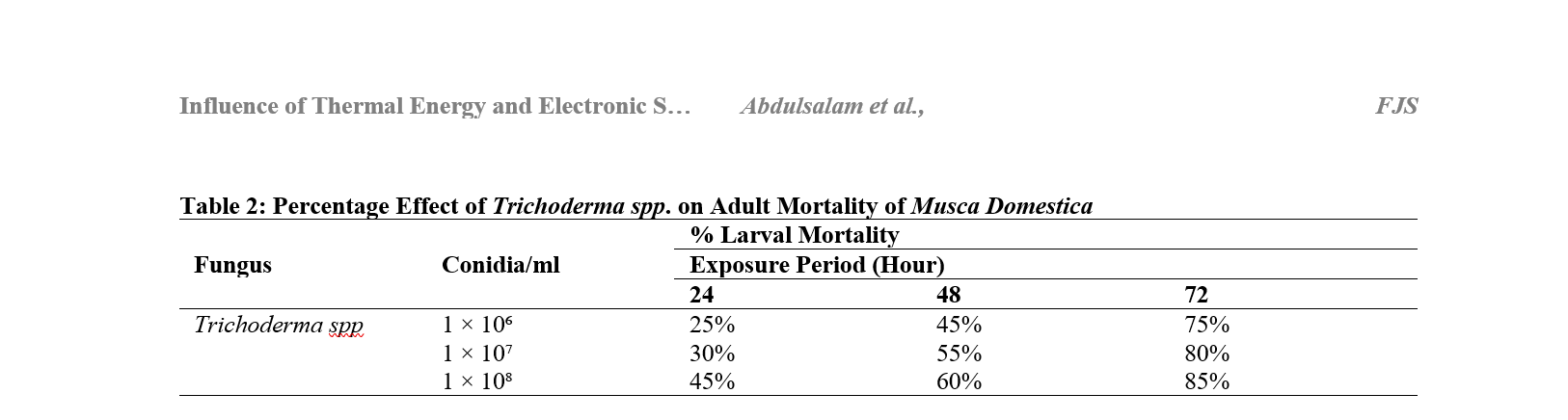
The housefly (Musca domestica L.) is an important mechanical vector of numerous pathogens affecting both humans and animals. The increasing development of resistance to synthetic insecticides and growing environmental concerns have stimulated interest in biological control agents such as entomopathogenic fungi. This study evaluated the larvicidal and adulticidal activities of an indigenous isolate of Trichoderma spp. against housefly larvae and adults under laboratory conditions. Different concentrations of fungal conidial suspensions (1x10⁶, 1x10⁷, and 1x10⁸ conidia/mL) were prepared and applied to 2ndinstar larvae and 10-day old adults of housefly. Mortality was recorded at 24-, 48-, and 72hour intervals and lethal time values (LT50) were determined. Results showed that Trichoderma spp. caused significant mortality in both larval and adult stages of Musca domestica, with mortality increasing with concentration and exposure period. Higher concentrations (75%) produced significantly greater mortality and shorter lethal times than lower concentrations. The findings indicate that indigenous Trichoderma spp. possesses considerable entomopathogenic potential against houseflies and may serve as an environmentally friendly alternative for housefly management. Further studies are recommended to evaluate its field performance and formulation for large-scale application.
References
Al-Olayan, E. M. (2013). Evaluation of pathogenicity of certain mitosporic ascomycete fungi to the house fly, Musca domestica L. (Diptera: Muscidae). Journal of Saudi Chemical Society, 17(1), 97–100. https://doi.org/10.1016/j.jscs.2011.11.019
Bilgo, E., Lovett, B., St. Leger, R. J., Sanon, A., Dabiré, R. K., & Diabaté, A. (2018). Native entomopathogenic Metarhizium spp. from Burkina Faso and their virulence against the malaria vector Anopheles coluzzii and non-target insects. Parasites & Vectors, 11, 209. https://doi.org/10.1186/s13071-018-2796-6
Butler, S. M., R. D. Moon, N. C. Hinkle, J. G. Millar, J. S. McElfresh, and B. A. Mullens. (2013). Gonotrophic developmet and survival in field populations of Musca domestica (Diptera: Musidae) at dairies in California, Minnesota, and Georgia, and the relationship of fly age to relative abundance of (Z)-9-tricosene (muscalure). Med. Entomol. 50:748-757.
Butt, T. M., Jackson, C., & Magan, N. (2001). Fungi as biocontrol agents: progress, problems, and potentials. CABI Publishing.
Fan, Y., Fang, W., Guo, S., Pei, X., Zhang, Y., Xiao, Y., Li, D., Jin, K., Bidochka, M. J., & Pei, Y. (2007). Increased insect virulence in Beauveria bassiana strains overexpressing an engineered chitinase. Applied and Environmental Microbiology, 73(1), 185–191. https://doi.org/10.1128/AEM.01974-06
Hogsette, J. A., Kaufman, P. E., and Weeks, E. N. I. (2021). Biology and management of Houseflies (Musca domestica L.). Insects, 12(3), 221.
Humber, R. A. (2012). Identification of entomopathogenic fungi. In L. A. Lacey (Ed.), Manual of techniques in invertebrate pathology (2nd ed., pp. 151–187). Academic Press. https://doi.org/10.1016/B978-0-12-386899-2.00006-3
Hussein SA, John LC. (2014). Housefly, Musca domestica Linnaeus (Insecta: Diptera: Muscidae). Inst Food Agric Scie.; 47:1–7.
Khan, M. A., Iqbal, N., Ali, S. (2023). Morphological and biological characteristics of Musca domestica (Diptera:Muscidae) reared under laboratory conditions. Journal of Entomological Research, 47(2), 305-313.
Khan, S., Guo, L., Maimaiti, Y., Mijit, M., & Qiu, D. (2012). Entomopathogenic fungi as microbial biocontrol agent. Molecular Plant Breeding, 3(7), 63–79. https://doi.org/10.5376/mpb.2012.03.0007
Lacey, L. A., Grzywacz, D., Shapiro-Ilan, D. I., Frutos, R., Brownbridge, M., & Goettel, M. S. (2015). Insect pathogens as biological control agents: Back to the future. Journal of Invertebrate Pathology, 132, 1–41. https://doi.org/10.1016/j.jip.2015.07.009
Malik, A., Singh, N., & Satya, S. (2007). House fly (Musca domestica): A review of control strategies for a challenging pest. Journal of Environmental Science and Health, Part B, 42(4), 453–469. https://doi.org/10.1080/03601230701316481
Miller, A. L. E., Tindall, K., & Leonard, B. R. (2010). Bioassays for monitoring insecticide resistance. Journal of Visualized Experiments (JoVE), (46), e2129. https://doi.org/10.3791/2129
Ownley, B. H., Gwinn, K. D., and Vega, F. E. (2010). Endophytic fungal entomopathogens with activity against plant pathogens: ecology and evolution. Bio Control 55, 113–128. https://doi.org/10.1007/s10526-009-9241-x
Phoku JZ, Barnard TG, Potgieter N, Dutton MF. (2016). Fungal dissemination by housefly (Musca domestica L.) and contamination of food commodities in rural areas of South Africa. Int J Food Microbiol. 2016; 217:177–81.
Sani, I., Jamian, S., Saad, N., Abdullah, S., Mohd Hata, E., Jalinas, J., & Ismail, S. I. (2023). Inoculation and colonization of the entomopathogenic fungi, Isaria javanica and Purpureocillium lilacinum, in tomato plants, and their effect on seedling growth, mortality and adult emergence of Bemisia tabaci (Gennadius). PLOS ONE, 18(5), e0285666. https://doi.org/10.1371/journal.pone.0285666
Sarwar M. (2015). Insect Vectors Involving in Mechanical Transmission of Human Pathogens for Serious Diseases. Int J Bioinformatics Biomed Engineering. 2015;1(3):300–6.
Sukontason K., Bunchoo M., Khantawa B., Sukontason K., Piangjai S. and Choochote W. (2000). Musca domestica as a mechanical carrier of bacteria in Chiang Mai, North Thailand. J. Vector Ecol., 25:114 117.
Yap, K. L., Kalpana, M. and Lee, H. L. (2008). Wings of the common house fly (Musca domestica L.): importance in mechanical transmission of Vibrio cholerae. Trop. Biomed. 25: 1–8.
Zarrin, M., Vazirianzadeh, B., Shams Solary, S., Zarei Mahmoudabadi, A., & Rahdar, M. (2007). Isolation of fungi from housefly (Musca domestica) in Ahwaz, Iran. Pakistani journal of medical sciences, 23(6), 917-919.
Downloads
Published
Issue
Section
Categories
License
Copyright (c) 2026 Zainab Tanimu Babale, Ibrahim Sani, Fatima Iyal Sada, Mohammed Suleiman, Hassana Yunusa Lawal, Abdullahi Shehu Iliya, Habiba Zakari Haruna

This work is licensed under a Creative Commons Attribution 4.0 International License.


