
Assessment of Microplastic Pollution, Seasonal Dynamic and Polymer Composition in Water, Sediment, and Fish from Mairuwa Reservoir, Funtua, Katsina Northwestern Nigeria
DOI:
https://doi.org/10.33003/fjs-2026-1012-5639Keywords:
Microplastics, Freshwater, Pollution, FTIR spectroscopy, Polymer characterizationAbstract
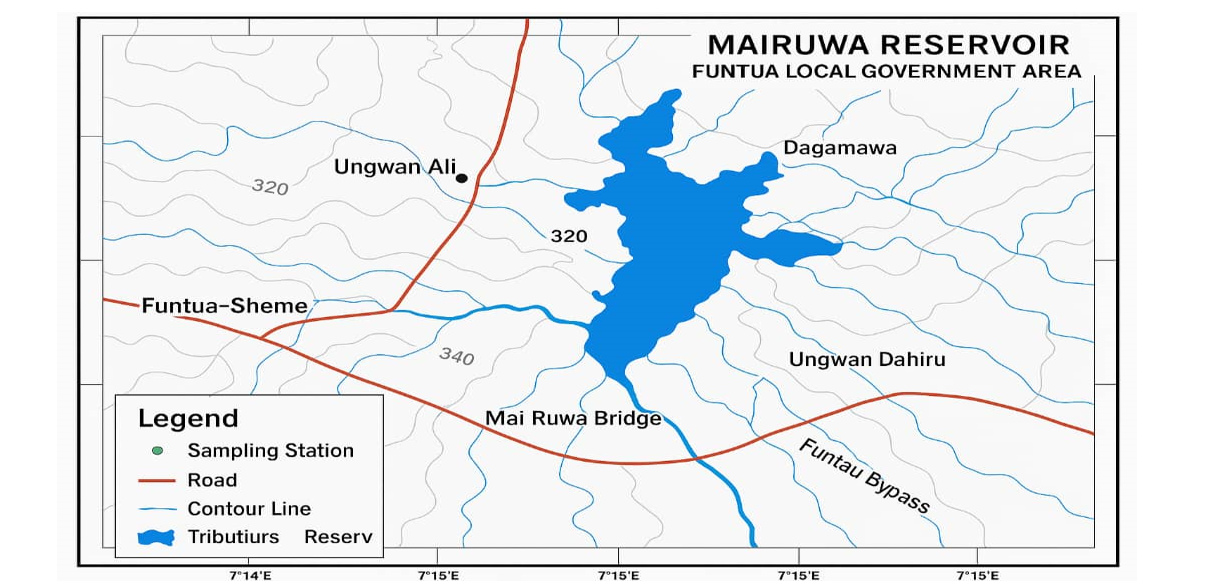
Microplastic (MP) pollution has emerged as a critical global environmental challenge, yet empirical data from Nigerian freshwater ecosystems remain scarce. This study evaluated microplastic contamination in Mairuwa Reservoir, Katsina State, Nigeria, across six months (April–September 2025). Water, sediment, and fish samples (Clarias gariepinus and Oreochromis niloticus) from nine stations were analyzed using wet peroxide oxidation, density separation, vacuum filtration, and Fourier-transform infrared spectroscopy (FTIR). Physicochemical analysis revealed significant seasonal variation: temperature decreased from 34.00°C to 27.70°C. Turbidity peaked at 75.56 NTU, dissolved oxygen declined from 6.44 to 3.09 mg/L, pH remained alkaline (8.00–9.71). Total MP concentrations were 307 counts/L (water), 272 counts/kg (sediment), 298 counts/fish (C. gariepinus), and 253 counts/fish (O. niloticus). FTIR identified six polymers: polyethylene (PE), polypropylene (PP), polyethylene terephthalate (PET), polystyrene (PS), polyamide (PA/nylon), and polyvinyl chloride (PVC). Distinct distribution patterns emerged: water was dominated by PET (18.57%) and PP (18.24%); sediment by PA (22.06%) and PE (21.32%); C. gariepinus by PS (19.80%) and PVC (17.11%); and O. niloticus by PET (19.37%) and PA (20.95%). Water ingestion posed the highest risk, approximately ten times higher than fish consumption. The study concludes that Mairuwa Reservoir is significantly contaminated with microplastics originating from packaging materials, textile fibers, and fishing gear, with seasonal runoff exacerbating pollution during rainy months. Urgent interventions including water filtration, improved plastic waste management, and regulatory frameworks are recommended to safeguard public health and the reservoir ecosystem.
References
Amana, R. A., Adeyemi, S. O., and Olayinka, K. O. (2025). Microplastic contamination in Clarias gariepinus and Oreochromis niloticus from River Niger, Lokoja, Nigeria: Species-specific accumulation and health risks. Journal of Aquatic Pollution and Toxicology, 12(3), 45–59.
Anderson, P. J., Warrack, S., Langen, V., Challis, J. K., Hanson, M. L., and Rennie, M. D. (2017). Microplastic contamination in Lake Winnipeg, Canada. Environmental Pollution, 225, 223–231.
Annisa, R., Kusumawati, D., and Prayogo, T. (2024). Microplastic distribution in Martapura River, South Kalimantan: Polymer characterization and species-specific accumulation. Indonesian Journal of Environmental Science, 18(2), 112–125.
APHA. (2017). Standard methods for the examination of water and wastewater (23rd ed.). American Public Health Association.
Atugoda, T., Vithanage, M., Wijesekara, H., Bolan, N., Sarmah, A. K., Bank, M. S., You, S., and Ok, Y. S. (2021). Interactions between microplastics, pharmaceuticals and personal care products: Implications for vector transport. Environment International, 149, 106367.
Barboza, L. G. A., Vieira, L. R., Branco, V., Figueiredo, N., Carvalho, F., Carvalho, C., and Guilhermino, L. (2023). Microplastics in sediments of a tropical estuary: Distribution, polymer types, and ecological risk. Marine Pollution Bulletin, 186, 114456.
Brachner, A., Fragouli, D., Duarte, I. F., Farias, P. M. A., Dembski, S., Ghosh, M., Barisic, I., Zdzieblo, D., and Vanoirbeek, J. (2020). Assessment of human health risks posed by nano-and microplastics: Current knowledge and future perspectives. Toxics, 8(4), 102.
Carbery, M., O'Connor, W., and Palanisami, T. (2018). Trophic transfer of microplastics and mixed contaminants in the marine food web and implications for human health. Environment International, 115, 400–409.
Castro-Jiménez, J., González-Fernández, D., Fornier, M., Schmidt, N., and Sempéré, R. (2019). Macro-litter in surface waters from the Rhone River: Plastic pollution and loading to the NW Mediterranean Sea. Marine Pollution Bulletin, 146, 60–66.
Collard, F., Gilbert, B., Eppe, G., Parmentier, E., and Das, K. (2015). Detection of anthropogenic particles in fish stomachs: An isolation method adapted to identification by Raman spectroscopy. Archives of Environmental Contamination and Toxicology, 69(3), 331–339.
Di, M., and Wang, J. (2018). Microplastics in surface waters and sediments of the Three Gorges Reservoir, China. Science of the Total Environment, 616–617, 1620–1627.
Dris, R., Gasperi, J., Saad, M., Mirande, C., and Tassin, B. (2016). Synthetic fibers in atmospheric fallout: A source of microplastics in the environment? Marine Pollution Bulletin, 104(1–2), 290–293.
Eerkes-Medrano, D., Thompson, R. C., and Aldridge, D. C. (2015). Microplastics in freshwater systems: A review of the emerging threats, identification of knowledge gaps and prioritisation of research needs. Water Research, 75, 63–82.
Emenike, E. C., Okonkwo, C. O., and Ogunlaja, O. O. (2023). Microplastic contamination in African aquatic systems: A review of sources, pathways, and ecological impacts. Environmental Science and Pollution Research, 30(15), 43215–43235.
Espinosa, C., García Beltrán, J. M., Esteban, M. Á., and Cuesta, A. (2016). In vitro effects of virgin microplastics on fish head-kidney leucocyte activities. Environmental Pollution, 214, 404–410.
Fischer, M., Scholz-Böttcher, B. M., and Fischer, D. (2020). Microplastic analysis in sediments: A comparative study of density separation techniques. Analytical Methods, 12(42), 5085–5095.
Geyer, R., Jambeck, J. R., and Law, K. L. (2017). Production, use, and fate of all plastics ever made. Science Advances, 3(7), e1700782.
Godoy, V., Blázquez, G., Calero, M., Quesada, L., and Martín-Lara, M. Á. (2019). The potential of microplastics as carriers of metals. Environmental Pollution, 255, 113363.
Iyare, P. U., Ouki, S. K., and Bond, T. (2020). Microplastics removal in wastewater treatment plants: A critical review. Environmental Science: Water Research and Technology, 6(10), 2664–2679.
Joystu, D., and Moharana, S. (2018). Plastic waste management and sustainable environment. Springer.
Klein, S., Worch, E., and Knepper, T. P. (2015). Occurrence and spatial distribution of microplastics in river shore sediments of the Rhine-Main area in Germany. Environmental Science and Technology, 49(10), 6070–6076.
Koelmans, A. A., Mohamed Nor, N. H., Hermsen, E., Kooi, M., Mintenig, S. M., and De France, J. (2019). Microplastics in freshwaters and drinking water: Critical review and assessment of data quality. Water Research, 155, 410–422.
Kumar, M., Xiong, X., He, M., Tsang, D. C. W., Gupta, J., Khan, E., Harrad, S., Hou, D., and Ok, Y. S. (2020). Microplastics as pollutants in agricultural soils. Environmental Pollution, 265, 114980.
Kutralam-Muniasamy, G., Pérez-Guevara, F., Elizalde-Martínez, I., and Shruti, V. C. (2023). Microplastic contamination in freshwater systems: Methodological challenges and emerging trends. TrAC Trends in Analytical Chemistry, 158, 116887.
Leng, J., Mukhtar, A., and Abbas, A. (2018). Polyethylene terephthalate: Production, properties and global market. Polymer Engineering and Science, 58(8), 1271–1285.
Li, C., Busquets, R., and Campos, L. C. (2020). Assessment of microplastics in freshwater systems: A review. Science of the Total Environment, 707, 135578.
Lithner, D., Larsson, Å. and Dave, G. (2011). Environmental and health hazard ranking and assessment of plastic polymers based on chemical composition. Science of the Total Environment, 409(18), 3309–3324.
Mani, T., Hauk, A., Walter, U., and Burkhardt-Holm, P. (2019). Microplastics profile along the Rhine River. Scientific Reports, 9(1), 1–11.
Masura, J., Baker, J., Foster, G., and Arthur, C. (2015). Laboratory methods for the analysis of microplastics in the marine environment: Recommendations for quantifying synthetic particles in waters and sediments. NOAA Technical Memorandum NOS-ORandR-48.
Maulidah, S., Nugroho, A. P., and Wulandari, D. (2025). Microplastic abundance and distribution in Kedung Ombo Reservoir, Central Java, Indonesia. Journal of Environmental Management, 334, 117456.
Mendoza, A., Osa, J., Basurko, O. C., Rubio, A., Santos, M., and Gago, J. (2019). Microplastics in the Bay of Biscay: An overview. Marine Pollution Bulletin, 140, 256–263.
Mizraji, R., Ahmed, C., Silva, C., Bravo, S., and Munoz, M. (2017). Microplastic ingestion in fish from the Pacific coast of Colombia. Marine Pollution Bulletin, 122(1–2), 349–354.
Nizzetto, L., Bussi, G., Futter, M. N., Butterfield, D., and Whitehead, P. G. (2023). A theoretical assessment of microplastic transport in river catchments and the role of FTIR reference libraries. Water Research, 229, 119432.
Ogunola, O. S., Onada, O. A., and Falaye, A. E. (2018). Mitigation measures to avert the impacts of plastics and microplastics in the marine environment (a review). Environmental Science and Pollution Research, 25(10), 9293–9310.
Oladeji, O. S., Adewumi, A. A., and Ogunbanwo, O. M. (2025). Seasonal dynamics of microplastic pollution in Aarin River, Southwestern Nigeria. African Journal of Aquatic Science, 50(1), 78–92.
Ololade, I. A., Oladoja, N. A., and Ademola, A. A. (2024). Microplastic particles in river sediments and water of southwestern Nigeria: Insights on the occurrence, seasonal distribution, composition, and source apportionment. Environmental Science and Pollution Research. [DOI not provided]
Omoigberale, M. O., Biose, E., Aigbebemen, E. R., Enabulele, C. O., Awomodu, F., Orienvwen, K. P., and Joshua, C. H. (2025). Occurrence, distribution, and characteristics of microplastics in the sediment of the Ovia River, Benin City, Nigeria. NIPES - Journal of Energy Technology and Environment, 7(2), 83–103.
Onaji, M. O. (2025). Microplastic and phthalate esters occurrences in Oreochromis niloticus and Clarias gariepinus obtained from Lagos and Epe Lagoons [Master's thesis, Lead City University, Ibadan, Nigeria].
Ossa-Yepes, L. F., Botero-Botero, A., and Pérez-Rincón, M. (2025). Hydrological influence on microplastic distribution in a tropical Andean reservoir, Colombia. Environmental Monitoring and Assessment, 197(3), 210.
Ragusa, A., Svelato, A., Santacroce, C., Catalano, P., Notarstefano, V., Carnevali, O., Papa, F., Rongioletti, M. C. A., Baiocco, F., Draghi, S., D'Amore, E., Rinaldo, D., Matta, M., and Giorgini, E. (2021). Plasticenta: First evidence of microplastics in human placenta. Environment International, 146, 106274.
Rochman, C. M., Brookson, C., Bikker, J., Djuric, N., Earn, A., Bucci, K., Athey, S., Huntington, A., McIlwraith, H., Munno, K., De Frond, H., Kolomijeca, A., Erdle, L., Grbic, J., Bayoumi, M., Borrelle, S. B., Wu, T., Santoro, S., Werbowski, L. M., ... and Hung, C. (2019). Rethinking microplastics as a diverse contaminant suite. Environmental Toxicology and Chemistry, 38(4), 703–711.
Rochman, C. M., Hoh, E., Kurobe, T., and Teh, S. J. (2013). Ingested plastic transfers’ hazardous chemicals to fish and induces hepatic stress. Scientific Reports, 3(1), 3263.
Silva, A. B., Bastos, A. S., Justino, C. I. L., da Costa, J. P., Duarte, A. C., and Rocha-Santos, T. A. P. (2018). Microplastics in the environment: Challenges in analytical chemistry. TrAC Trends in Analytical Chemistry, 101, 23–31.
Silva, L. G., Oliveira, M. C., and Souza, F. M. (2022). Sample collection and preservation for microplastic analysis in freshwater systems. MethodsX, 9, 101678.
Su, L., Xue, Y., Li, L., Yang, D., Kolandhasamy, P., Li, D., and Shi, H. (2016). Microplastics in Taihu Lake, China. Environmental Pollution, 216, 711–719.
UNEP. (2009). Converting waste plastics into a resource: Assessment guidelines. United Nations Environment Programme.
USGS. (2016). National field manual for the collection of water-quality data. U.S. Geological Survey Techniques of Water-Resources Investigations, Book 9.
Vanapalli, K. R., Sharma, H. B., Ranjan, V. P., Samal, B., Bhattacharya, J., Dubey, B. K., and Goel, S. (2021). Challenges and strategies for effective plastic waste management in India and beyond. Journal of Environmental Management, 293, 112875.
Wang, C., Zhao, J., and Xing, B. (2021). Environmental source, fate, and toxicity of microplastics. Journal of Hazardous Materials, 407, 124357.
Wang, W., Wang, J., and Zhang, Y. (2023). Methodological advances in microplastic sampling and extraction from freshwater matrices. Chemosphere, 313, 137456.
WHO. (2011). Guidelines for drinking-water quality (4th ed.). World Health Organization.
Wong, J. K. H., Lee, K. K., Tang, K. H. D., and Yap, P. S. (2020). Microplastics in the freshwater and terrestrial environments: Prevalence, fates, impacts and sustainable solutions. Science of the Total Environment, 719, 137512.
Xiang, Y., Jiang, L., Zhou, Y., Luo, Z., Zhi, D., Yang, J., and Lam, S. S. (2022). Microplastics in freshwater sediments: A review on methods, occurrence, and emerging challenges. Journal of Hazardous Materials, 424, 127482.
Yahaya, A., Lawal, M., and Umar, B. (2024). Physicochemical parameters and microplastic contamination in Birnin Kebbi rivers, Nigeria. Nigerian Journal of Environmental Sciences, 9(2), 101–115.
Yang, X., Bui, X. T., and You, S. (2023). Wet peroxide oxidation for organic matter removal in microplastic analysis of water samples. Environmental Nanotechnology, Monitoring and Management, 19, 100789.
Zhang, K., Xiong, X., Hu, H., Wu, C., Bi, Y., Wu, Y., Zhou, B., Lam, P. K. S., and Liu, J. (2022). Microplastic pollution in China's inland water systems: A review of findings, methods, characteristics, effects, and management. Science of the Total Environment, 814, 152568.
Zhang, S., Wang, J., Liu, X., Qu, F., Wang, X., Wang, X., Li, Y., and Sun, Y. (2023). Microplastics in the freshwater environment: A review of detection methods and occurrence. Chemosphere, 311, 137092.
Downloads
Published
Issue
Section
Categories
License
Copyright (c) 2026 Muhammad Sulaiman, Usman Lawal Usman, Badamasi Mudassir, Aliyu Abdullahi Salisu

This work is licensed under a Creative Commons Attribution 4.0 International License.


