
Effects of Sodium Azide (NaN₃) on Germination and Yield Parameters of Sweet Pepper (Capsicum annuum), Cabbage (Brassica oleracea), and Sweet Potato (Ipomoea batatas)
DOI:
https://doi.org/10.33003/fjs-2026-1013-5731Keywords:
Sodium Azide, Capsicum annuum, Brassica oleracea, Ipomoea batatas, Germination, Yield ParametersAbstract
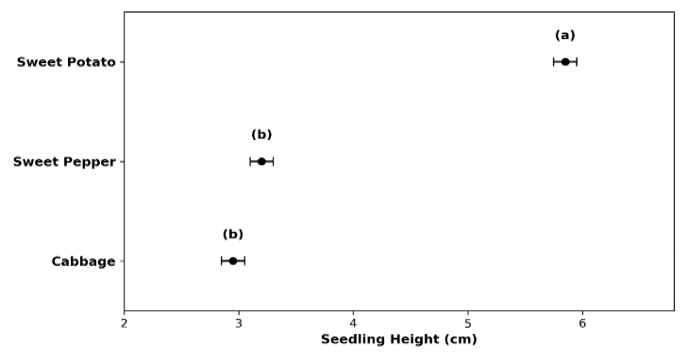
This research examined the impact of varying concentrations of sodium azide (NaN₃) at 0.5, 1.0, and 1.5 mM on the germination, growth, and yield of sweet pepper, cabbage, and sweet potato. The study was carried out in a screen house utilising a completely randomised pot design with three replications, where treated seeds and vine cuttings were evaluated over a period of eight weeks. The results from ANOVA indicated highly significant differences specific to each species (p < 0.001) across all measured parameters, with the type of crop having the most substantial effect on plant height (F = 793.447), root length (F = 2045.677), and biomass. Additionally, sodium azide concentration had a significant impact on root length (F = 23.754, p < 0.001) and exhibited near-significant effects on biomass (p = 0.085–0.100), suggesting physiological responses that are dependent on the dosage. The germination rate was not significantly affected (p = 0.322), indicating that the concentrations applied were below the levels that would inhibit germination. The results illustrate that sodium azide can induce noticeable phenotypic variation with distinct species-specific responses. These findings endorse sodium azide as a potent mutagenic agent for fostering genetic diversity in crop enhancement initiatives.
References
Agbo, E. P., Ettah, E. B., and Eno, E. E. (2021). The impacts of meteorological parameters on the seasonal, monthly, and annual variation of radio refractivity: EP Agbo et al. Indian Journal of Physics, 95(2), 195-207.
Animasaun, D.A., Oyedeji, S., Azeez, M.A., and Onasanya, A. (2014). Alkylating efficiency of sodium azide on pod yield, nut size and nutrition composition of Samnut 10 and Samnut 20 varieties of groundnut (Arachis hypogea L.). African Journal of Food, Agriculture, Nutrition and Development, 14, 9497–9510.
Ati, H.M., Chiroma, I.A., and Ahmed, A.A. (2025). Stimulating genetic variability on growth and yield of Okra (Abelmoschus esculentus) using Sodium Azide. Journal of Basics and Applied Sciences Research, 1(1), 9–15.
Bado, S., Forster, B. P., Nielen, S., Ali, A. M., Lagoda, P. J., Till, B. J., and Laimer, M. (2015). Plant mutation breeding: current progress and future assessment. Plant Breeding Reviews, 39: 23-88.
Beck, A., and Teboulle, M. (2009). A fast iterative shrinkage-thresholding algorithm for linear inverse problems. SIAM journal on imaging sciences, 2(1), 183-202.
Bernardi, G., de Bruyn, A. G., Brentjens, M. A., Ciardi, B., Harker, G., Jelić, V., Koopmans, L. V. E., Labropoulos, P., Offringa, A., Pandey, V. N., Schaye, J., Thomas, R. M., Yatawatta, S., and Zaroubi, S. (2009). Foregrounds for observations of the cosmological 21 cm line: I. First Westerbork measurements of Galactic emission at 150 MHz in a low latitude field. Astronomy and Astrophysics, 500(3), 965–979.
Buacheen, P., Karinchai, J., Inthachat, W., Butkinaree, C., Jankam, C., Wongnoppavich, A., Imsumran, A., Chewonarin, T., Pimpha, N., Temviriyanukul, P., and Pitchakarn, P. (2023). The toxicological assessment of Anoectochilus burmannicus ethanolic-extract-synthesized selenium nanoparticles using cell culture, bacteria, and Drosophila melanogaster as suitable models. Nanomaterials, 13(20), Article 2804.
Capiz, Z.N. (2017). Induction of mutation in sweetpotato (Ipomoea batatas) using sodium azide and characterization of the putative mutants. Undergraduate thesis, University of the Philippines Los Baños.
Ceballos, H., Kawuki, R. S., Gracen, V. E., Yencho, G. C., and Hershey, C. H. (2015). Conventional breeding, marker-assisted selection, genomic selection and inbreeding in clonally propagated crops: a case study for cassava. Theoretical and Applied Genetics, 128(9), 1647-1667.
Costa, A. S., Dias, L. S., and Dias, A. S. (2019). Imbibition, germination, and early seedling growth responses of light purple and yellow seeds of red clover to distilled water, sodium chloride, and nutrient solution. Sci, 1(2), 51.
Dahot, M.U., Rafiq, M., Arif, A.M. and Naqvi, S.H.A. (2009). Effect of sodium azide on the growth of Capsicum annuum (Chili). Pakistan Journal of Biotechnology, 9(1), 61–74.
De Vita, P., and Taranto, F. (2019). Durum wheat (Triticum turgidum ssp. durum) breeding to meet the challenge of climate change. In Advances in Plant Breeding Strategies: Cereals: Volume 5 (pp. 471-524). Cham: Springer International Publishing.
Eldengawy, E., Gawish, M. S., and Farrag, M. (2026). Effect of Treating Seeds with Gamma Rays and Sodium Azide on Seed Germination, Resulting Plant Growth, Flowering, and Fruit Properties in Papaya cv (Solo). Damietta Journal of Agricultural Sciences, 5(2), 178-192.
Forneck, A. (2005). Plant breeding: clonality—a concept for stability and variability during vegetative propagation. In Progress in Botany: Genetics Physiology Systematics Ecology (pp. 164-183). Berlin, Heidelberg: Springer Berlin Heidelberg.
Freinbichler, W., Colivicchi, M. A., Stefanini, C., Bianchi, L., Ballini, C., Misini, B., Weinberger, P., Linert, W., Varešlija, D., Tipton, K. F., and Della Corte, L. (2011). Highly reactive oxygen species: Detection, formation, and possible functions. Cellular and Molecular Life Sciences, 68(12), 2067–2079. https://doi.org/10.1007/s00018-011-0682-x
Graber, E. R., Meller Harel, Y., Kolton, M., Cytryn, E., Silber, A., Rav David, D., Tsechansky, L., Borenshtein, M., and Elad, Y. (2010). Biochar impact on development and productivity of pepper and tomato grown in fertigated soilless media. Plant and Soil, 337(1), 481–496. https://doi.org/10.1007/s11104-010-0544-6
Halewood, M., Chiurugwi, T., Sackville Hamilton, R., Kurtz, B., Marden, E., Welch, E., and Powell, W. (2018). Plant genetic resources for food and agriculture: opportunities and challenges emerging from the science and information technology revolution. New Phytologist, 217(4), 1407-1419.
Hussain, S., Khan, W. M., Khan, M. S., Akhtar, N., Umar, N., Ali, S., and Shah, S. S. (2017). Mutagenic effect of sodium azide (NaN₃) on M2 generation of Brassica napus L.(variety Dunkled). Pure and Applied Biology (PAB), 6(1), 226-236.
Ibeh, A. G., Udechukwu, C. D., and Ofoegbu, J. N. G. (2024). Evaluating the lethal dose and mutagenic effects of sodium azide on germination and quality traits in two varieties of tomato (Solanum lycopersicum). UMYU Scientifica, 3(4), 57–62. https://doi.org/10.56919/usci.2434.006
Ilhan, E., Kasapoglu, A. G., Turkoglu, A., Aygoren, A. S., Muslu, S., Aydin, M., Aldaif, M., and Haliloglu, K. (2023). Evaluation of sodium azide as a chemical mutagen in developing cold-tolerant quinoa (Chenopodium quinoa Willd.) lines. Iranian Journal of Science, 47(3), 663–671. https://doi.org/10.1007/s40995-023-01452-4
Ilyushina, N. A. (2019). Assessment of the equivalence of technical materials of analogous pesticides to original active substances on the basis of “mutagenicity” criterion. Ecological genetics, 17(2), 101-112.
Jankowicz-Cieslak, J., Mba, C., and Till, B. J. (2016). Mutagenesis for crop breeding and functional genomics. In Biotechnologies for plant mutation breeding: protocols (pp. 3-18). Cham: Springer International Publishing.
Juan, C. A., Pérez de la Lastra, J. M., Plou, F. J., and Pérez-Lebeña, E. (2021). The chemistry of reactive oxygen species (ROS) revisited: outlining their role in biological macromolecules (DNA, lipids and proteins) and induced pathologies. International journal of molecular sciences, 22(9), 4642.
Junker, A., Muraya, M. M., Weigelt-Fischer, K., Arana-Ceballos, F., Klukas, C., Melchinger, A. E., Meyer, R. C., and Altmann, T. (2015). Optimizing experimental procedures for quantitative evaluation of crop plant performance in high-throughput phenotyping systems. Frontiers in Plant Science, 5, Article 770. https://doi.org/10.3389/fpls.2014.00770
Khan, R., Punia, S. S., Dalip, Ram, M., Gupta, D., Bhatt, B., Ahmad, S., Dheer, M., Rajput, S. S., and Kumawat, G. L. (2024). Determination of lethal dose and sensitivity of fenugreek (Trigonella foenum-graecum) to sodium azide for induction of mutation. The Indian Journal of Agricultural Sciences, 94(4), 440–443. https://doi.org/10.56093/ijas.v94i4.134877
Khan, S., Al-Qurainy, F., and Anwar, F. (2009). Sodium azide: A chemical mutagen for enhancement of agronomic traits of crop plants. International Journal of Science & Technology, 4, 1–21.
Kohanski, M. A., DePristo, M. A., and Collins, J. J. (2010). Sublethal antibiotic treatment leads to multidrug resistance via radical-induced mutagenesis. Molecular cell, 37(3), 311-320.
Kumawat, S., Rana, N., Bansal, R., Vishwakarma, G., Mehetre, S. T., Das, B. K., Kumar, M., Yadav, S. K., Sonah, H., Sharma, T. R., and Deshmukh, R. (2019). Expanding avenue of fast neutron mediated mutagenesis for crop improvement. Plants, 8(6), Article 164. https://doi.org/10.3390/plants8060164
Lalusin, A. G., Heredia, A. C., Batalon-Gaviña, L. J., and Iranista, E. J. A. (2025). Genetic diversity of Philippine sweet potato (Ipomoea batatas L. Lam) germplasm using morphological and molecular markers. International Journal of Agricultural Technology, 21(6), 2329-2354.
Lenz, S., Karsten, P., Schulz, J. B., and Voigt, A. (2013). Drosophila as a screening tool to study human neurodegenerative diseases. Journal of neurochemistry, 127(4), 453-460.
Liu, J., Wang, X., Mitchell, T., Hu, Y., Liu, X., Dai, L., and Wang, G. L. (2010). Recent progress and understanding of the molecular mechanisms of the rice–Magnaporthe oryzae interaction. Molecular plant pathology, 11(3), 419-427.
Mba, C., Afza, R., Bado, S., and Jain, S. M. (2010). Induced mutagenesis in plants using physical and chemical agents. Plant cell culture: essential methods, 20(20), 111-130.
Melancon, M. J., Alscher, R., William, B., George, K., Lee, R. F., Sikka, H. C., and Spies, R. B. (2018). Metabolic products as biomarkers. In Biomarkers (pp. 87-124). CRC Press.
Mistry, V., Tiwari, P., Patel, P., Vishwakarma, G. S., Lee, G. J., and Sharma, A. (2022). Ethyl methane sulfonate and sodium azide-mediated chemical and X-ray-mediated physical mutagenesis positively regulate Peroxidase 1 gene activity and biosynthesis of antineoplastic vinblastine in Catharanthus roseus. Plants, 11(21), 2885.
Naaz, N., Choudhary, S., Sharma, N., Hasan, N., Al Shaye, N. A., and Abd El-Moneim, D. (2023). Frequency and spectrum of M2 mutants and genetic variability in cyto-agronomic characteristics of fenugreek induced by caffeine and sodium azide. Frontiers in Plant Science, 13, 1030772.
Naidoo, S., and Lorenzo, J.C. (2025). Technical considerations for use of sodium azide in plant biotechnology-assisted genetic improvement. Biologia, 80, 1939–1946.
Oladosu, Y., Rafii, M. Y., Abdullah, N., Hussin, G., Ramli, A., Rahim, H. A., and Usman, M. (2016). Principle and application of plant mutagenesis in crop improvement: a review. Biotechnology & Biotechnological Equipment, 30(1), 1-16.
Pama, R., Doronila, J., and Marutani, M. (2004). Comparison of Morphological and Genetic Characteristics of 15 Sweetpotato [Ipomoea batatas (L.) Lam] Accessions Grown on Guam. HortScience, 39(4), 773D-774.
Penna, S., Shirani Bidabadi, S., and Jain, S. M. (2023). Mutation breeding to promote sustainable agriculture and food security in the era of climate change. In Mutation breeding for sustainable food production and climate resilience (pp. 1-23). Singapore: Springer Nature Singapore.
Pour, A. H., Tosun, M., and Haliloğlu, K. (2023). Effect of sodium azide treatment at different duration and concentration on germination and seedling growth characters in wheat (Triticum aestivum L.). Erzincan University Journal of Science and Technology, 16(2), 406-422.
Prakash, A., and Paul, P. (2021). Recent trends in propagation of horticulture crops and application of Genomics tools in plant Breeding. Recent Trends in Propagation of Horticulture Crops; Taran Publication: New Delhi, India, 581-602.
rajam Srividya, A., Sangai Palanisamy Dhanabal, V., and Vishnuvarthan, J. (2012). Mutagenicity/Antimutagenicity of plant extracts used in traditional medicine: a review. World J Pharma Res, 2, 236-59.
Suprasanna, P., Mirajkar, S. J., and Bhagwat, S. G. (2015). Induced mutations and crop improvement. In Plant biology and biotechnology: volume I: plant diversity, organization, function and improvement (pp. 593-617). New Delhi: Springer India.
Talamè, V., Bovina, R., Sanguineti, M. C., Tuberosa, R., Lundqvist, U., and Salvi, S. (2008). TILLMore, a resource for the discovery of chemically induced mutants in barley. Plant Biotechnology Journal, 6(5), 477–485. https://doi.org/10.1111/j.1467-7652.2008.00341.x
Turanlı, H., Çoban, F., and Haliloğlu, K. (2025). Optimization of Sodium Azide Application in Black Cumin (Nigella sativa L.) and Determination of Agronomic Characteristics in M1 Generation. Turkish Journal of Agricultural and Natural Sciences, 12, 753–763.
Türkoğlu, A., Haliloğlu, K., Tosun, M., Szulc, P., Demirel, F., Eren, B., and Niedbała, G. (2023). Sodium azide as a chemical mutagen in wheat (Triticum aestivum L.): patterns of the genetic and epigenetic effects with iPBS and CRED-iPBS techniques. Agriculture, 13(6), 1242.
Van Hintum, T., and Wijker, E. (2024). Quality management in a genebank environment: Principles and experiences at the Centre for Genetic Resources, The Netherlands (CGN). In Genetic Resources (No. S2, pp. 6-12).
Wahid, A., Noreen, A., Basra, S. M., Gelani, S., and Farooq, M. (2008). Priming-induced metabolic changes in sunflower (Helianthus annuus) achenes improve germination and seedling growth. Botanical Studies, 49(2), 343-350.
Wani, A. A. (2011). Evaluation of sodium azide induced mutagenesis in pepper (Capsicum annuum L.). Research Journal of Botany, 6(3), 95–102.
Wani, M. R., Kozgar, M. I., Tomlekova, N., Khan, S., Kazi, A. G., Sheikh, S. A., and Ahmad, P. (2014). Mutation breeding: a novel technique for genetic improvement of pulse crops particularly Chickpea (Cicer arietinum L.). Improvement of Crops in the Era of Climatic Changes: Volume 2, 217-248.
Xu, L., Najeeb, U., Naeem, M. S., Wan, G. L., Jin, Z. L., Khan, F., and Zhou, W. J. (2011). In vitro mutagenesis and genetic improvement. In Technological Innovations in Major World Oil Crops, Volume 2: Perspectives (pp. 151-173). New York, NY: Springer New York.
Yafizham, A. and Herwibawa, B. (2018). The effects of sodium azide on seed germination and seedling growth of chili pepper (Capsicum annum L. cv. Landung). IOP Conference Series: Earth and Environmental Science, 102(1), Article 012052.
Yousof, F. I., Mersal, I. F., and El-Emam, A. A. M. (2010). Effect of soaking rice (Oryza sativa, L.) seed in some anitioxidants solutions on germination and seedling vigor under different salinity levels. Journal of Plant Production, 1(2), 279-290.
Zidenga, T., Leyva-Guerrero, E., Moon, H., Siritunga, D., and Sayre, R. (2012). Extending cassava root shelf life via reduction of reactive oxygen species production. Plant physiology, 159(4), 1396-1407.
Downloads
Published
Issue
Section
Categories
License
Copyright (c) 2026 Salisu Aliyu Abdullahi, Nasir Hassan Wagini, Kallimullahi Sagir, Usman Lawal Usman, Bawa Yusuf Muhammad, Sulaiman Muhammad

This work is licensed under a Creative Commons Attribution 4.0 International License.