
Comparative Assessment of Medicinal Plant Diversity in Agroforestry Systems and Open Farmlands in Northern Katsina State, Nigeria
DOI:
https://doi.org/10.33003/Keywords:
Medicinal plant, Agroforestry, Shannon-Weiner index, Ethnobotany, Biodiversity conservation, Semi-arid NigeriaAbstract
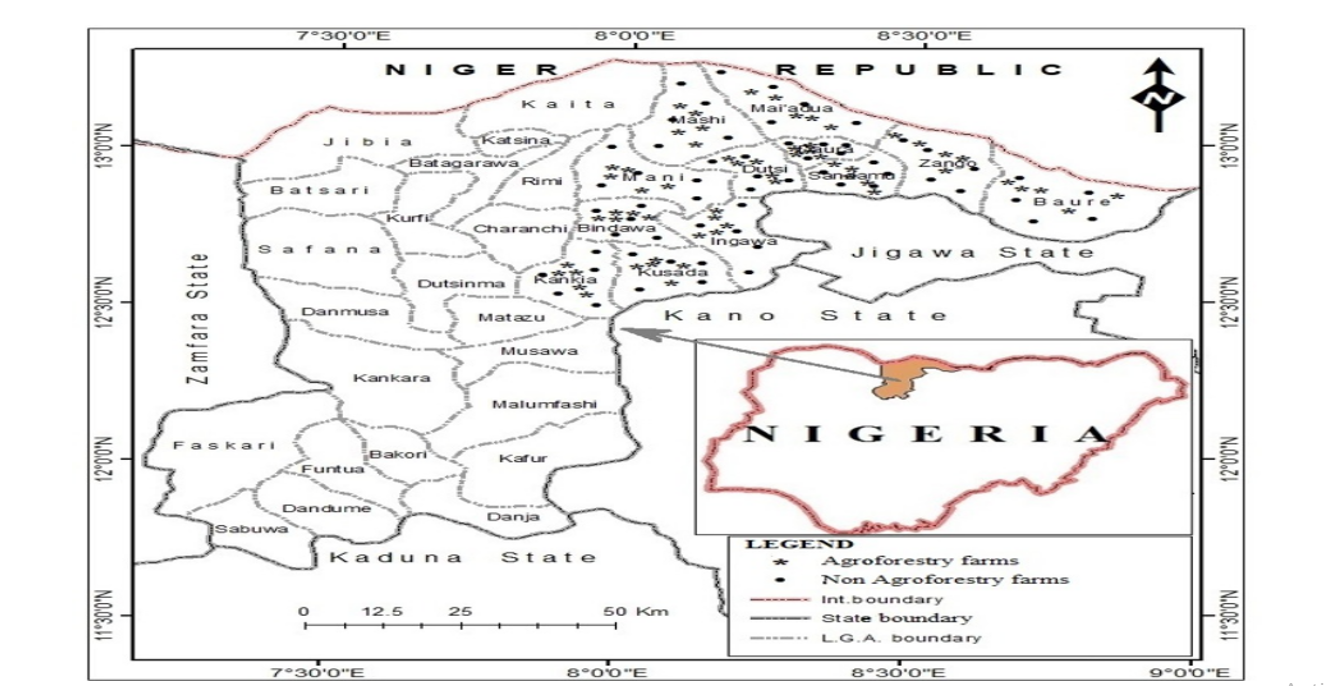
This study assessed medicinal plant diversity in agroforestry and open farmland systems in northern Katsina State, Nigeria. A comparative field-based approach was employed across parklands, homegardens and open farmlands using standard quadrat sampling methods for vegetation assessment. A total of 82 medicinal plant species belonging to 37 families were recorded. Species diversity was measured using the Shannon–Wiener index (H’), with parklands (H′ ≈ 1.75 ± 0.30) and homegardens (H′ ≈ 1.61 ± 0.44) showing higher diversity than open farmlands (H′ ≈ 0.91 ± 0.48). Welch’s ANOVA indicated a significant difference in medicinal plant diversity among land-use types (F (2, 105.58) = 69.65, p < 0.001). Post-hoc comparisons (Games-Howell test) revealed that both parklands and homegardens had significantly higher medicinal plant diversity than open farmlands. Significant difference was observed between parklands and homegardens. The findings conclude that agroforestry systems play an important role in conserving medicinal plant diversity in semi-arid environments, highlighting their value for biodiversity conservation and sustainable land management.
References
Akinnifesi, F. K., Ajayi, O. C., Sileshi, G., Chirwa, P. W., & Chianu, J. (2010). Fertilizer trees for sustainable food security in the maize-based production systems of East and Southern Africa: A review. Agronomy for Sustainable Development, 30(3), 615–629. https://doi.org/10.1051/agro/2009058
Bello, A., Jamaladdeen, S., Elder, M. T., Yaradua, S. S., Kankara, S. S., Wagini, N. H., Stirton, C. H., & Muasya, M. (2019). Threatened medicinal and economic plants of the Sudan Savanna in Katsina State, northwestern Nigeria. Bothalia – African Biodiversity & Conservation, 49(1), Article a2325. https://doi.org/10.4102/abc.v49i1.2325
Gidado, M. S., & Yaradua, S. S. (2024). Ethnobotanical survey of medicinal plants in Malumfashi Local Government Area, Northwestern Nigeria. Fountain Journal of Natural and Applied Sciences, 13(1), 47–61.
https://doi.org/10.53704/fujnas.v13i1.492
Ifunanya, O. L. (2024). Ethnobotanical survey and economic importance of medicinal plants in home gardens in Njikoka Local Government Area of Anambra State [Undergraduate project, Michael Okpara University of Agriculture, Umudike]. Michael Okpara University Repository.
International Society of Ethnobiology. (2006). Code of ethics (with 2008 additions). https://www.ethnobiology.net/code-of-ethics
Jose, S. (2009). Agroforestry for ecosystem services and environmental benefits: An overview. Agroforestry Systems, 76(1), 1–10. https://doi.org/10.1007/s10457-009-9229-7
Kankara, S. S., Ibrahim, M. H., Mustafa, M., & Go, R. (2015). Ethnobotanical survey of medicinal plants used for traditional maternal healthcare in Katsina State, Nigeria. South African Journal of Botany, 97, 165–175. https://doi.org/10.1016/j.sajb.2015.01.007
Kankara, S. S., Isah, A. B., Ahmad, A., Bello, A., & Lawal, U. (2018). Medicinal plants used for the management of hepatic ailments in Katsina State, Nigeria. Journal of Medicinal Plants Research, 12(24), 375–386. https://doi.org/10.5897/JMPR2018.6637
Kankara, S. S., Tukur, K., Bello, A., Lawal, U., & Bindawa, K. A. (2020). Medicinal plants used for complementary and alternative cancer therapy in Katsina State, Northwestern Nigeria. Tropical Journal of Natural Product Research, 4(9), 550–558. https://doi.org/10.26538/tjnpr/v4i9.21
Kankara, S. S., Nuhu, A. I., Haruna, M. R., Bindawa, K. A., Abubakar, I. B., & Bello, A. (2022). Indigenous traditional knowledge of medicinal plants used for the management of HIV/AIDS opportunistic infections in Katsina State, Nigeria. Ethnobotany Research and Applications, 23, 1–17. https://doi.org/10.32859/era.23.35.1-17
Kent, M. (2012). Vegetation description and data analysis: A practical approach (2nd ed.). Wiley-Blackwell.
Kumar, B. M., & Nair, P. K. R. (2004). The enigma of tropical homegardens. Agroforestry Systems, 61(1–3), 135–152. https://doi.org/10.1023/B:AGFO.0000028995.13227.ca
Maid, M., Mudi, T., Ding, A., Lajuni, G., & Kodoh, J. (2022). Diversity and composition of plant species in a communal agroforestry system at Manggatal, Sabah. IOP Conference Series: Earth and Environmental Science, 1053, Article 012021. https://doi.org/10.1088/1755-1315/1053/1/012021
Magurran, A. E. (2004). Measuring biological diversity. Blackwell Publishing.
Martin, G. J. (1995). Ethnobotany: A methods manual. Chapman & Hall.
Mbow, C., Smith, P., Skole, D., Duguma, L., & Bustamante, M. (2014). Achieving mitigation and adaptation to climate change through sustainable agroforestry practices in Africa. Current Opinion in Environmental Sustainability, 6, 8–14. https://doi.org/10.1016/j.cosust.2013.09.002
Nandy, S., & Das, A. K. (2013). Comparing tree diversity and population structure between a traditional agroforestry system and natural forests of Barak Valley, Northeast India. International Journal of Biodiversity Science, Ecosystem Services & Management, 9(2), 104–113. https://doi.org/10.1080/21513732.2012.748691
Nigerian Meteorological Agency. (2020). Annual climate review bulletin. Nigerian Meteorological Agency.
Odewo, S. A., Ajani, B. A., Agbeja, A. O., Oyedeji, O. F., Soyewo, L. T., Oyelowo, J. O., Williams, O. A., & Ogunkalu, O. A. (2022). Ethno-medicinal plants used in the treatment of human diseases in agroforestry farms in FRIN Arboretum, Ibadan, Oyo State, Nigeria. Journal of Research in Forestry, Wildlife and Environment, 14(3), 63–74.
Pandey, H. P., Pokhrel, N. P., Luitel, D. R., Acharya, K., & Shah, K. K. (2021). Diversity of agroforestry species and uses in two ecological regions: A case from central Nepal. Advances in Agriculture, 2021, Article 1198341. https://doi.org/10.1155/2021/1198341
Shanley, P., & Luz, L. (2003). The impacts of forest degradation on medicinal plant use and implications for health care in eastern Amazonia. BioScience, 53(6), 573–584. https://doi.org/10.1641/0006-3568
(2003)053[0573: TIOFDO] 2.0.CO; 2
Sofowora, A., Ogunbodede, E., & Onayade, A. (2013). The role and place of medicinal plants in the strategies for disease prevention. African Journal of Traditional, Complementary and Alternative Medicines, 10(5), 210–229. https://doi.org/10.4314/ajtcam.v10i5.2
Tadesse, E., Abdulkedir, A., Khamzina, A., Son, Y., & Noulèkoun, F. (2019). Contrasting species diversity and values in home gardens and traditional parkland agroforestry systems in Ethiopian sub-humid lowlands. Forests, 10(3), Article 266. https://doi.org/10.3390/f10030266
Tebkew, M., Asfaw, Z., Worku, A., & Jacobson, M. (2024). Contribution of agroforestry practices to income and poverty status of households in Northwestern Ethiopia. Discover Agriculture, 2, Article 48. https://doi.org/10.1007/s44279-024-00062-x
World Health Organization. (2013). WHO traditional medicine strategy: 2014–2023. World Health Organization.
Yasin, D., Ashine, S., & Asfaw, Z. (2022). Woody species diversity and farmers' preference in parkland agroforestry system in Benishangul Gumuz, Western Ethiopia. Journal of Ethiopian Agroforestry Sciences, 6(2), 75–87.
Yeboah, S. O., Abunyewa, A. A., & Nasare, L. I. (2022). Effect of land use on floristic composition and diversity of medicinal plants in the Guinea Savanna Zone of Ghana. Heliyon, 8. Advance online publication. https://doi.org/10.2139/ssrn.4085383
Zankan, J. A. A., Endas, L., Abubakar, Y. M., & Yakubu, I. B. (2019). Tree species density and diversity in Jema'a Local Government Area of Kaduna State, Nigeria. FUDMA Journal of Sciences, 3(2), 302–311.
Downloads
Published
Issue
Section
Categories
License
Copyright (c) 2026 Sulaiman Sani Kankara, Badiatu Sade Abdullahi, Nasiru Hassan Wagini, Usman Lawal Usman

This work is licensed under a Creative Commons Attribution 4.0 International License.


