
Assessment of Urban Traffic Characteristics, Vehicular Composition, and Stakeholder Perspectives on Emission Control in Major Cities of Nigeria
DOI:
https://doi.org/10.33003/fjs-2026-1011-5637Keywords:
Emissions, Traffic, Air pollution, Stakeholders, Control strategies, Urban transportAbstract
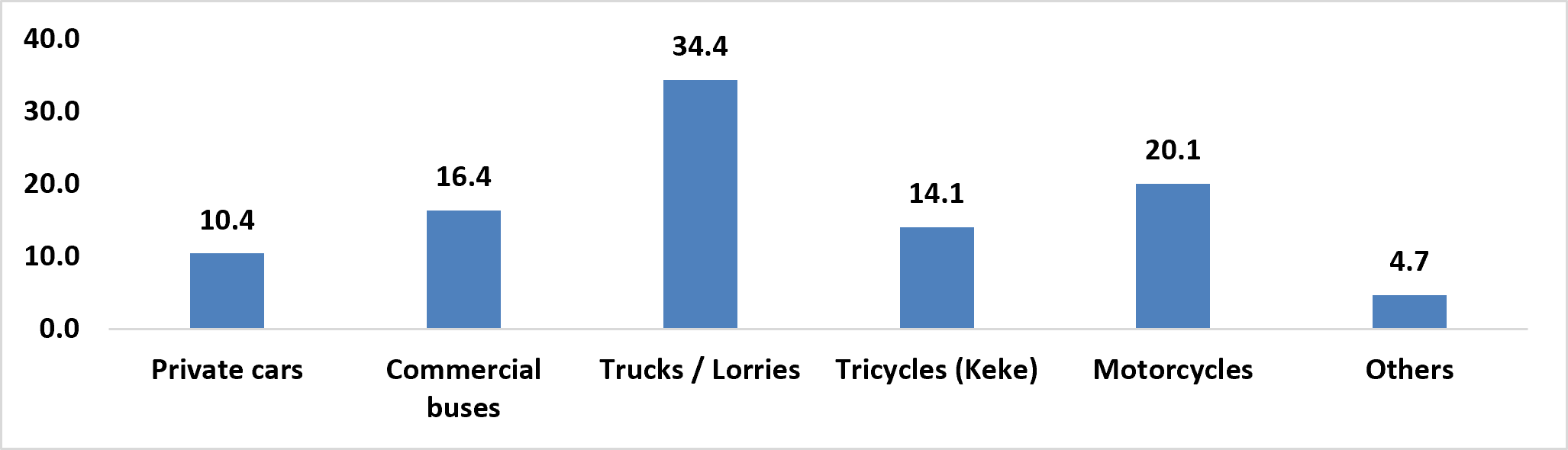
Rapid urbanisation and motorisation in Nigeria have intensified vehicular emissions, contributing to air pollution and associated health risks. This study examined traffic characteristics, vehicular composition, and stakeholder perspectives on emission control in three major cities: Abuja, Kano, and Lagos. It combines quantitative traffic counts conducted from 6:00 a.m. to 6:00 p.m. along key urban corridors with surveys of 384 stakeholders, including government officials, commercial vehicle operators, transport union members, auto technicians, environmental advocates, and urban residents. Traffic data were analyzed for daily, hourly, and directional patterns, while vehicular composition and Passenger Car Unit calculations were used to assess road capacity impact. Survey responses were analyzed using descriptive statistics to summarize awareness, perceptions of emission sources, policy adequacy, and preferred mitigation strategies. Results revealed peak traffic periods in the morning and evening, with Lagos–Ibadan Expressway recording the highest volumes. Cars, mini buses, and heavy-duty vehicles were the most prevalent, while heavy vehicles exerted disproportionate influence on congestion and emissions. Stakeholders identified old vehicles, poor fuel quality, and weak regulation as major emission contributors, with 70% supporting stricter emission control measures. Suggested interventions included vehicle emission testing, phasing out high-emission vehicles, promoting public transport, strengthening enforcement, and raising public awareness. The findings underscore the critical link between traffic dynamics, vehicle types, and urban air pollution, highlighting areas for targeted policy and operational interventions. Implementing recommended strategies can reduce emissions, improve air quality, and guide sustainable transport planning in Nigerian cities, contributing to environmental protection, public health, and urban mobility efficiency.
References
Ajayi, O. O., Afolabi, A. O., & Adewale, T. M. (2023). The impact of traffic mobility measures on vehicle emissions for heterogeneous traffic in Lagos City. Scientific African, 21, e01822. https://doi.org/10.1016/j.sciaf.2023.e01822
Adediran, S. A., Ojo, O. T., & Okafor, T. T. (2025). On road vehicular traffic emissions inventory and air quality on major roadways in Lagos City. African Transport Studies, 3, 100034. https://doi.org/10.1016/j.ats.2025.100034
Ayeni, T. S., & Iyeke, S. (2024). Evaluation of capacity and level of service for urban arterial road under mixed traffic conditions: A case study of Oba Adesida Road, Akure, Nigeria. Journal of Civil Engineering Science and Technology. https://publisher.unimas.my/ojs/index.php/JCEST/article/view/6412
International Energy Agency. (2024). Global EV outlook 2024: Moving towards increased affordability. IEA. https://www.iea.org/reports/global-ev-outlook-2024
IQAir. (2024). World air quality report 2023. IQAir. https://www.iqair.com/world-air-quality-report
Krejcie, R. V., & Morgan, D. W. (1970). Determining sample size for research activities. Educational and Psychological Measurement, 30(3), 607–610. https://doi.org/10.1177/001316447003000308
Onyeka, O. O., Ifeyinwa, O. C., Ernest, E., Adunola, I. B., & Onyinye, N. J. (2020). Out door air pollution levels in vehicular traffic junctions in Nsukka and Enugu Metropolis, Nigeria. Open Journal of Air Pollution, 9(4), 105–115. https://doi.org/10.4236/ojap.2020.94008
Subair, S. O., Ibitoye, B. A., & Kuranga, A. T. (2024). Evaluation of traffic congestion in urban roads: A review. ABUAD Journal of Engineering and Applied Sciences, 2(2), 1–7. https://journals.abuad.edu.ng/index.php/ajeas/article/view/809
United Nations Environment Programme. (2025). Global environment outlook 7. United Nations Environment Programme.
Wang, Q., Feng, H., Feng, H., Yu, Y., Li, J., Wang, J., Zhang, X., Liu, Y., & Chen, L. (2021). The impacts of road traffic on urban air quality in a Chinese city using geographically weighted regression and remote sensing. Scientific Reports, 11, 15512. https://doi.org/10.1038/s41598-021-94159-8
World Bank. (2024). Global mobility report 2024. World Bank. https://www.worldbank.org/en/topic/transport
World Health Organization. (2023). Global status report on road safety 2023. World Health Organization. https://www.who.int/publications/i/item/9789240086517
Downloads
Published
Issue
Section
Categories
License
Copyright (c) 2026 Mohammed Ibrahim Maikano, Abubakar Baballe Abubakar, Murtala Sidi, Mansur Abdulhameed Pada, Ismaila Hadi, Mohammed Sirajo Moriki, Imrana Abdurrahman

This work is licensed under a Creative Commons Attribution 4.0 International License.


