
Effect of Rhenium Doping on Basal Plane Activation of 1H-WX₂ (X = S, Se, Te) Electrocatalysts for Improved Hydrogen Evolution Reaction: A First-Principles Study
DOI:
https://doi.org/10.33003/fjs-2026-1012-5629Keywords:
Rhenium, Doping, Density functional theory, Tungsten dichalcogenides, Hydrogen evolution reaction, Volcano plot, ElectrocatalystsAbstract
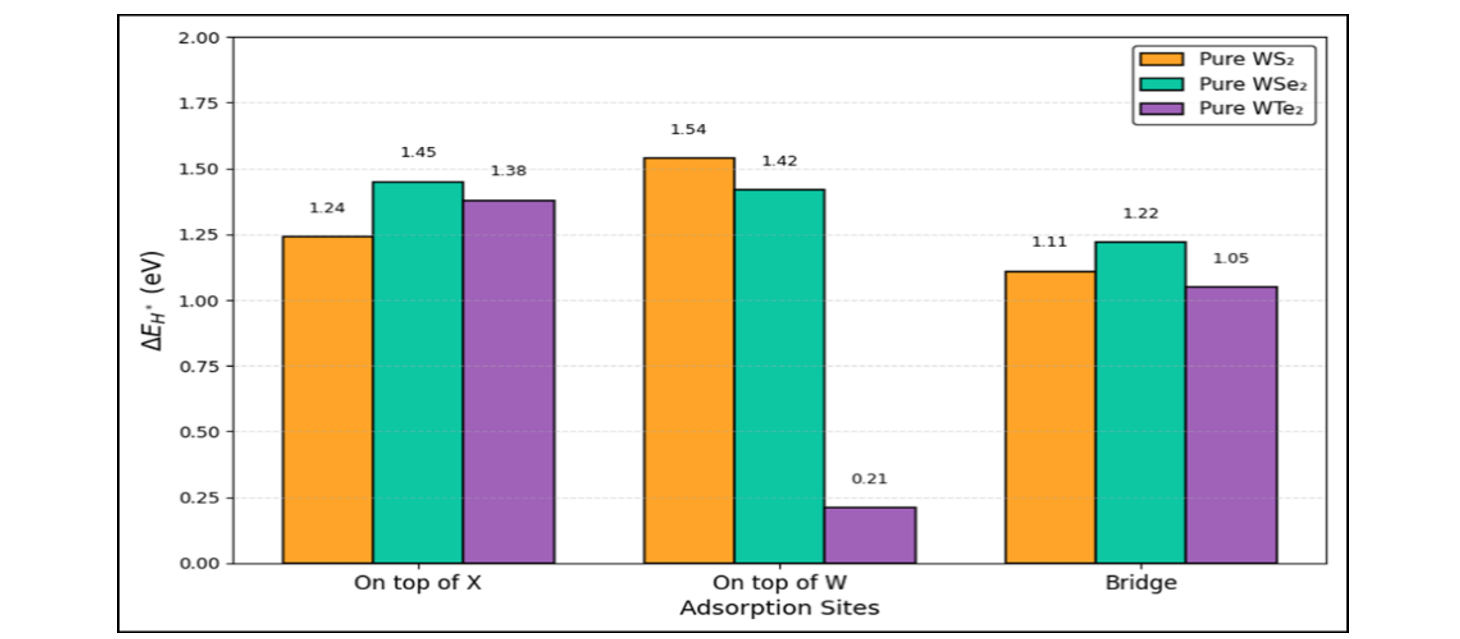
The development of earth-abundant and low-cost electrocatalysts for hydrogen evolution reaction (HER) is essential for sustainable hydrogen production through water electrolysis. In this work, density functional theory (DFT) calculations were employed to systematically investigate how substitutional rhenium (Re) doping activates the basal plane of pure 1H-WX₂ (X = S, Se, Te) monolayers. Two doping concentrations, namely 25% and 50%, were considered to elucidate the concentration-dependent catalytic behavior. Our results revealed that the hexagonal crystal symmetry of the host lattice is preserved after Re substitution, and negative dopant formation energies across all 25% doping systems establish their thermodynamic stability while the 50% Re doping systems were thermodynamically unstable due to positive formation energies. Hydrogen adsorption analysis demonstrated that pristine WX₂ monolayers possess weak catalytic activity due to unfavorable hydrogen adsorption free energy (ΔGH*). However, Re doping significantly improved HER performance. Among all investigated systems, the 25% Re-doped WS₂ monolayer (W0.75Re0.25S₂) exhibited the most favorable HER activity with a ΔGH* value of -0.16 eV. Volcano plot analysis further established that moderate Re doping (25%) provides the optimal catalytic performance, whereas excessive doping (50%) leads to hydrogen over-binding. Density of states analysis showed that Re incorporation induces semiconductor-to-metal transitions in all WX₂ systems through the introduction of impurity states near the Fermi level, which may facilitates charge-transfer kinetics during catalysis. This study demonstrates that Re doping is an effective strategy for tuning the catalytic activity of tungsten dichalcogenides and highlights Re-doped WX₂ monolayers, particularly W0.75Re0.25S₂, as promising non-precious electrocatalyst for efficient hydrogen production.
References
Alhassan, S. S. & Abdulsalam, M. (2024). A DFT+U study of the structural and electronic properties of zinc-doped anatase TiO2 nanomaterial. UMYU Scientifica, 3(1), 186–191. https://doi.org/10.56919/usci.2431.020
Alhassan, S. S., Abdulsalam, M., & Tanimu, A. (2025). Application of transition metals dichalcogenides in electrocatalytic splitting of water for hydrogen production: A review. Nigerian Journal of Physics, 34(2), 44. https://doi.org/10.62292/njp.v34i2.2025.366
Aliaga, J., Vera, P., Araya, J., Ballesteros, L., Urzúa, J., Farías, M., Paraguay-Delgado, F., Alonso-Núñez, G., González, G., & Benavente, E. (2019). Electrochemical hydrogen evolution over hydrothermally synthesized Re-doped MoS2 flower-like microspheres. Molecules, 24(24), 4631. https://doi.org/10.3390/molecules24244631
Chhetri, M., Gupta, U., Yadgarov, L., Rosentsveig, R., Tenne, R., & Rao, C. N. R. (2015). Beneficial effect of Re doping on the electrochemical HER activity of MoS2 fullerenes. Dalton Transactions, 44(37), 16399–16404.
Creazzo, F. (2025). Engineering of MoSe2 and WSe2 monolayers and heterostructures by DFT-molecular dynamics simulations. ACS Applied Materials & Interfaces, 17, 39676–39693.
Deng, C., He, R., Shen, W., Li, M., & Zhang, T. (2019). A single-atom catalyst of cobalt supported on a defective two-dimensional boron nitride material as a promising electrocatalyst for the oxygen reduction reaction: A DFT study. Physical Chemistry Chemical Physics, 21(13), 6900–6907. https://doi.org/10.1039/C9CP00452A
Do, M., Nguyen, N. H., Phung, H. T. T., Phuc, H. V., Amin, B., Hoi, B. D., Hieu, N. V., Nhan, L. C., Nguyen, C. V., & Le, P. T. T. (2019). Electronic properties of WS2 & WSe2 monolayers with biaxial strain: A first principle study. Chemical Physics, 519, 69–73.
Dolui, K., Rungger, I., Das Pemmaraju, C., & Sanvito, S. (2013). Origin of the n-type and p-type conductivity of MoS2 monolayers on a SiO2 substrate. Physical Review B, 88, 075420.
Dorian, A. H. H., Mohammed, H. N. A., Sean, L., Aibing, Y., & Charles, C. S. (2012). Ab initio study of phase stability in doped TiO2. Computational Mechanics, 50(2), 185–194.
Enyashin, A. N., Yadgarov, L., Houben, L., Popov, I., Weidenbach, M., Tenne, R., Bar-Sadan, M., & Seifert, G. (2011). New route for stabilization of 1T-WS2 and MoS2 phases. The Journal of Physical Chemistry C, 115(50), 24586–24591.
Fu, Q., Han, J., Wang, X., Xu, P., Yao, T., Zhong, J., Zhong, W., Liu, S., Gao, T., Zhang, Z., Xu, L., & Song, B. (2020). 2D transition metal dichalcogenides: Design, modulation, and challenges in electrocatalysis. Advanced Materials, 32, 1907818. https://doi.org/10.1002/adma.201907818
Giannozzi, P., Baroni, S., Bonini, N., Calandra, M., Car, R., Cavazzoni, C., Ceresoli, D., Chiarotti, G. L., Cococcioni, M., Dabo, I., Dal Corso, A., Fabris, S., Fratesi, G., de Gironcoli, S., Gebauer, R., Gerstmann, U., Gougoussis, C., Kokalj, A., Lazzeri, M., Wentzcovitch, R. M. (2009). QUANTUM ESPRESSO: A modular and open-source software project for quantum simulations of materials. Journal of Physics: Condensed Matter, 21(39), 395502. https://doi.org/10.1088/0953-8984/21/39/395502
Grimme, S., Antony, J., Ehrlich, S., & Krieg, H. (2010). A consistent and accurate ab initio parametrization of density functional dispersion correction (DFT-D) for the 94 elements H-Pu. The Journal of Chemical Physics, 132, 154104. https://doi.org/10.1063/1.3382344
Huang, H., Fan, X., Singh, D. J., & Zheng, W. (2020). Recent progress of TMD nanomaterials: Phase transitions and applications. Nanoscale, 12(3), 1247–1268.
Huang, H., Hu, G., Hu, C., & Fan, X. (2022). Enhanced hydrogen evolution reactivity of T′-phase tungsten dichalcogenides (WS2, WSe2, and WTe2) materials: A DFT study. International Journal of Molecular Sciences, 23(19), 11727. https://doi.org/10.3390/ijms231911727
Jain, A., Ong, S. P., Hautier, G., Chen, W., Richards, W. D., Dacek, S., Cholia, S., Gunter, D., Skinner, D., Ceder, G., & Persson, K. A. (2013). The Materials Project: A materials genome approach to accelerating materials innovation. APL Materials, 1(1), 011002. https://doi.org/10.1063/1.4812323
Jaramillo, T. F., Jørgensen, K. P., Bonde, J., Nielsen, J. H., Horch, S., & Chorkendorff, I. (2007). Identification of active edge sites for electrochemical H2 evolution from MoS2 nanocatalysts. Science, 317(5834), 100–102. https://doi.org/10.1126/science.1141483
Kadam, S. R., Enyashin, A. N., Houben, L., Bar-Ziv, R., & Bar-Sadan, M. (2020). Ni–WSe2 nanostructures as efficient catalysts for electro-chemical hydrogen evolution reaction (HER) in acidic and alkaline media. Journal of Materials Chemistry A, 8(3), 1403–1416.
Kang, M., Lin, C., Yang, H., Guo, Y., Liu, L., Xue, T., Liu, Y., Gong, Y., Zhao, Z., & Zhai, T. (2021). Proximity enhanced hydrogen evolution reactivity of substitutional doped monolayer WS2. ACS Applied Materials & Interfaces, 13(16), 19406–19413.
Kumar, A., & Ahluwalia, P. K. (2012). Electronic structure of transition metal dichalcogenides monolayers 1H-MX2 (M = Mo, W; X = S, Se, Te) from ab-initio theory: New direct band gap semiconductors. The European Physical Journal B, 85, 186. https://doi.org/10.1140/epjb/e2012-30070-x
Lin, Y., Dumcenco, D. O., Komsa, H.-P., Niimi, Y., Krasheninnikov, A. V., Huang, Y.-S., & Suenaga, K. (2014). Properties of individual dopant atoms in single-layer MoS2: Atomic structure, migration, and enhanced reactivity. Advanced Materials, 26(18), 2857.
Luo, J., & Liang, C. (2024). Rhenium in heterogeneous catalysis: A rising star for hydrogenation reactions. ACS Catalysis, 14(9), 7032–7049.
Meng, H., Zhang, W., Ma, Z., Zhang, F., Tang, B., Li, J., & Wang, X. (2018). Self-supported ternary Ni–S–Se nanorod arrays as highly active electrocatalyst for hydrogen generation in both acidic and basic media: Experimental investigation and DFT calculation. ACS Applied Materials & Interfaces, 10(3), 2430–2437. https://doi.org/10.1021/acsami.7b14506
Nørskov, J. K., Bligaard, T., Logadottir, A., Kitchin, J., Chen, J. G., Pandelov, S., & Stimming, U. (2005). Trends in the exchange current for hydrogen evolution. Journal of the Electrochemical Society, 152(3), J23–J26. https://doi.org/10.1149/1.1856988
Ogunkunle, S. A., Bouzid, A., Hinsch, J. J., Allen, O. J., White, J. J., Bernard, S., Wu, Z., Zhu, Y., & Wang, Y. (2024). Defect engineering of 1T′ MX2 (M = Mo, W and X = S, Se) transition metal dichalcogenide-based electrocatalyst for alkaline hydrogen evolution reaction. Journal of Physics: Condensed Matter, 36(14), 145002. https://doi.org/10.1088/1361-648x/ad19a4
Perdew, J.P., Burke K. & Ernzerhof M. (1996). Generalized gradient approximation made simple. Physical Review Letter, 77, 3865–3868. https://doi.org/10.1103/PhysRevLett.77.3865
Sarma, P. V., Vineesh, T. V., Kumar, R., Sreepal, V., Prasannachandran, R., Singh, A. K., & Shaijumon, M. M. (2020). Nanostructured tungsten oxysulfide as an efficient electrocatalyst for hydrogen evolution reaction. ACS Catalysis, 10(11), 6753–6762.
Schutte, W. J., De Boer, J. L., & Jellinek, F. (1987). Crystal structures of tungsten disulfide and diselenide. Journal of Solid State Chemistry, 70(2), 207–209. https://doi.org/10.1016/0022-4596(87)90057-0
Sigiro, M., Huang, Y. S., Ho, C. H., Lin, Y. C., & Suenaga, K. (2015). Influence of rhenium on the structural and optical properties of molybdenum disulfide. Japanese Journal of Applied Physics, 54, 04DH05.
Stamenkovic, V. R., Strmcnik, D., Lopes, P. P., & Markovic, N. M. (2017). Energy and fuels from electrochemical interfaces. Nature Materials, 16(1), 57–69. https://doi.org/10.1038/nmat4738
Sukanya, R., da Silva Alves, D. C., & Breslin, C. B. (2022). Review—recent developments in the applications of 2D transition metal dichalcogenides as electrocatalysts in the generation of hydrogen for renewable energy conversion. Journal of the Electrochemical Society, 169(6), 064504. https://doi.org/10.1149/1945-7111/ac7172
Sun, L., Gao, M., Jing, Z., Cheng, Z., Zheng, D., Xu, H., Zhou, Q., & Lin, J. (2022). 1T-Phase enriched P doped WS2 nanosphere for highly efficient electrochemical hydrogen evolution reaction. Chemical Engineering Journal, 429, 132187.
Tonndorf, P., Schmidt, R., Böttger, P., Zhang, X., Börner, J., Liebig, A., Albrecht, M., Kloc, C., Gordan, O., & Zahn, D. R. (2013). Photoluminescence emission and Raman response of monolayer MoS2, MoSe2, and WSe2. Optics Express, 21(4), 4908–4916.
Vikraman, D., Hussain, S., Patil, S. A., Truong, L., Arbab, A. A., Jeong, S. H., Chun, S.-H., Jung, J., & Kim, H.-S. (2021). Engineering MoSe2/WS2 hybrids to replace the scarce platinum electrode for hydrogen evolution reactions and dye-sensitized solar cells. ACS Applied Materials & Interfaces, 13(4), 5061.
Vuong, V. T., Nguyen, T. H., & Do, V. T. (2018). Charge-induced electromechanical actuation of Mo- and W-dichalcogenide monolayers. RSC Advances, 8(68), 38667.
Wang, F., Niu, S., Liang, X., Wang, G., & Chen, M. (2022). Phosphorus incorporation activates the basal plane of tungsten disulfide for efficient hydrogen evolution catalysis. Nano Research, 15(4), 2855–2861.
Wang, H., Xu, Z., Zhang, Z., Hu, S., Ma, M., Zhang, Z., Zhou, W., & Liu, H. (2020). Addressable surface engineering for N-doped WS2 nanosheet arrays with abundant active sites and the optimal local electronic structure for enhanced hydrogen evolution reaction. Nanoscale, 12(41), 22541–22550.
Woo, S. H., Yadgarov, L., Rosentsveig, R., Park, Y., Song, D., Tenne, R., & Hong, S. Y. (2015). Fullerene-like Re-doped MoS2 nanoparticles as an intercalation host with fast kinetics for sodium ion batteries. Israel Journal of Chemistry, 55(5–6), 599–603.
Ye, S., Ding, C., Chen, R., Fan, F., Fu, P., Yin, H., Wang, X., Wang, Z., Du, P., & Li, C. (2018). Mimicking the key functions of photosystem II in artificial photosynthesis for photoelectrocatalytic water splitting. Journal of the American Chemical Society, 140(9), 3250–3256.
Zhang, K., Guo, Y., Ji, Q., Lu, A.-Y., Su, C., Wang, H., Puretzky, A. A., Geohegan, D. B., Qian, X., Fang, S., Kaxiras, E., Kong, J., & Huang, S. (2020). Enhancement of van der Waals interlayer coupling through polar Janus MoSSe. Journal of the American Chemical Society, 142(41), 17499–17507. https://doi.org/10.1021/jacs.0c07051
Zhang, W., Liu, X., Liu, T., Chen, T., Shen, X., Ding, T., Cao, L., Wang, L., Luo, Q., & Yao, T. (2021). In situ investigation on doping effect in Co-doped tungsten diselenide nanosheets for hydrogen evolution reaction. The Journal of Physical Chemistry C, 125(11), 6229–6236.
Zhu, J., Hu, L., Zhao, P., Lee, L. Y. S., & Wong, K. Y. (2020). Recent advances in electrocatalytic hydrogen evolution using nanoparticles. Chemical Reviews, 120(2), 851–918. https://doi.org/10.1021/acs.chemrev.9b00248
Downloads
Published
Issue
Section
Categories
License
Copyright (c) 2026 Muhammad Ibrahim Bagudo, Shamsuddeen Sani Alhassan, Mahmud Abdulsalam, Abdullahi Tanimu

This work is licensed under a Creative Commons Attribution 4.0 International License.


