
Effects of Aqueous Wood Extracts of Azadirachta Indica and Parkia Biglobosa on the Haematological Profile of Mus Musculus
DOI:
https://doi.org/10.33003/fjs-2026-1011-5532Keywords:
Azadirachta indica, Parkia biglobosa, wood-ash extract, Hematotoxicity, Mus musculus, Safety profileAbstract
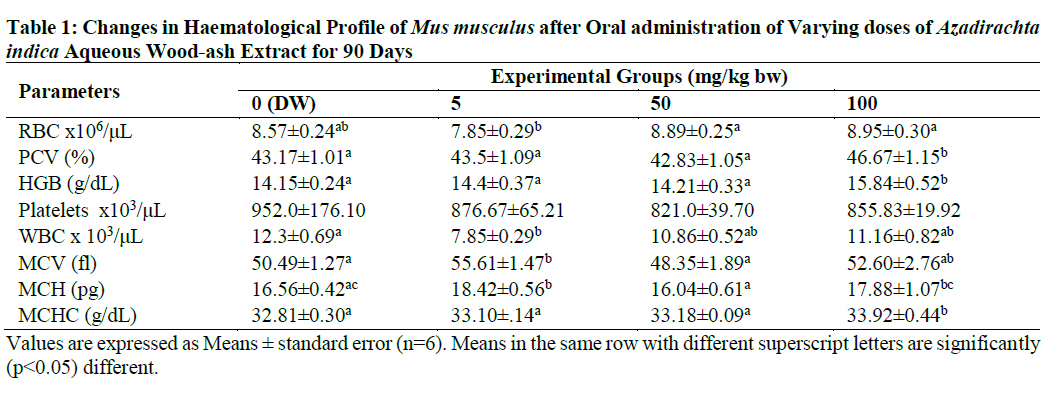
Traditional ethnomedicine often utilizes non-timber plant derivatives like wood ash, yet their long-term toxicological boundaries remain largely uncharacterized. This study evaluated the subchronic (90-day) and chronic (180-day) hematological impacts of aqueous wood-ash extracts from Azadirachta indica and Parkia biglobosa using a murine model. Male Swiss albino mice (Mus musculus) were randomly assigned to seven groups (n = 10/group) and orally administered distilled water (control) and varying concentrations (5, 50, and 100 mg/kg body weight) of A. indica and P. biglobosa extract daily. Comprehensive hematological profiles were analyzed via retro-orbital phlebotomy at days 90 and 180. Subchronic exposure to both extracts significantly (P < 0.05) increased packed cell volume (PCV) and hemoglobin (HGB) at 100 mg/kg, accompanied by localized leukocyte alterations. Particularly, chronic 180-day exposure induced a pronounced, dose-dependent polycythemic effect across all treatment cohorts, marked by marked elevations in red blood cell (RBC) counts, PCV, and HGB, alongside shifted erythrocyte indices (MCV, MCH, MCHC). Conversely, chronic administration of both extracts caused significant, severe thrombocytopenia (P < 0.05). Furthermore, P. biglobosa induced systemic, persistent leukopenia (3.40±0.06 X 10³ / μL vs. 4.53±0.15 X 10³ / μL in controls), whereas high-dose A. indica stimulated leukopoiesis. Although both wood-ash extracts possess potent erythropoietic-stimulating activities likely mediated by antioxidant phytocompounds, their chronic administration triggers critical systemic hematotoxicity characterized by thrombocytopenia and line-specific leukocyte suppression. These findings establish strict safety thresholds and caution against unregulated, long-term therapeutic consumption of these ethnomedicinal preparations.
References
Adebayo, J. O., Adesokan, A. A., Olatunji, L. A., Burro, D. O., & Soladoye, A. O. (2005). Effect of ethanolic extract of Bougainvillea spectabilis leaves on haematological and serum lipid variables in rats. Biochemistry, 17(1), 45–50.
Adedapo, A. A., Abatan, M. O., & Olorunsogo, O. O. (2004). Toxic effects of some plants in the genus Euphorbia on haematological and biochemical parameters in rats. Veterinarski Arhiv, 74(1), 53–62.
Adedapo, A. A., Abatan, M. O., & Olorunsogo, O. O. (2007). Effect of some plants of the spurge family on haematological and biochemical parameters in rats. Veterinarski Arhiv, 77, 29–38.
Aliu, T. B., Obun, F. E., Raji, H., & Badmus, K. (2025). Safety evaluation and concerns of natural products in traditional medicine. AROC Pharmaceutical Biotechnology, 5, 9–17.
Ashafa, A. O. T., Yakubu, M. T., Grierson, D. S., & Afolayan, A. J. (2009). Effects of aqueous extract from the leaves of Chrysocoma ciliate L. on some biochemical parameters of Wistar rats. African Journal of Biotechnology, 8, 1425–1430.
Azando, E. V. B. (2016). A review on medicinal plants of Parkia biglobosa (Mimosaceae-Fabaceae) and Pterocarpus erinaceus (Leguminosae–Papilionoidea). Journal of Medicinal Plants Studies, 4(2), 101–107.
Balkrishna, A., Sharma, N., Srivastava, D., Kukreti, A., Srivastava, S., & Arya, V. (2024). Exploring the safety, efficacy, and bioactivity of herbal medicines: Bridging traditional wisdom and modern science in healthcare. Future Integrative Medicine, 3(1), 35–49.
Banga, H. S., Deshmukh, S., Banga, J., & Dutta, N. (2020). Looking through blood cell abnormalities as a diagnostic tool for improved disease diagnosis in animals. Indian Journal of Veterinary Medicine, 40(2), 1–8.
Blaxhall, P. C., & Daisley, K. W. (1973). Routine haematological methods for use with fish blood. Journal of Fish Biology, 5(6), 771–781. https://doi.org/10.1111/j.1095-8649.1973.tb04510.x
Dashputre, N. L., & Naikwade, N. S. (2010). Immunomodulatory activity of Abutilon indicum (Linn) on albino mice. International Journal of Pharmaceutical Sciences and Research, 1, 178–184.
Devi, J., & Sharma, R. B. (2023). Medicinal importance of Azadirachta indica: An overview. Journal of Drug Delivery and Therapeutics, 13(6), 159–165.
Ganong, W. F. (2001). Review of medical physiology (20th ed.). Lange Medical Books/McGraw-Hill Companies.
Grumet, L., Tromp, Y., & Stiegelbauer, V. (2020). The development of high-quality multispecies probiotic formulations: From bench to market. Nutrients, 12(8), Article 2453.
Guyton, A. C., & Hall, J. E. (2000). A textbook of medical physiology (10th ed.). W.B. Saunders Co.
Iranloye, B. O. (2002). Effect of chronic garlic feeding on some haematological parameters. African Journal of Biomedical Research, 5, 81–82.
Itemobong, S. E., Item, J. A., Henry, D. A., Itoro, F. U., Oboso, E. E., & Patrick, E. E. (2010). Effects of ethanol extract of Azadirachta indica leaves on some immunological and haematological parameters of diabetic Wistar rats. African Journal of Pharmacy and Pharmacology, 4(3), 104–108.
Jain, N. C. (1993). Essentials of veterinary haematology. Lea & Febiger.
Jimoh, O. R., Olaore, J., Olayaki, L. A., Olawepo, A., & Biliaminu, S. A. (2008). Effects of aqueous extract of Ocimum gratissimum on haematological parameters of Wistar rats. Biokemistri, 20, 3–37.
Kuppast, I. J., Vasudeva, N. P., Ravi, M. C., & Biradar, S. S. (2009). Studies on the haematological effect of the extracts of Cordia dichotoma Forst fruits. Research Journal of Agriculture Science and Forestry, 1, 195–204.
Lakshmi, V., Pandey, K., Puri, A., Saxena, R. P., & Saxena, K. C. (2003). Immunostimulant principles from Curculigo orchioides. Journal of Ethnopharmacology, 89, 181–184.
Mansi, K., & Lahham, J. (2008). Effects of Artemisia sieberi Besser (A. herba-alba) on heart rate and some hematological values in normal and alloxan induced diabetic rats. Journal of Basic and Applied Sciences, 4, 57–62.
Mensah, M. L., Komlaga, G., Forkuo, A. D., Firempong, C., Anning, A. K., & Dickson, R. A. (2019). Toxicity and safety implications of herbal medicines. Herbal Medicine, 63, 1–17.
Miyata, Y., Furugouri, K., & Shijimaya, K. (1994). Developmental changes in serum ferritin concentration in rats. Journal of Dairy Science, 67, 1256–1263.
Muriithi, N. J., Maina, G. S., Maina, M. B., Kiambi, M. J., Kelvin, J. K., Umar, A., John, M. K., Ngugi, N. W. A., Piero, M., & Eliud, N. N. M. (2015). Determination of haematological effects of methanolic leaf extract of Vernonia lasiopus in normal mice. Journal of Blood & Lymph, 5(3), 1–6.
Nwozo, O. S., Effiong, E. M., Aja, P. M., & Awuchi, C. G. (2023). Antioxidant, phytochemical, and therapeutic properties of medicinal plants: A review. International Journal of Food Properties, 26(1), 359–388.
Odesanmi, S. O., Lawal, R. A., & Ojokuku, S. A. (2010). Haematological effects of ethanolic fruit extract of Tetrapleura tetraptera in male Dutch white rabbits. Research Journal of Medicinal Plant, 4, 213–217.
OECD. (2008). Acute oral toxicity – up-and-down-procedure (UDP) (OECD Guideline for the Testing of Chemicals, No. 425). OECD Publishing.
Organisation for Economic Co-operation and Development. (1998). Test No. 408: Repeated dose 90-day oral toxicity study in rodents. OECD Guidelines for the Testing of Chemicals, Section 4. OECD Publishing. https://doi.org/10.1787/9789264070707-en
Okpuzor, J., Ogbunugafor, H. A., & Kareem, G. K. (2009). Hepatoprotective and hematologic effects of fractions of Globimetula braunii in normal albino rats. EXCLI Journal, 8, 182–189.
Ong, E. S., Cheong, J. S. H., & Goh, D. (2006). Pressurized hot water extraction of bioactive or marker compounds in botanicals and medicinal plant materials. Journal of Chromatography A, 1112(1–2), 92–102.
Osuigwe, D. I., Nwosu, C., & Oguni, J. O. (2007). Preliminary observations on some haematological parameters of juvenile Heterobranchus longifilis fed different dietary level of raw and boiled jackbean (Canavalea ensiformis) seed meal [Paper presentation]. Conference on International Agricultural Research for Development, Göttingen, Germany.
Perlman, R. L. (2016). Mouse models of human disease: An evolutionary perspective. Evolution, Medicine, and Public Health, 2016(1), 170–176.
Rodrigues, B., & McNeill, J. H. (1992). The diabetic heart: Metabolic causes for the development of cardiomyopathy. Cardiovascular Research, 26, 913–922.
Saleh, M. S., Jalil, J., Zainalabidin, S., Asmadi, A. Y., Mustafa, N. H., & Kamisah, Y. (2021). Genus Parkia: Phytochemical, medicinal uses, and pharmacological properties. International Journal of Molecular Sciences, 22(2), Article 618.
Sankar, V., & Villa, A. (2021). Hematologic diseases. In M. Glick, W. M. Feagans, & A. Villa (Eds.), Burket's oral medicine (13th ed., pp. 627–664). John Wiley & Sons.
Sofowora, A., Ogunbodede, E., & Onayade, A. (2013). The role and place of medicinal plants in the strategies for disease prevention. African Journal of Traditional, Complementary and Alternative Medicines, 10(5), 210–229.
Downloads
Published
Issue
Section
Categories
License
Copyright (c) 2026 Esther Samuel Danjuma, Ubi Ebri Ubi, Timothy Zagwai Auta

This work is licensed under a Creative Commons Attribution 4.0 International License.


