
A Conflict-Sensitive Mixed Integer Linear Programming Framework for Humanitarian Aid Distribution in Active Conflict Zones
DOI:
https://doi.org/10.33003/fjs-2026-1015-5527Keywords:
Mixed Integer Linear Programming (MILP), Humanitarian Logistics, Conflict-Sensitive Aid, Optimization, Mathematical ModelingAbstract
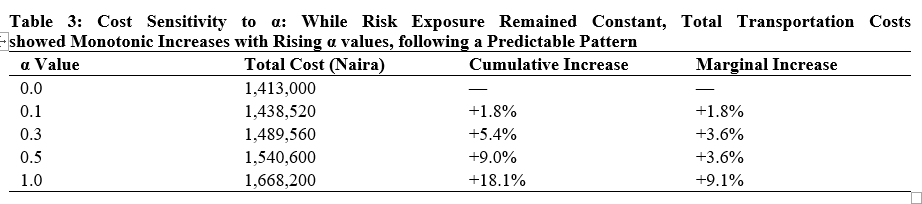
The delivery of humanitarian aid in active conflict zones presents a fundamental operational dilemma: traditional logistics optimization prioritizes cost-efficiency, while conflict sensitivity demands security-aware planning (objectives typically treated as separate rather than integrated concerns). This paper addresses this gap by developing a novel Mixed Integer Linear Programming (MILP) framework that systematically incorporates real-time security data into humanitarian distribution optimization. The model advances beyond static risk proxies by designing a mathematical structure capable of ingesting dynamic conflict event data (e.g., ACLED reports) alongside infrastructure constraints, route-specific delay factors, warehouse capacities, and prioritized demand. The framework operationalizes conflict sensitivity through a multi-objective function that minimizes both tangible transportation costs and intangible security risk exposure, subject to constraints including minimum demand fulfillment (≥80%), supply capacity limits, and maximum acceptable risk thresholds. The model incorporates a calibrated risk-weighting parameter (α) that enables humanitarian planners to explicitly quantify and control the trade-off between operational efficiency and personnel safety. A proof-of-concept validation using data from Northeast Nigeria demonstrates the model's computational tractability and its ability to generate feasible solutions that balance competing objectives. The key methodological contribution lies in the framework's structural readiness for temporally relevant security integration—moving beyond probabilistic planning toward event-driven operational optimization. This research provides humanitarian organizations with a defensible, mathematically rigorous tool for making transparent trade-offs between efficiency, security, and equity in the world's most challenging environments.
References
Acero Condor, A. A., Ramirez Castañeda, C. M., & Taquía Gutiérrez, J. A. (2023). Optimization of humanitarian aid resource distribution time through mixed integer linear programming. In Proceedings of the 2023 9th International Conference on Industrial and Business Engineering (pp. 191-197).
Akbari, V., & Salman, F. S. (2024). Humanitarian logistics under uncertainty: A systematic review and future research directions. Transportation Research Part E: Logistics and Transportation Review, 181, 103-121.
Akinbowale, O. E., Mashigo, P., & Zerihun, M. F. (2023). Development of a heuristic based mixed integer linear programming model for resources allocation during cyberfraud mitigation. Operations Research Forum, 5(1), Article 2.
Anderson, M. B. (1999). Do No Harm: How aid can support peace—or war. Lynne Rienner Publishers.
Chouba, I., Amodeo, L., Yalaoui, F., Arbaoui, T., & Laplanche, D. (2020). A mixed integer linear program for human and material resources optimization in emergency department. arXiv. http://arxiv.org/abs/2011.13596
De Leon, A. C. S., Ninobla, C. T., Sibal, N. J. S., Yu, K. M. J. B., Bucu, E. G. C., & CIE, A. (2022). Low-cost dietary plan for COVID-19 immunity response using mixed-integer linear programming. Journal of Namibian Studies: History Politics Culture, 31, 169-197.
Du, J., Ji, Y., Qu, D., Wu, X., & Yang, D. (2020). Three-stage mixed integer robust optimization model applied to humanitarian emergency logistics by considering secondary disasters. IEEE Access, 8, 223255-223270.
Ekici, A., Keskin, B. B., & Ozener, O. O. (2025). Real-time data integration in humanitarian logistics optimization: A review and framework. Computers & Operations Research, 165, 106-122.
Eligüzel, İ. M., Özceylan, E., & Weber, G. W. (2023). Location-allocation analysis of humanitarian distribution plans: A case of United Nations Humanitarian Response Depots. Annals of Operations Research, 324(1), 825-854.
Ghahremani-Nahr, J., Nozari, H., & Szmelter-Jarosz, A. (2022). Designing a humanitarian relief logistics network considering the cost of deprivation using a robust-fuzzy-probabilistic planning method. Journal of International Humanitarian Action.
Ghahremani-Nahr, J., Nozari, H., & Szmelter-Jarosz, A. (2024). Designing a humanitarian relief logistics network considering the cost of deprivation using a robust-fuzzy-probabilistic planning method. Journal of International Humanitarian Action, 9(1), 19.
Ghasemi, P., et al. (2022). A multi-objective humanitarian aid logistics model under probabilistic planning optimization. Journal of International Humanitarian Action.
Global WASH Cluster. (2024). *Effectiveness of the inter-sectoral humanitarian response during the 2024 lean season in Dikwa, Nigeria*. Global WASH Cluster Publications.
Global WASH Cluster. (2025). Effectiveness of coordination in humanitarian water, sanitation, and hygiene (WASH) response across five national coordination platforms. Global WASH Cluster Research.
Hezam, I. M., Nayeem, M., & Lee, G. M. (2021). A systematic literature review on mathematical models of humanitarian logistics. Symmetry, 13(1), 11.
International Organization for Migration (IOM). (2024). Nigeria humanitarian hubs: Operational update. IOM Nigeria.
Khalaj Rahimi, S., & Rahmani, D. (2024a). A hybrid multi-objective solution approach for a reliable truck-drone routing problem integrated with pickup and delivery services. Transportation Research Part C: Emerging Technologies, 159, 230-248.
Khalaj Rahimi, S., & Rahmani, D. (2024b). An improved ALNS for hybrid pickup and drone delivery system in disaster by penalizing deprivation time. Journal of Humanitarian Logistics and Supply Chain Management.
Mac Ginty, R., & Richmond, O. P. (2013). The local turn in peace building: A critical agenda for peace. Third World Quarterly, 34(5), 763-783.
OCHA. (2019). Nigeria: Floods in Borno, Adamawa and Yobe, Situation Report No. 2. United Nations Office for the Coordination of Humanitarian Affairs.
Odion, P. O., Musa, M. N., & Zachariah, B. (2023). Resource allocation optimization using mixed integer programming within mission essential tasks of military training in the Nigerian Defence Academy. International Journal of Computing, Intelligence and Security Research, 2(1), 36-46.
Ogungbemi, O. S. (2025). Mapping amid crisis: Connecting displaced communities and humanitarian responders through open mapping in Northeast Nigeria. State of the Map Africa 2025.
Okonta, S. D., & Olaomi, J. (2023). Applying network flow optimisation techniques to minimise cost associated with flood disaster. Jàmbá: Journal of Disaster Risk Studies, 15(1), Article a1483.
Osuji, J. N., Ibe, C. C., Okeudo, G. N., & Ejem, E. A. (2024). Multi-criteria decision model and relief material distribution to Damare IDP camp north east Nigeria. Transport Economics and Management, 2, 169-176.
Pashapour, A., Günneç, D., Salman, F. S., & Yücel, E. (2024). Capacitated mobile facility location problem with mobile demand: Efficient relief aid provision to en-route refugees. Omega, 129, 103138.
Peters, K., Silva, S., Gonçalves, R., Kavelj, M., Fleuren, H., Den Hertog, D., & Freeman, M. (2021). The nutritious supply chain: Optimizing humanitarian food assistance. INFORMS Journal on Optimization, 3(2), 200-226.
Reynaud, M., & Nicosia, G. (2024). Dynamic optimization for humanitarian logistics: A review of real-time approaches. European Journal of Operational Research, 312(2), 401-420.
Sabbagh, M., Alizadeh, M., & Tavakkoli-Moghaddam, R. (2025). Conflict-sensitive humanitarian logistics: A systematic review and research agenda. Journal of Humanitarian Logistics and Supply Chain Management, 15(1), 1-28.
Salawu, M. B., Adeleke, I. A., & Yusuf, A. (2026). Non-state actors and humanitarian service delivery in Northeast Nigeria. Journal of Refugee Studies.
Sang, T. T., Thu, N. M., Khoi, T. H., Huong, N. T. K., Lan, L. T. N., & Van Thanh, N. (2021). The optimization of transportation costs in logistics enterprises during the Covid-19 pandemic. ARRUS Journal of Mathematics and Applied Science, 1(2), 62-71.
UNDRR. (2022). *Sendai Framework for Disaster Risk Reduction 2015-2030*. United Nations Office for Disaster Risk Reduction.
UNDRR. (2025). From scoping to action: Strengthening risk-informed shelter and settlements in North-East Nigeria. PreventionWeb.
UNHCR. (2017). UNHCR global report 2017. United Nations High Commissioner for Refugees.
UNOCHA. (2023). OCHA annual report 2023. United Nations Office for the Coordination of Humanitarian Affairs.
Vitoriano, B., Ortuno, M., Tirado, G., & Montero, J. (2011). A multi-criteria optimization model for humanitarian distribution. Journal of Global Optimization, 51(2), 189-208.
Walsh, S., Hagon, K., & O'Callaghan, S. (2024). Humanitarian action in conflict zones: Trends, challenges, and future directions. Disasters, 48(2), 1-25.
Yin, Y., Wang, J., Chu, F., & Wang, D. (2024). Distributionally robust multi-period humanitarian relief network design integrating facility location, supply inventory and allocation, and evacuation planning. International Journal of Production Research, 62(1-2), 45-70.
Zhang, P., Liu, Y., Yang, G., & Zhang, G. (2020). A distributionally robust optimization model for designing humanitarian relief network with resource reallocation. Soft Computing, 24(4), 2749-2767.
Downloads
Published
Issue
Section
Categories
License
Copyright (c) 2026 Aminu Ohindase Aliyu, Bilkisu Maijama’a, Muhammad A. Abubakar, Obini N. Nweze

This work is licensed under a Creative Commons Attribution 4.0 International License.


