
Extraction, Characterization, and Comparative Evaluation of Natural Colourants from Carrot (Daucus Carota) and Spinach (Spinacia Oleracea) for Potential Applications in Food, Cosmetic, and Textile Industries
DOI:
https://doi.org/10.33003/Keywords:
Natural Colourants, Carotenoids, Chlorophyll, Carrot, Spinach, Antioxidant Activity, Textile Dyeing, Food ColourantsAbstract
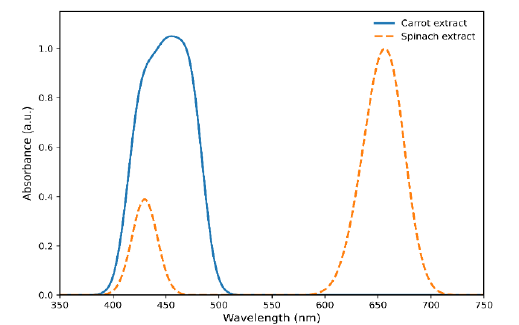
Natural colourants are increasingly being investigated as sustainable alternatives to synthetic dyes for applications in food, cosmetics, pharmaceuticals, and textiles. This study comparatively extracted and evaluated pigments from carrot (Daucus carota) and spinach (Spinacia oleracea) to assess their industrial potential. Carotenoid-rich pigments from carrot were obtained using an acetone–ethanol system followed by petroleum ether partitioning, while chlorophyll-rich pigments from spinach were extracted with ethanol under light-protected conditions. Carrot extract exhibited higher extraction yield (8.42 ± 0.11%) and pigment concentration (118.6 ± 3.4 mg/g extract) than spinach extract (5.66 ± 0.09% and 87.4 ± 2.7 mg/g extract, respectively). UV–Visible spectroscopy confirmed characteristic absorption maxima of carotenoids (425, 450, and 474 nm) and chlorophylls (430, 645, and 663 nm). Carrot pigments showed greater pH, thermal, and photostability and stronger antioxidant activity (IC₅₀ = 54.8 μg/mL) than spinach pigments (IC₅₀ = 69.2 μg/mL). In textile dyeing, carrot extracts produced higher colour strength and superior fastness properties on cotton, silk, and wool. They also exhibited better colour retention and consumer acceptance in model food and cosmetic formulations. Overall performance scores were 89.6% for carrot and 69.8% for spinach, indicating that carrot-derived carotenoid pigments possess greater potential for broad industrial applications, while spinach-derived chlorophyll pigments remain valuable where natural green coloration is desired.
References
6.0 References
Britton, G., Liaaen-Jensen, S., & Pfander, H. (2008). Carotenoids: Natural functions (Vol. 4). Birkhäuser.
Clydesdale, F. M. (1993). Color as a factor in food choice. Critical Reviews in Food Science and Nutrition, 33(1), 83–101. https://doi.org/10.1080/10408399309527614
Delgado-Vargas, F., & Paredes-López, O. (2003). Natural colorants for food and nutraceutical uses. CRC Press.
Dutta, D., Chaudhuri, U. R., & Chakraborty, R. (2005). Structure, health benefits, antioxidant property and processing and storage of carotenoids. African Journal of Biotechnology, 4(13), 1510–1520.
Francis, F. J. (1995). Quality as influenced by color. Food Quality and Preference, 6(3), 149–155. https://doi.org/10.1016/0950-3293(94)00026-R
Gross, J. (1991). Pigments in vegetables: Chlorophylls and carotenoids. Van Nostrand Reinhold.
Heaton, J. W., & Marangoni, A. G. (1996). Chlorophyll degradation in processed foods and senescent plant tissues. Trends in Food Science & Technology, 7(1), 8–15. https://doi.org/10.1016/0924-2244(96)81352-5
Humphrey, A. M. (1980). Chlorophyll. Food Chemistry, 5(1), 57–67. https://doi.org/10.1016/0308-8146(80)90010-9
Khoo, H. E., Azlan, A., Tang, S. T., & Lim, S. M. (2011). Carotenoids and their role in promoting human health. Molecules, 16(2), 1710–1738. https://doi.org/10.3390/molecules16021710
Kirk, J. T. O. (1994). Light and photosynthesis in aquatic ecosystems (2nd ed.). Cambridge University Press.
Lichtenthaler, H. K. (1987). Chlorophylls and carotenoids: Pigments of photosynthetic biomembranes. Methods in Enzymology, 148, 350–382. https://doi.org/10.1016/0076-6879(87)48036-1
Melo, M. J., Claro, A., & Bracci, S. (2018). Natural dyes in textile conservation and sustainable dyeing applications. Coloration Technology, 134(1), 1–14.
Mortensen, A. (2006). Carotenoids and other pigments as natural colorants. Pure and Applied Chemistry, 78(8), 1477–1491. https://doi.org/10.1351/pac200678081477
Rodriguez-Amaya, D. B. (2019). Food carotenoids: Chemistry, biology and technology. Wiley-Blackwell.
Shahidi, F., & Ambigaipalan, P. (2015). Phenolics and bioactives in foods and nutraceuticals. Journal of Functional Foods, 18, 820–897. https://doi.org/10.1016/j.jff.2015.06.018
Singh, S., & Pandey, A. K. (2018). Natural pigments from plants and their applications in food systems. Journal of Food Science and Technology, 55(10), 4080–4090. https://doi.org/10.1007/s13197-018-3371-5
Stringheta, P. C., Oliveira, T. T., Gomes, R. C., Amaral, M. P. H., Carvalho, A. F., & Vilela, M. A. P. (2012). Natural dyes in foods and beverages. Food Reviews International, 28(2), 131–164. https://doi.org/10.1080/87559129.2011.637477
Tiwari, B. K., Cummins, E., O’Donnell, C. P., & Muthukumarappan, K. (2013). Applications of natural colorants in food and pharmaceutical systems. Food Engineering Reviews, 5(2), 69–81.
Von Elbe, J. H., & Schwartz, S. J. (1996). Colorants. In O. R. Fennema (Ed.), Food chemistry (3rd ed., pp. 651–722). Marcel Dekker.
Wrolstad, R. E., Durst, R. W., & Lee, J. (2005). Tracking color and pigment changes in anthocyanin products. Trends in Food Science & Technology, 16(9), 423–428. https://doi.org/10.1016/j.tifs.2005.03.019
Downloads
Published
Issue
Section
Categories
License
Copyright (c) 2026 Yasir Albashir, Hauwa Yahaya Umar, Mahmud Khalifa Shuaibu

This work is licensed under a Creative Commons Attribution 4.0 International License.


