
Policy and Health System Barriers Affecting Rehabilitation Services for Adolescents with Handicaps in Kano Metropolis, Nigeria
DOI:
https://doi.org/10.33003/fjs-2026-1009-5302Keywords:
Rehabilitation services, Adolescents, Policy barriers, Health system, Disability, Kano MetropolisAbstract
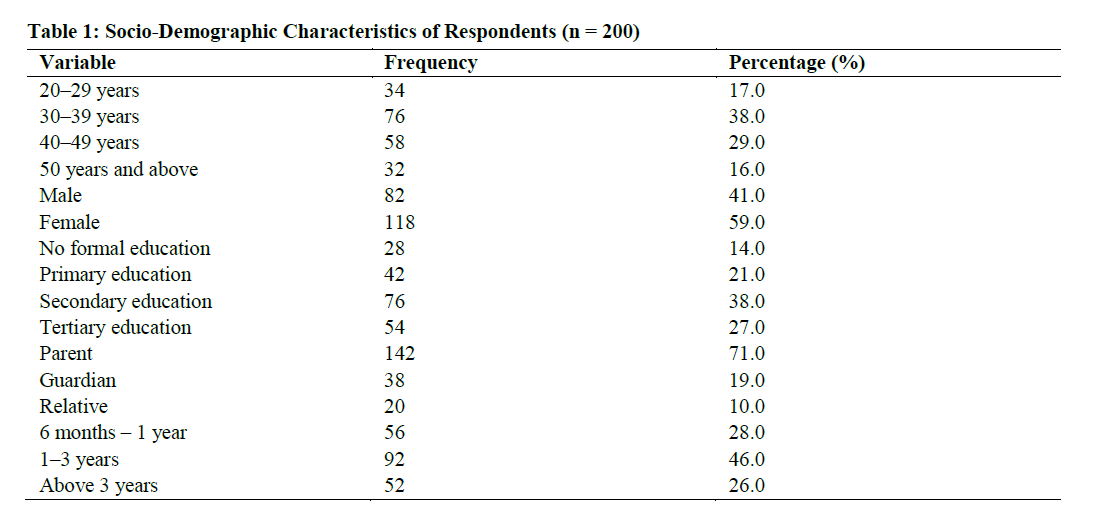
Adolescents with handicaps in low- and middle-income countries continue to experience significant barriers in accessing rehabilitation services due to weak health systems and ineffective policy implementation. This study assessed policy and health system barriers affecting rehabilitation services for adolescents with handicaps in Kano Metropolis, Nigeria. A descriptive cross-sectional study design was adopted involving 200 caregivers selected through purposive sampling. Data were collected using a structured questionnaire and analyzed using descriptive statistics and chi-square test at p < 0.05 significance level. Findings revealed that 74.0% of respondents reported weak implementation of disability policies, while 72.0% identified long waiting time in health facilities. In addition, 69.5% reported shortage of rehabilitation professionals and 66.5% indicated inadequate funding of rehabilitation units. A significant association was found between policy awareness and utilization of rehabilitation services (χ² = 14.26, p = 0.001). The study concluded that weak policy enforcement and fragile health system structures significantly limit rehabilitation service utilization. Strengthening disability policy implementation, increasing funding, and expanding rehabilitation workforce capacity were recommended.
References
Abdullahi, M. A., (2021). Disability and rehabilitation services in Northern Nigeria. African Health Journal, 15(2), 44–53.
Adebayo, T. O., and Yusuf, A. R. (2020). Statistical methods in health research. Nigerian Journal of Medical Statistics, 8(1), 21–30.
Babbie, E. (2021). The practice of social research. Cengage.
Bolarinwa, O. A. (2015). Principles of questionnaire validation. Annals of Ibadan Postgraduate Medicine, 13(2), 96–103.
Creswell, J. W., and Creswell, J. D. (2018). Research design. Sage.
Field, A. (2018). Discovering statistics using SPSS. Sage.
Garba, H. U., and Yusuf, M. K. (2022). Rehabilitation infrastructure in Kano State. Journal of Health Systems Research, 12(3), 88–97.
Ibrahim, A. L., and Yusuf, N. M. (2022). Workforce challenges in rehabilitation services. International Journal of Disability Studies, 14(1), 45–56.
Mills, A., Smith, R. J., and Carter, L. M. (2022). Health system strengthening in Africa. Global Health Review, 10(2), 112–120.
Ojo, D. A., and Abdullahi, S. M. (2020). Disability policy implementation in Nigeria. Journal of Social Policy and Health, 9(2), 88–97.
Smith, R. J., and Carter, L. M. (2023). Disability and rehabilitation access. Global Health Review, 18(2), 101–113.
UNICEF. (2022). Disability inclusion report. UNICEF Publications.
WHO. (2023). Rehabilitation in health systems. World Health Organization.
Downloads
Published
Issue
Section
Categories
License
Copyright (c) 2026 Hamza Garba, Sani Hashim, Mustapha Umar, Mustapha Abdullahi

This work is licensed under a Creative Commons Attribution 4.0 International License.


