
Availability and Accessibility of Rehabilitation Services for Children with Disabilities in Kano Metropolis
DOI:
https://doi.org/10.33003/fjs-2026-1009-5308Keywords:
Accessibility, availability, rehabilitation services, disability, children, Kano MetropolisAbstract
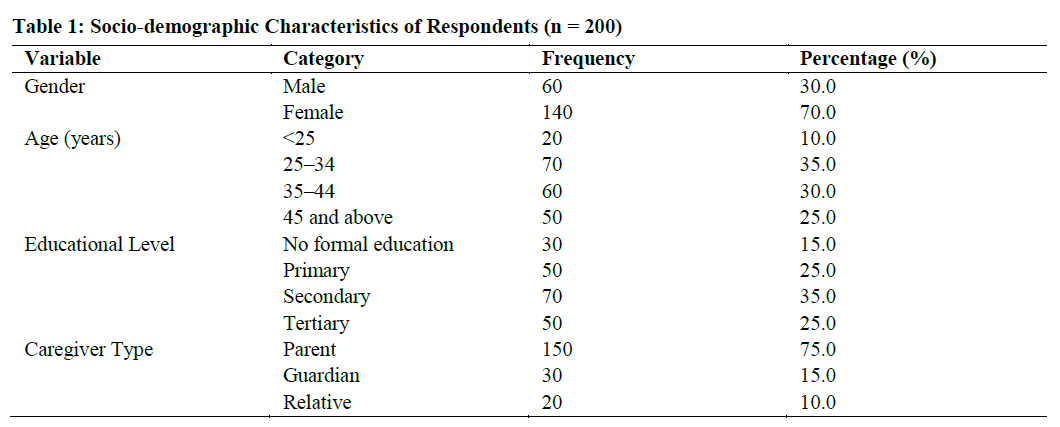
Rehabilitation services are essential for improving physical and social participation among children with disabilities, globally, childhood disability remains a major public health concern, particularly in low- and middle-income countries, in Nigeria inadequate rehabilitation infrastructure continue to limit effective rehabilitation service among children with disabilities. This study assessed the availability and accessibility of rehabilitation services for children with disabilities in Kano Metropolis. A descriptive cross-sectional study design was employed among 200 caregivers of children with disabilities attending selected rehabilitation centers and healthcare facilities in Kano Metropolis, a multistage sampling technique was used to recruit respondents. Data were collected using structured interviewer-administered questionnaires and checklists, variables was assessed, Data were analyzed using Statistical Package for Social Sciences (SPSS) version 26 using descriptive and inferential statistics. Findings showed that physiotherapy services were the most available rehabilitation services (76.5%), while speech therapy services were the least available (32.0%). More than half of the respondents (58.0%) traveled over 10 km before accessing rehabilitation services, while 65.5% reported transportation difficulties, long waiting time was experienced by 60.0% of caregivers, and 55.5% reported poor physical accessibility within rehabilitation facilities, a statistically significant association was observed between distance to rehabilitation centers and regular utilization of rehabilitation services (χ² = 10.72, p = 0.004). The study concluded that availability and accessibility of rehabilitation services for children with disabilities in Kano metropolis remain inadequate due to long travel distances, shortage of specialized services, and infrastructural barriers. The study recommends strengthening community-based rehabilitation services, improving healthcare infrastructure in Kano Metropolis.
References
Barnett, M., Thomson, G., and Turner, S. (2019). Structural barriers to disability inclusion in health systems. Health Policy and Planning, 34(7), 1–9.
Bright, T., Kuper, H., and Kivlin, J. (2018). Access to rehabilitation services in low-income settings: Barriers and facilitators. Disability and Rehabilitation, 40(5), 1–10.
Graham, H., Higgins, C., and McColl, E. (2017). Disability, caregiving and social inequality in low-income settings. Social Science and Medicine, 180, 24–31.
Morris, S., Firth, S., and Shakespeare, T. (2020). Rehabilitation systems and disability inclusion in low-resource contexts. The Lancet Global Health, 8(9), 120–128.
Peters, D. H., Garg, A., and Bloom, G. (2019). Poverty and access to healthcare services in developing countries. World Health Report Commentary, 15(2), 45–53.
Shakespeare, T., Ndagire, F., and Seketi, Q. (2018). Disability and rehabilitation in low-income countries: A global perspective. Disability and Society, 33(5), 1–15.
UNICEF. (2021). Disability inclusion and rehabilitation services for children. United Nations Children’s Fund.
World Bank. (2018). Rehabilitation services in low- and middle-income countries. World Bank Publications.
World Health Organization. (2022). Rehabilitation in health systems. WHO Guidelines and Technical Report. https://www.who.int
World Health Organization. (2023). Global report on assistive technology and rehabilitation access. WHO Press.
Downloads
Published
Issue
Section
Categories
License
Copyright (c) 2026 Hamza Garba

This work is licensed under a Creative Commons Attribution 4.0 International License.


