
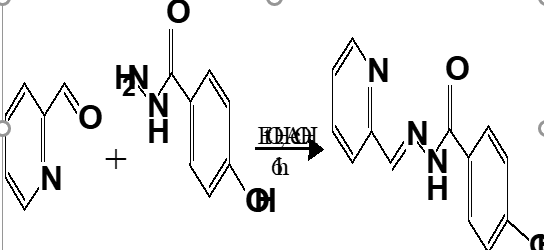
Synthesis, Characterization and Antimicrobial Activity of a Tridentate Hydrazide-hydrazone Ligand Derived from 2-Pyridinecarboxaldehyde and 4-Hydroxybenzohydrazide and Its Co(II) and Zn(II) Complexes
DOI:
https://doi.org/10.33003/fjs-2026-1009-5297Keywords:
Tridentatehydrazide-Hydrazone, Antimicrobial, Metal(II) ComplexesAbstract
A hydrazide-hydrazone ligand was synthesized through the condensation of 2-pyridinecarboxaldehyde and 4-hydroxybenzohydrazide. Its corresponding Co(II) and Zn(II) complexes were prepared and characterized bysolubility, melting point and decomposition temperature, elemental analysis, molar conductance, magnetic susceptibility, FTIR, and UV-Vis spectroscopic techniques. Analytical and spectroscopic data confirmed the formation of neutral complexes [Co(L)Cl2(H2O)].H2O and [Zn(L)Cl2].H2O. The IR spectral data of the ligand showed a band at 1648cm-1 which were assigned tohydrazide carbonylv(C=O) this same band was observed to shift to lower frequencies 1635, 1633 cm-1, after complexation. Another band appeared at 1560 cm-1assigned to azomithene v(C=N) and the sameband was observed to shift to higher frequencies 1600 cm-1 and 1611 cm-1in the complexes, suggesting coordination of the ligand with the respective metal(II) ions. Other peaks appeared at 608, 577;508, 551 cm-1 which are attributed to v(M-N) and v(M-O) respectively, showing that the ligand coordinated in a tridentate manner through hidrazide oxygen, azomethine nitrogen and pyridyl nitrogen. The magnetic moment 4.58 BM of Co(II) suggested its paramagnetic nature, while the value for the Zn(II) complex suggested its diamagnetic nature (0 BM). Molar conductance values 11.58 and 2.70Ω-1cm2mol-1 confirmed the neutral nature of both complexes. The result of the antimicrobial showed that the hydrazide-hydrazone ligand itself possessed inherent antifungal properties against Candida albicans, Tinea rub rum and Tinea pendisthat may be diminished rather than enhanced by metal coordination. This contrasted with the antibacterial results for tested bacteriaStaphylococcus aures, Eschirichia coli and Pseudomonas ariginosa where metal complexation generally improved the activity.
References
Aboafia, S.A., Elsayed, S.A., El-Sayed, A.K.A. (2018). El-Hendawy, A.M. New transition metal complexes of 2,4-dihydroxybenzaldehyde benzoylhydrazone Schiff base (H 2 dhbh): Synthesis, spectroscopic characterization, DNA binding/cleavage and antioxidant activity. Journal of Molecular Structructure 1158, 39–50. http://doi.org/10.1016/molstrruc.2018.01.008
Aliyu, H. N. and Sani, U. (2012). Synthesis, Characterization and Biological Activity of Manganese(II), Iron(II), Cobalt(II), Nickel(II) and Copper(II) Schiff Base Complexes against multidrug Resistant Bacterial and Fungal Pathogens. International Research Journal of Pharmacy and Pharmacology (IISSN 2251-0176). 2(2): 040-044.
Bikas, R., Ghorbanloo, M., Sasani, R., Pantenburg, I., Meyer, G. (2011). Mn(II) complexes of hydrazone based NNO-donor ligands and their catalytic activity in the oxidation of olefins. Journal of Coordination Chemistry, 70, 819 - 830.http://doi.org/10.1080/00958972.2017.1281918
Burgos-López, Y., Balsa, L.M.; Piro, O.E.; León, I.E.; García-Tojal, J.; Echeverría, G.A.; González-Baró, A.C., Parajón-Costa, B.S. (2022). Tridentate acylhydrazone copper(II) complexes with heterocyclic bases as coligands. Synthesis, spectroscopic studies, crystal structure and cytotoxicity assays. Polyherdon. 213, 115621. http://doi.org/10.1016/j.poly.2021.115621
Cordeiro, R.d.A., de Melo, C.V., Marques, F.J., Serpa, R., Evangelista, A.J., Caetano, E.P.; Mafezoli, J., Oliveira, M.d.C.F.d., da Silva, M.R., Bandeira, T.d.J.P.G., (2016). Synthesis and in vitro antifungal activity of isoniazid-derived hydrazones against Coccidioides posadasii. Microbial Pathogenics 98, 1 - 5.http://doi.org/10.1016/j.micpath.2016.06.022
Czyzewska, I,; Mazur, L., Biernasiuk, A., Hordyjewska, A., Popiołek, L.(2024). Synthesis, Structural Properties and Biological Activities ˙ of Novel Hydrazones of 2-, 3-, 4-Iodobenzoic Acid. Molecules. 29, 3814. http://doi.org/10.3390/molecules29163614
Czyzewska, I., Mazur, L., Biernasiuk, A., Hordyjewska, A., Popiolek, L. (2025). Novel derivatives of nicotinic acid: Synthesis, crystal ˙ structure, antimicrobial activity and cytotoxicity. Chemistry and Biodiversity. 22, e202500264.http://doi.org/10.1002/cbdv.202500264
Czyzewska, I., Mazur, L., Popiolek, L. (2024). Transition metal complexes of hydrazones as potential antimicrobial and anticancer agents: ˙ A short review. Chemical Biology and Drug Design. 104, e14590. http://doi.org/10.1111/cbdd.14590
Eben, S.S. Imlay, J.A. (2023). Excess copper catalyzes protein disulfide bond formation in the bacterial periplasm but not in the cytoplasm. Molecular Microbiology 119, 423–438. http://doi.org/10.1111/mmi.15032
Jabbi, A. M., Aliyu,H. N., Isyaku, S. and Kabir, A. M. (2020)Preparation, Characterization and AntimicrobialStudies of Mn(II) and Fe(II) Complexeswith Schiff Base Ligand Derivedfrom 2-aminophenol and 3-formyl-2-hydroxy-6-methoxyquinoline. Open Journal of Inorganic Chemistry, 10(2), 15-24. https://doi.org/10.4236/ojic.2020.102003
Leszek, J., Trypka, E., Tarasov, V.V., Ashraf, G.M., Aliev, G. (2017). Type 3 diabetes mellitus: A novel implication of Alzheimers disease. Curr. Top. Medicinal Chemistry 17, 1331–1335.http://doi.org/10.2174/15680266176660103163403
Mathew, N.; Sithambaresan, M., Kurup, M.R. (2011). Spectral studies of copper(II) complexes of tridentate acylhydrazone ligands with heterocyclic compounds as coligands: X-ray crystal structure of one acylhydrazone copper(II) complex. Spectrochim. Acta A Molecular Biomol. Spectrosc. 79, 1154 - 1161.http://doi.10.1016/j.saa.2011.04.036
Meshram, U.P., Pethe, G.B., Yaul, A.R., Khobragade, B.G., Narwade, M.L. (2017). Studies in stability constants of schiff base hydrazone complexes with transition metal ions. Effect of ligand on seed germination. Russian Journal of Physical Chemistry A. 91, 1877–1882. http://doi.org/10.1134/S0036024417100259
Mohanty, H., Pachpute, S., Yadav, R.P. (2021). Mechanism of drug resistance in bacteria: Efflux pump modulation for designing of new antibiotic enhancers. Folia Microbiol. 66, 727-739. http://doi:10.1007/s12223-021-00910-2
Mohler, J.S., Kolmar, T., Synnatschke, K., Hergert, M., Wilson, L.A., Ramu, S., Elliott, A.G., Blaskovich, M.A., Sidjabat, H.E., Paterson, D.L. (2017). Enhancement of antibiotic-activity through complexation with metal ions - Combined ITC, NMR, enzymatic and biological studies. Journal of Inorganic Biochemistry 167, 134 - 141. http://doi.org/10.1016/j.jinorgbio.2016.11.028
Munita, J.M.; Arias, C.A. (2016). Mechanisms of Antibiotic Resistance. Microbiology Spectr. 4, 464-473.http://doi.10.1128/microbiolspec.VMBF-0016-2015
Popiolek, L. (2017). Hydrazide-hydrazones as potential antimicrobial agents: Overview of the literature since 2010. Medicinal Chemistry Research 26, 287-301. http://doi.10.1007/s00044-016-1756-y
Popiolek, L. (2021). Updated information on antimicrobial activity of hydrazide-hydrazones. International Journal of Molecular Scicience, 22, 9389. http://doi.org/10.3390/ijms22179389
Qin, J., Zhao, S.S., Liu, Y.P., Man, Z.W., Wang, P., Wang, L.N., Xu, Y., Zhu, H.L. (2016) Preparations, characterization, and biological features of mononuclear Cu(II) complexes based on hydrazone ligands. Bioorganic Medicinal Chemistry Letters26, 4925 - 4929. http://doi.org/10.1016/j.bmcl.2016.09.015
Salian, A.R.; Foro, S.; Gowda, B.T. (2018). Crystal structures and the Hirshfeld surface analysis of (E)-4-nitro-N′ -(o-chloro, o- and p-methyl-benzyl-idene)benzene-sulfono-hydrazides. Acta Crystallogr. Sect. E Crystallografic Communications. 74, 1710 - 1716. http://doi.org/10.1107/S2056989018014500
Tafere, D.A.; Gebrezgiabher, M.; Elemo, F.; Sani, T.; Atisme, T.B.; Ashebr, T.G.; Ahmed, I.N. (2025). Hydrazones, hydrazones-based coinage metal complexes, and their biological applications. RSC Adv. 15, 6191 - 6207. http://doi.org/10.1039/D4RA07794F
Tang, D., Kroemer, G., Kang, R. (2024). Targeting cuproplasia and cuproptosis in cancer. Natural Review Clinical Oncology. 21, 370 - 388. http://doi.org/10.1038/s41571-024-00876-0
Kumar, N.; Kaushal, R.; Awasthi, P. (2025). Transition Metal Complexes as Antibacterial Agents: An Overview. J. Fluoresc. 24, 1 - 7. http://doi.org/10.1007/s10895-025-04313-y
Teneva, Y.; Simeonova, R.; Valcheva, V.; Angelova, V.T. (2023). Recent Advances in Anti-Tuberculosis Drug Discovery Based on Hydrazide-Hydrazone and Thiadiazole Derivatives Targeting InhA. Pharmaceuticals. 16, 484. http://doi.org/10.3390/ph16040484
Vineetha, M.C.; Sithambaresan, M.; Nair, Y.S.; Prathapachandra Kurup, M.R. (2019). Structural investigation of discrete solvent protonated vanadium and other transition metal complexes of N′-[(E)-(3-ethoxy-2-hydroxyphenyl)methylidene]benzohydrazide, synthetic, spectroscopic and cytotoxicity studies. Inorganic Chimica Acta. 491, 93-104. http://doi.10.1016/j.ica.2019.03.040
Wu, Y., Wu, D., Lan, K., Li, A., Hou, L., Xu, Y., Gou, Y. (2024). Assessment of Mononuclear/Dinuclear copper acylhydrazone complexes for lung cancer treatment. Bioorg. Chem. 144, 107122. http://doi.org/10.1016/j.bioorg.2024.107122
Downloads
Published
Issue
Section
Categories
License
Copyright (c) 2026 Abubakar Muhammad Jabbi, Habu Nuhu Aliyu

This work is licensed under a Creative Commons Attribution 4.0 International License.


