
Growth, Rumen Ecology Apparent Nutrient Digestibility and Economics of Feed Conversion in Uda Sheep fed Concentrate Diets Containing Ensiled Urea-Molasses Treated Soybean Haulms
DOI:
https://doi.org/10.33003/fjs-2026-1011-5277Keywords:
Uda sheep, Soybean haulms, Urea-molasses, Growth indices, Rumen ecology, Economics of feed conversionAbstract
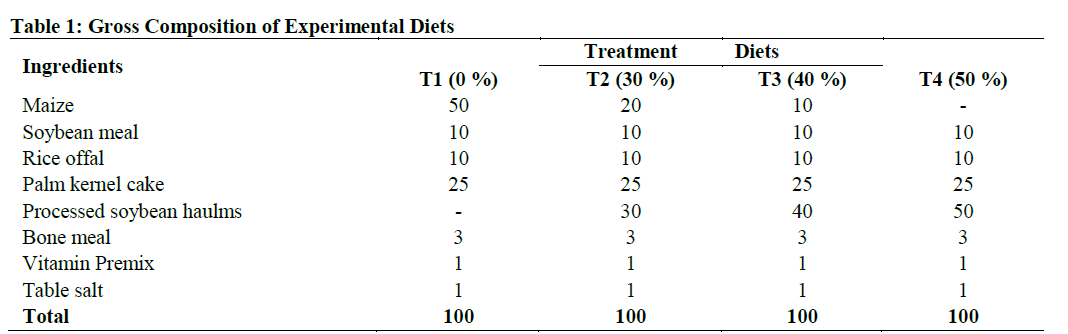
This study evaluated the effects of incorporating ensiled urea–molasses treated soybean haulms into concentrate diets on growth performance, rumen ecology, nutrient digestibility, and economics of feed conversion in Uda rams. Soybean haulms were treated with a solution of urea and molasses (4:1 w/w), ensiled at 70% moisture, thereafter dried and included in experimental diets at 0, 30, 40 and 50%, ( T1, T2, T3 and T4). Twenty yearling Uda rams with average weight of 12.60 ± 0.20 kg used in the experiment were distributed into four groups and assigned to one of the experimental diets in a completely randomized design (CRD). The feeding trail lasted for 84 days. Results showed that all growth indices were not significantly affected (p>0.05) by dietary treatments. There was significantly higher total volatile fatty acids, acetate, and propionate concentrations (p<0.05), in supplemented groups with rumen pH remaining stable (p>0.05). There was significantly higher (p<0.05) total and amylolytic bacteria populations in rams fed 30% and 40% inclusion of processed soybean haulms, while protozoa and fungi populations were largely unaffected. Apparent nutrient digestibility coefficients were not significantly (p>0.05) influenced, except for nitrogen-free extract digestibility, which declined at the 50% inclusion level. There was a progressive reduction in total feed cost and improved cost efficiency with inclusion of treated soybean haulms, with the lowest feed cost per kilogram weight gain observed at 40% inclusion. It is recommended that processed soybean haulms can be included in concentrate diets of Uda rams up to 40% for optimum production.
References
Abdulazeez, A. (2024). Crop Residue Treatment: A Technique for Improving Intake and Digestibility of Ruminants. Nigerian Journal of Animal Production, 1490–1493. https://doi.org/10.51791/njap.vi.5625
Anantasook, N., Wanapat, M., Cherdthong, A., and Gunun, P. (2014). Effects of Physical Form and Urea Treatment of Rice Straw on Rumen Fermentation, Microbial Protein Synthesis and Nutrient Digestibility in Dairy Steers. Asian-Australasian Journal of Animal Sciences, 27(6), 798–805
AOAC (2005) Official method of Analysis. 18th Edition, Association of Officiating Analytical Chemists, Washington DC, Method 935.14 and 992.24
Arowolo, M.A. and He, J. (2018). Use of probiotics and botanical extracts to improve ruminant production in the tropics: A review. Animal Nutrition, 4(3):241–249. doi: 10.1016/j.aninu.2018.04.010
Aruwayo, A., Maigandi, S. A., Malami, B. S. and Daneji, A. I. (2018). Use of urea-treated crop residues in ruminant feeding. International Journal of Advances in Scientific Research and Engineering, 4(7), 54–64.
Babayemi, O. J and Bamikole, M. A. (2006). Effects of Tephrosia candida DC Leaf and its Mixtures with Guinea Grass on in vitro Fermentation Changes as Feed for Ruminants in Nigeria. Pakistan Journal of Nutrition, 5: 14-18.
Begna R, Urge M, Negesse T. and Animut G. (2023). Performances, carcass characteristics, and economic benefit of yearling Hararghe highland rams fed diet containing concentrate mixtures and sugarcane bagasse or rice husk treated with Trichoderma viride and effective microorganisms. Food Science Nutrition, 11(12):7686-7697. doi: 10.1002/ fsn3.3687
Google, (2023). Google Earth. Available at: https://earth.google.com/ [Accessed 5 June 2026]
Gunun, P., Wanapat, M. and Anantasook, N. (2013). Effects of Physical Form and Urea Treatment of Rice Straw on Rumen Fermentation, Microbial Protein Synthesis and Nutrient Digestibility in Dairy Steers. Asian-Australas Journal of Animal Science, 26(12):1689-1697
Hailemariam, S., Zhao, S., He, Y. and Wang, J. (2021). Urea transport and hydrolysis in the rumen: A review. Animal Nutrition, 7(4), 989–996. https://doi.org/10.1016/j.aninu.2021.07.002
Iftikhar, T., Niaz, M., Zia, M. A. and Haq, I. U. (2011). Production of extracellular lipases by Rhizopus oligosporus in a stirred fermentor. Pakistan Journal of Botany, 43(2):1343–1349.
Ikyume, T. T., Afele, T., Donkoh, D. S., Aloko, J. M. and Suleiman, U. (2020). Comparative effect of garlic (Allium sativum) and ginger (Zingiber officinale) and their combination on growth, rumen ecology and apparent nutrient digestibility in sheep. Nigerian Journal of Animal Production, 47(5): 227 – 238
Ikyume, T. T., Shittu, H.A., Ogu, I. E., Afele, T., Ichin, S. V., Tersur, N. I., Adebayo, F., Ewetade, R.O., Nyijime, T. and Shaahu, D.T. (2025). Physiological Changes in Uda Sheep fed Ensiled Urea-Molasses Treated Soybean Haulms in Concentrate Diets. FUDMA Journal of Agriculture and Agricultural Technology, 11(4):133- 139
Ikyume, T.T., Afele, T., Ewetade,R.O., Kefas, U.M.,Orhungur, F.S. and Nyam D.L. (2023). Response of Sheep to Dietary Soybean Haulms: Effect on Growth, Serum Indices and Oxidative Biomarkers Profile. Trends Agricultural Science, 2 (2): 153-160
Jiao, J., Wang, P., He, Z., Tang, S., Zhou, C., Han, X. and Kang, J. (2022). Rumen fermentation and microbial interactions in ruminants. Frontiers in Microbiology, 13:848457. https://doi.org/10.3389/fmicb.2022.848457
Kanimozhi, M., Johny, M., Gayathri, N., & Subashkumar, R. (2014). Optimization and production of α-amylase from halophilic Bacillus species isolated from mangrove soil sources. Journal of Applied & Environmental Microbiology, 2(3):70–73. https://doi.org/10.12691/jaem-2-3-2
Khattab I.M, Salem A.Z.M, Abdel-wahed A. and Kewan K.Z. (2013). Effects of urea supplementation on nutrient digestibility, nitrogen utilisation and rumen fermentation in sheep fed diets containing dates. Livestock Science, 155(2-3):223–229
McDonald, P., Edwards, R. A., Greenhalgh, J. F. D., Morgan, C. A., Sinclair, L. A. and Wilkinson, R. G. (2011). Animal Nutrition (7th ed.). Pearson Education Limited, Harlow, England.
Mordenti, A.L., Giaretta, E., Campidonico, L., Parazza, P. and Formigoni, A. (2021). A Review Regarding the Use of Molasses in Animal Nutrition. Animals (Basel), 11(1):115. doi: 10.3390/ani11010115.
Musa, H. and Adebayo-Tayo, B. C. (2012). Screening of microorganisms isolated from different environmental samples for extracellular lipase production. AU Journal of Technology, 15(3):179–186.
Ngele, M. B., Adegbola, T. A., Bogoro, S. E. F., Abubakar, M. and Kalla, D. J. U. (2021). Nutrient intake, digestibility and growth performance of Yankasa sheep fed urea-treated or untreated rice straw with supplements. Nigerian Journal of Animal Production, 37(1):61–70. https://doi.org/10.51791/njap.v37i1.649
Ogbonna, C. N., Okpokwu, N. M., Okafor, C. U. and Onyia, C. E. (2014). Isolation and screening of amylase-producing fungi obtained from garri processing site. International Journal of Biotechnology and Food Science, 2(5):88–93.
Ogu, I.E., Ikyume, T.T., Shaahu, D.T., Shittu, H.A. and Igbudu, F.A. (2024). Effect of Processing on the Nutritional Quality of Soybean Haulms. Nigerian Journal of Animal Science and Technology, 7(4):118–125
Russell, J. B. and Rychlik, J. L. (2001). Factors that alter rumen microbial ecology. Science, 292(5519), 1119–1122. https://doi.org/10.1126/science.1058830
Vorlaphim, T., Paengkoum, P., Purba, R.A.P., Yuangklang, C., Paengkoum, S., Schonewille, J.T. (2021).Treatment of Rice Stubble with Pleurotus ostreatus and Urea Improves the Growth Performance in Slow-Growing Goats. Animals (Basel). 11(4):1053. doi: 10.3390/ani11041053.
Xu, Y., Li, Z., Moraes, L.E., Shen, J., Yu, Z. and Zhu, W. (2019). Effects of ıncremental urea supplementation on rumen fermentation, nutrient digestion, plasma metabolites, and growth performance in fattening lambs. Animals, 9(9):682. doi: 10.3390/ani9090652.
Downloads
Published
Issue
Section
Categories
License
Copyright (c) 2026 Timothy Tertsegha Ikyume, Elizabeth Ijeoma Ogu, Hammed Abiodun Shittu, David Terhemba Shaahu, Terkula Afele, Mnenga Moses Teryila, Rosemary Olubukola Ewetade, Silas Kator Adega, Chidiebere Anusionwu

This work is licensed under a Creative Commons Attribution 4.0 International License.


