
DISTRIBUTION AND BIOACCUMULATION OF POLYCHLORINATED BIPHENYL (PCB) RESIDUES IN WATER, SEDIMENT AND Clarias gariepinus FROM ZOBE RESERVOIR, KATSINA STATE, NIGERIA
DOI:
https://doi.org/10.33003/fjs-2026-1007-5260Keywords:
Polychlorinated Biphenyls (PCBs), Clarias gariepinus, Zobe, Sediments, ReservoirAbstract
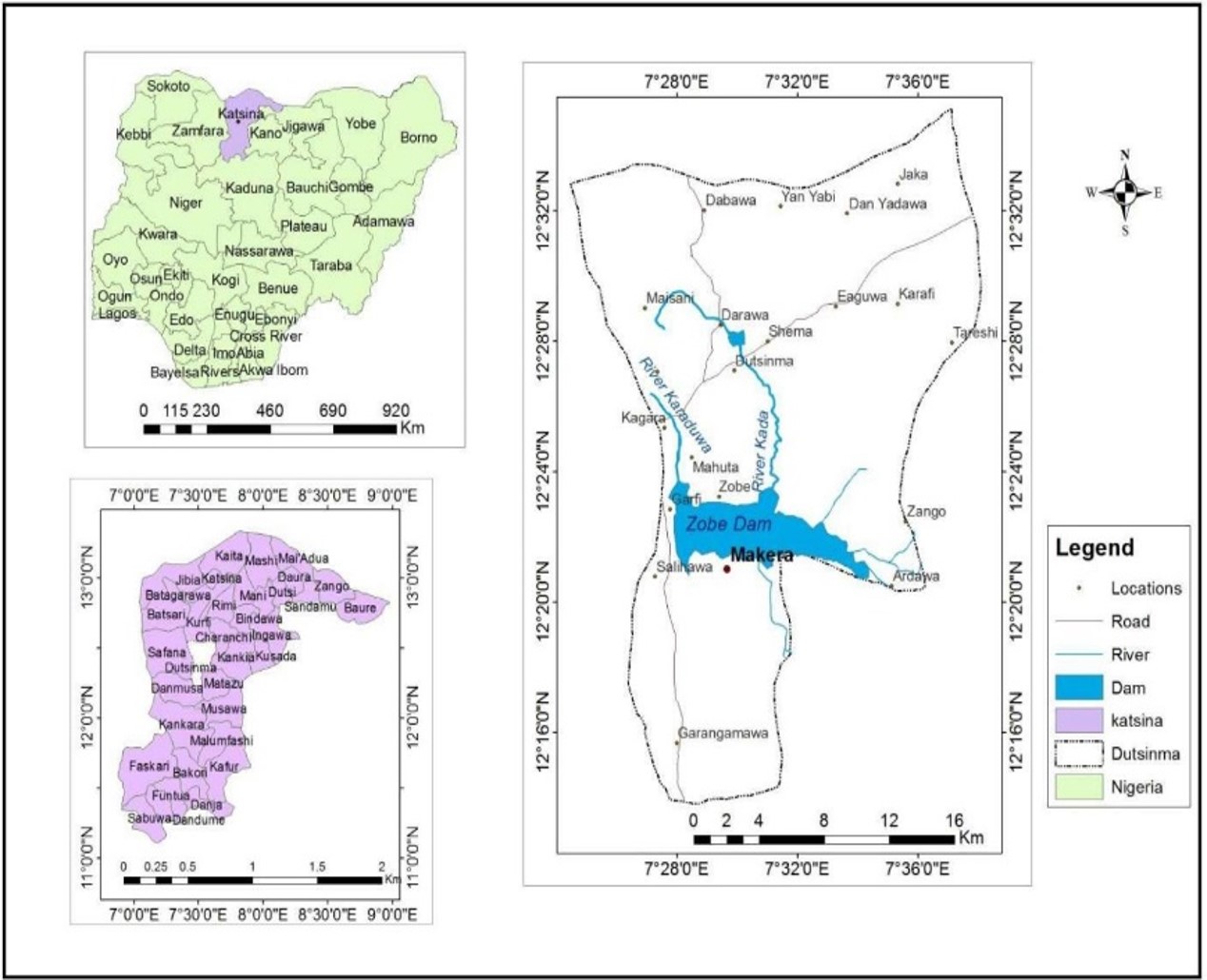
Polychlorinated biphenyls (PCBs) are persistent organic pollutants of global concern due to their toxicity, environmental persistence, and bioaccumulation in aquatic organisms. This study assessed physicochemical characteristics and concentrations of selected PCB congeners (PCB-28, PCB-52, PCB-101, PCB-138, PCB-153, and PCB-180) in water, sediment, and tissues (muscle, liver, and gills) of Clarias gariepinus from Zobe Reservoir, Katsina State, Nigeria. Physicochemical parameters indicated moderate organic pollution with spatial variation. Turbidity ranged from 27–51 NTU, exceeding NESREA limits, while dissolved oxygen showed negative correlations with turbidity (r = –0.39) and biological oxygen demand (r = –0.45). Conductivity correlated strongly with nitrate (r = 0.77, p < 0.05), suggesting runoff influence. PCB concentrations followed the pattern: sediment > liver > muscle > gills > water. Water concentrations were low (0.012–0.060 µg/L) with no significant variation. Higher concentrations were observed in sediment (up to 0.320 mg/kg) and fish tissues, particularly liver (up to 0.302 mg/kg), indicating bioaccumulation. PCB-101 showed the highest levels across all matrices. Significant differences occurred among sample types (p < 0.001), but not across stations or months, suggesting widespread contamination. Sediments act as the primary sink, while the liver is the major site of accumulation. Despite low concentrations in water, elevated levels in fish tissues indicate ecological and potential public health risks. Continuous monitoring of PCB contamination in the reservoir is recommended.
References
Adeogun, A. O., Azubuike, V., Chukwuka, C. P., Okoli, C., & Arukwe, A. (2016). Concentration of polychlorinated biphenyl (PCB) congeners in the muscle of Clarias gariepinus and sediment from inland rivers of southwestern Nigeria and estimated potential human health consequences. Journal of Toxicology and Environmental Health, Part A. https://doi.org/10.1080/15287394.2016.1209141
American Public Health Association (APHA). (2012). Standard methods for the examination of water and wastewater (22nd edition.). American Public Health Association.
Auta, T., Rabiu, M. D., & Sadauki, M. A. (2024). Interactions of physicochemical parameters with snails in Dutsin-Ma Reservoir. Asian Science Bulletin, 2(4), 401–408. Available at: https://doi.org/10.3923/asb.2024.401.408
Boalt, E., Miller, A., & Dahlgren, H. (2014). Distribution of cadmium, mercury, and lead in different body parts of Baltic herring (Clupea harengus) and perch (Perca fluviatilis). Marine Pollution Bulletin, 78, 130–136.
Byrne, S., Miller, P., Waghiyi, V., Buck, C. L., von Hippel, F. A., & Carpenter, D. O. (2015). Persistent organochlorine pesticide exposure related to a former defense site on St. Lawrence Island, Alaska. Journal of Toxicology and Environmental Health, Part A, 78, 976–992.
Davies, O. A., & Anwuri, P. A. (2020). Polychlorinated biphenyl contamination in aquatic organisms of Nigerian inland waters. International Journal of Research Studies in Science, Engineering and Technology, 7(1), 2349-476X.
Environmental Protection Agency (EPA). (2019). Understanding PCB risks at the GE Pittsfield/Housatonic River site.
Food and Agriculture Organization of the United Nations (FAO) & World Health Organization (WHO). (2016). Safety evaluation of certain food additives and contaminants: Non-dioxin-like polychlorinated biphenyls (PCBs). WHO Press.
Kinta, M. Jr., Ayanwale, A. V., Keke, U. N., Auta, Y. I., Adama, B. S., & Usman, H. (2021). Physico-chemical and heavy metals concentration analyses on three common fish species. FUDMA Journal of Sciences, 5(1), 223–232. Doi: https://doi.org/10.33003/fjs-2021-0501-559
Ogbeibu, A. E., & Orhue, E. R. (2017). Assessment of heavy metal contamination in water, fish, and sediments. Environmental Monitoring and Assessment, 189(7), 316.
Ololade, I. A., Apata, A. O., Oloyede, O. J., Akindumila, O. I., Asanga, O. P., & Oloye, F. F. (2025). Health risk assessment of polychlorinated biphenyls in a fish species (Clarias gariepinus). Environmental Science Advances, 4, 1065. Doi: https://doi.org/10.1039/d4va00399c
Sadauki, M. A., Hadiza, Y. B., & Badamasi, M. (2024). Detection of blood parasites (Trypanosoma spp.) in Nile tilapia. Scientific Reports in Life Sciences, 5(4), 31–40. Doi: https://doi.org/10.5281/zenodo.14198544
Sadauki, M. A., Bichi, A. H., Dauda, A. B., & Geidam, M. B. (2022). Assessment of water quality parameters of Zobe and Ajiwa Reservoirs. African Scientist, 23(1), 9–18.
Wang, Y., & Zhong, G. (2011). Characterization and risk assessment of PCBs in soils and vegetables. Chemosphere, 85(3), 344 - 350
World Health Organization. (2017). Guidelines for Drinking water Quality” World Health Organization of the United Nation” Report. Fourth Edition Incorporating the First Addendum. Pp.518.
World Health Organization. (2022). Guidelines for drinking-water quality: Fourth edition incorporating the first and second addenda. Available at: https://iris.who.int/bitstream/handle/10665/352532/9789240045064-eng.pdf?iAllowed=y&sequence=1#page=29
Downloads
Published
Issue
Section
Categories
License
Copyright (c) 2026 S. B. Bello, Timothy Auta, Tolulope E. Atalabi

This work is licensed under a Creative Commons Attribution 4.0 International License.


