
Application of Factor Analysis in Identifying Determinants of Academic Performance among University Students in Nigeria
DOI:
https://doi.org/10.33003/fjs-2026-1011-5140Keywords:
Academic performance, Factor analysis, Higher education, Multivariate statistics, NigeriaAbstract
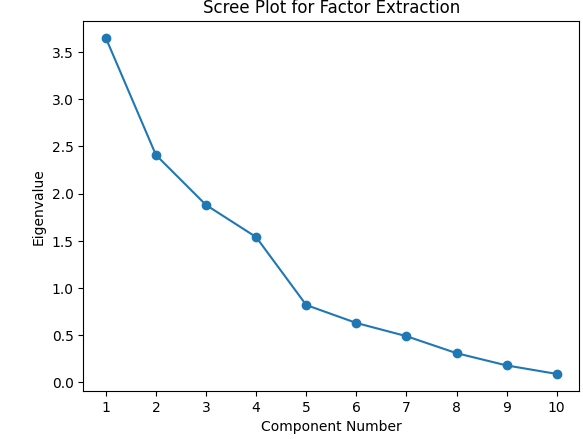
Academic performance in higher education is shaped by a complex interplay of socio-economic, institutional, psychological, and environmental factors. In Nigeria, despite the critical role of university education, there is a lack of parsimonious, empirically validated frameworks that organize the multitude of potential determinants into coherent underlying dimensions. This study applies exploratory factor analysis (EFA) to identify the latent determinants of academic performance among university students in Nigeria. Data were collected from 1,200 undergraduate students across six geopolitical zones using a structured questionnaire. The Kaiser-Meyer-Olkin measure (0.861) and Bartlett’s test of sphericity (p < 0.001) confirmed the suitability of the data for factor analysis. Principal component extraction with Varimax rotation yielded four factors with eigenvalues >1, explaining 79.0% of the total variance: Academic Engagement (30.42%), Socio-Economic Background (20.08%), Learning Environment (15.67%), and Institutional Support (12.83%). These findings provide a robust empirical structure for understanding student performance and offer actionable insights for policy, resource allocation, and student support services in Nigerian universities.
References
Adebayo, O. (2021). Living conditions and academic performance: A study of off-campus students in Nigerian universities. Journal of Educational Research and Development, 14(2), 45–58.
Adeyemi, T. O. (2020). Lecturer quality and student academic performance in Southwest Nigerian universities. Educational Research and Reviews, 15(3), 112–121.
Agboola, B. M., and Ogunode, N. J. (2022). Impact of ASUU strike actions on academic performance of university students in Nigeria. International Journal of Educational Research, 10(1), 33–44.
Hawamdeh, N., and Al-Hawamdeh, S. (2022). The impact of COVID-19 on academic performance: The role of digital literacy and home environment. Education and Information Technologies, 27(5), 6945–6963.
Al-Madi, M., Al-Madi, N., and Al-Madi, F. (2019). Psychological well-being and study environment as predictors of medical students’ academic performance: A confirmatory factor analysis approach. BMC Medical Education, 19(1), 1–9.
Bean, J. P., and Metzner, B. S. (1985). A conceptual model of nontraditional undergraduate student attrition. Review of Educational Research, 55(4), 485–540.
Becker, G. S. (1964). Human capital: A theoretical and empirical analysis, with special reference to education. University of Chicago Press.
Bourdieu, P. (1986). The forms of capital. In J. G. Richardson (Ed.), Handbook of theory and research for the sociology of education (pp. 241–258). Greenwood Press.
Deci, E. L., and Ryan, R. M. (1985). Intrinsic motivation and self-determination in human behavior. Plenum Press.
Eze, J. U., and Eze, C. N. (2021). Test anxiety and academic achievement among first-year undergraduates in Nigerian universities. Journal of Psychology and Education, 18(4), 201–214.
Falola, H. O., Osibanjo, A. O., and Adeniji, A. A. (2019). Underlying factors influencing employability skills of university graduates in Nigeria: A factor analytic approach. Journal of Teaching and Learning for Graduate Employability, 10(1), 73–89.
Gijbels, D., Donche, V., Richardson, J. T. E., and Vermunt, J. D. (2018). Learning patterns in higher education: A systematic review of the literature. Educational Psychology Review, 30(3), 765–791.
Hossain, M. M., and Sultana, S. (2020). Factors affecting student academic performance: An exploratory factor analysis. International Journal of Educational Management, 34(6), 1023–1039.
Mji, A., and Mbinda, Z. (2021). Exploring factors influencing student success in South African universities: A factor analysis approach. South African Journal of Higher Education, 35(2), 187–202.
Nwankwo, B. E., Obi, T. C., and Onyekwere, L. A. (2020). Study habits and academic performance among university students in Anambra State, Nigeria. Journal of Educational Foundations, 11(1), 67–80.
Ogunode, N. J., and Adeyinka, T. (2021). Infrastructural challenges and academic performance in Nigerian public universities. Interdisciplinary Journal of Education, 4(1), 55–68.
Ogunyemi, B., and Ogunyemi, O. (2020). Dimensions of learning environment in Lagos State universities: An exploratory factor analysis. Nigerian Journal of Educational Studies, 17(2), 112–125.
Omoniyi, M. B., and Akinwumi, F. S. (2019). Financial stress and academic performance of undergraduates in Oyo State, Nigeria. African Journal of Educational Management, 20(1), 45–60.
Oni, A. A., and Adebayo, S. O. (2022). Peer influence and academic performance among university students in southwestern Nigeria. Journal of Educational Research and Practice, 12(1), 89–102.
Richardson, M., Abraham, C., and Bond, R. (2012). Psychological correlates of university students’ academic performance: A systematic review and meta-analysis. Psychological Bulletin, 138(2), 353–387.
Robbins, S. B., Oh, I. S., and Le, H. (2021). Psychosocial and study skill factors predicting college outcomes: A meta-analysis. Journal of Educational Psychology, 113(4), 789–806.
Tinto, V. (1975). Dropout from higher education: A theoretical synthesis of recent research. Review of Educational Research, 45(1), 89–125.
Downloads
Published
Issue
Section
Categories
License
Copyright (c) 2026 Stephen Etebefia, Victor Obukohwo, Anthony Omokiniovo Aruoture

This work is licensed under a Creative Commons Attribution 4.0 International License.


