
VARIABILITY IN NUTRITIONAL QUALITY AND EVALUATING THE EFFICACY OF SSR MARKERS IN CHARACTERIZATION OF SELECTED BAMBARA GROUNDNUT ACCESSIONS
DOI:
https://doi.org/10.33003/fjs-2026-1007-4963Keywords:
Vigna subterranea L. Verdc, Proximate Analysis, Accessions, phytochemical analysis, Yield, SSR MarkersAbstract
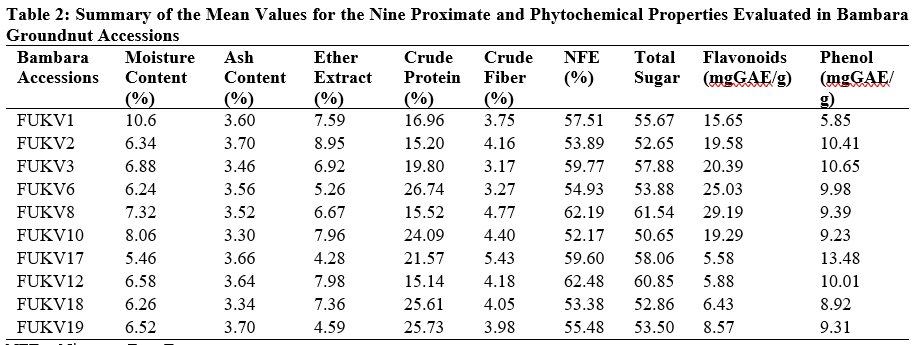
Variety, soil conditions, climatic change, time, and biodiversity are some of the factors contributing to the inconsistent evaluation of Bambara groundnut accessions over the years. Finding Bambara groundnut accessions with excellent nutritional contents and molecular markers for efficient genetic diversity screening was the aim of this research. Five polymorphic SSR markers and ten Bambara groundnut accessions were used in the experiment. This study aimed to identify Bambara groundnut accessions with high nutritional contents and molecular markers for effective genetic diversity screening. The experiment consisted of Ten Bambara groundnut accessions and five polymorphic SSR markers. Nine proximate and phytochemical parameters were observed among the studied accessions. Wide variability was recorded among the accessions on the total flavonoid content, total phenolic content, crude protein, crude fiber, moisture content, ether extract, nitrogen free extract and total sugar content. The total flavonoid content (TFC) varied among the accessions of Bambara groundnut ranging from 5.58 – 29.19 mgGAE/g with FUKV8 recording the highest. Total phenolic content ranges from 13.48 to 5.85 mgGAE/g, crude protein ranges from 26.74% to 15.14% with FUKV6 recording the highest. The microsatellite markers under analysis had polymorphism information content (PIC) values ranging from 0 to 89%, with an average of 52%. In genetic diversity investigations, CEDG294 and PR-32 had the greatest PIC values, indicating efficiency. It is possible to classify FUKV6, FUKV18, FUKV19, and FUK10 as high-nutrient types, FUKV1 and FUKV2 as low-nutrient types, and the remaining ones as medium-nutrient types
References
Abu Bakar, M.F., Mohamed, M., Rahmat, A. & Fry, J.R. 2009. Phytochemicals and antioxidant activity of different parts of bambangan (Mangifera pajang) and tarap (Artocarpus odoratissimus). Food Chemistry 113: 479-483
Akpalu M.M. (2010). Growth, Yield and Nutritional Quality of Five Bambara Groundnut (Vigna subterranea (L) Verdc.) Landraces to Different Plant Population Densities, School of Postgraduate Studies, Kwame Nkrumah University of Science and Technology
Aliyu, S., Massawe, F., & Mayes, S. (2016). Genetic diversity and population structure of Bambara groundnut [Vigna subterranea (L.) Verdc.]: synopsis of the past two decades of analysis and implications for crop improvement programmes. Genetic Resources and Crop Evolution, 63(6), 925- 943
Atoyebi, J. O., Osilesi, O., Adebawo, O., & Abberton, M. T. (2017). Evaluation of nutrient parameters of selected African accessions of Bambara groundnut (Vigna subterranea (L.) Verdc.).
Bamshaiye, O. M., Adegbola, J. A., & Bamishaiye, E. I. (2011). Bambara groundnut: an under-utilized nut in Africa. Advances in agricultural biotechnology, 1(1), 60-72
Berchie J.N., Sarkodie-Addo J., Adu-Dapaah H., Agyemang A., Addy S., Asare E and Donkor J. (2010). Yield Evaluation of Three Early Maturing Bambara Groundnut (Vigna subterranea L. Verdc.) Landraces at the CSIR-Crops Research Institute, Fumesua- Kumasi, Ghana Journal of Agronomy 9:175- 179
Esan, V. I., Oke, G. O., & Ogunbode, T. O. (2023). Genetic variation and characterization of Bambara groundnut [Vigna subterranea (L.) Verdc.] accessions under multi-environments considering yield and yield components performance. Scientific Reports, 13(1), 1498
FAOSTAT (2020). Programme mondial du recensement de l’agriculture. Collection FAO: développement statistique. ISSN 1014 3394
Gonné, S., Félix-Alain, W., & Benoît, K. B. (2013). Assessment of twenty bambara groundnut (Vigna subterranea (L.) Verdcourt) landraces using quantitative morphological traits. International Journal of Plant Research, 3(3), 39-45.
Halimi, R. A., Barkla, B. J., Mayes, S., & King, G. J. (2019). The potential of the underutilized pulse Bambara groundnut [Vigna subterranea (L.) Verdc.] for nutritional food security. Journal of Food Composition and Analysis, 77, 47-59.
Heller J., Begemann F and Mushonga J. (1997). Bambara groundnut. Vigna subterranea (L.) Verdc. In Promoting the conservation and use of underutilised and neglected crops. 9. Proceedings of the Workshop on Conservation and Improvement of Bambara Groundnut (Vigna subterranea (L.) Verdc.), 14-16 November 1995, Harare, Zimbabwe. International plant genetic resources institute (IPGRI), Rome, Italy
Ibrahim, A. Z. Y., Amadou, H. I., & Alhassane, A. (2022). Assessment of genetic diversity of Bambara groundnut accessions [Vigna subterranea (L) Verdcourt] in Sahelian zone of Niger. Scholars Academic Journal of Biosciences, 10(9), 218-229
Ijarotimi, O. S. (2012). Formulation and nutritional quality of infant formula produced from germinated popcorn, Bambara groundnut and African locust bean flour. The Journal of Microbiology, Biotechnology and Food Sciences
Jibrin, M., Usman, M.G., Musa, I., Muhammad, I. & Mshelia, J.S (2026). Morphological Characterization and Genetic Estimates of Bambara Groundnut Accessions In Multi-Location Trials In Sudan Savanna. Journal of Agricultural Economics, Environment and Social Science 12(1):179-195
Karikari S.K., Chaba O and Molosiwa B. (1999). Effects of intercropping bambara groundnut on pearl millet, sorghum and maize in Botswana. African Crop Science Journal 7:143- 152
Kaur, G., Joshi, A., & Jain, D. (2018). SSR-Marker assisted evaluation of Genetic Diversity in Mungbean [Vigna radiata (L.) Wilcezk] accessionss. Brazilian Archives of Biology and Technology, 61
Lombardi M, Materne M, Cogan NOI, Rodda M, Daetwyler HD, Slater AT, Forster JW, Kaur S. (2014). Assessment of genetic variation within a global collection of lentil (Lensculinaris Medik.) cultivars and landraces using SNP markers. BMC. Genetics 15:150. doi:10.1186/s12863-014-0150-3
Mayes S., Basu, S., Murchie E., Roberts J.A., Azam-Ali S.N., Stadler F., Mohler V., Wenzel G., Massawe F., Kilian A., Bonin A., Beena A. and Sheshshayee M.S. (2019). BAMLINK – a Cross-disciplinary programme to enhance the role of bambara groundnut (Vigna subterranea L. Verdc.) for food security in Africa and India. Acta Horticulturae 806: 137 – 150
Molosiwa, O. O., Aliyu, S., Stadler, F., Mayes, K., Massawe, F., Kilian, A., & Mayes, S. (2015). SSR marker development, genetic diversity and population structure analysis of Bambara groundnut [Vigna subterranea (L.) Verdc.] landraces. Genetic Resources and Crop Evolution, 62, 1225-1243
Musa, I., Rafii, M. Y., Ahmad, K., Ramlee, S. I., Md Hatta, M. A., Magaji, U., ... & Mat Sulaiman, N. N. (2021). Influence of wild relative rootstocks on eggplant growth, yield and fruit physicochemical properties under open field conditions. Agriculture, 11(10), 943.
Ntundu, W. H., Bach, I. C., Christiansen, J. L., & Andersen, S. B. (2004). Analysis of genetic diversity in bambara groundnut [Vigna subterranea (L.) Verdc] landraces using amplified fragment length polymorphism (AFLP) markers. African Journal of Biotechnology, 3(4), 220-225
Olukolu, B.A.; Mayes, S.; Stadler, F.; Ng, N.Q.; Fawole, I.; Dominique, D.; Azam-Ali, S.N.; Abbott, A.G.; Kole, C. (2012). Genetic diversity in bambara groundnut (Vigna subterranea (L.) Verdc.) as revealed by phenotypic descriptors and dart marker analysis. Genetic Resources & Crop Evolution, 59, 347–358
Osundare, O. T., Akinyele, B. O., Odiyi, A. C., Paliwal, R., Oyatomi, O. A., & Abberton, M. T. (2023). Detection of genome donor species of neglected tetraploid crop Vigna reflexo-pilosa (creole bean), and genetic structure of diploid species based on newly developed EST-SSR markers from azuki bean (Vigna angularis). PLoS One, 9(8), e104990
Sanilkumar, R., & Muthu, A. K. (2013). Evaluation of in-vivo antioxidant activity of methanolic extract of Triumfetta rotundifolia (Linn.) on streptozotocin induced oxidative stress in Wistar rats. Journal of Pharmaceutical Sciences and Research, 5(12), 249.
Thiex, N. (2009). Evaluation of analytical methods for the determination of moisture, crude protein, crude fat, and crude fiber in distillers dried grains with solubles. Journal of AOAC international, 92(1), 61-73.
Ulian, T., Diazgranados, M., Pironon, S., Padulosi, S., Liu, U., Davies, L., Howes, M.J.R., Borrell, J.S., Ondo, I., Pérez‐Escobar, O.A. & Sharrock, S., (2020). Unlocking plant resources to support food security and promote sustainable Agriculture. Plants, People & Planet, 2(5), pp.421-445
Usman MG, MY Rafii, MY Martini, MR Ismail, OA Yusuff and R. Ridzuan (2020). Molecular Confirmation of Candidate Hsp70 Gene Associated with Heat Tolerance in BC3F2 Advanced Backcross Lines and Their Phenotypic Resemblance with Recurrent Chilli Kulai. Acta Agriculturae Scandinavica, Section B – Soil and Plant Science (SAGB). 79(3): 252-264
Veldsman, Z., Pretorius, B., & Schönfeldt, H. C. (2023). Examining the contribution of an underutilized food source, Bambara Groundnut [Vigna subterranea (L.) Verdc.], in improving protein intake in Sub-Saharan Africa. Frontiers in Sustainable Food Systems, 7, 1183890
Weir, B. S., Anderson, A. D., & Hepler, A. B. (2006). Genetic relatedness analysis: modern data and new challenges. Nature Reviews Genetics, 7(10), 771-780.
Yeh F. C., Yang R. and Boyle T. 1999 POPGENE, version 1.31. Microsoft Window-based freeware for population genetic analysis, University of Alberta. Edmonton, Canada
Downloads
Published
Issue
Section
Categories
License
Copyright (c) 2026 Magaji G. Usman, Ibrahim Musa, Isma’ila Muhammad, Jesse Silas Mshelia, Babayo Musa Gwaram, Halima U. Badiya

This work is licensed under a Creative Commons Attribution 4.0 International License.


