
MOLECULAR DIVERSITY OF ORANGE-FLESH SWEET POTATO (Ipomoea batatas [L.] Lam) GENOTYPES USING SIMPLE SEQUENCE REPEATS (SSR) MARKERS
DOI:
https://doi.org/10.33003/fjs-2026-1004-4890Keywords:
Genotypes, Genetic Diversity, Molecular Markers, Simple Sequence Repeat, Sweet PotatoAbstract
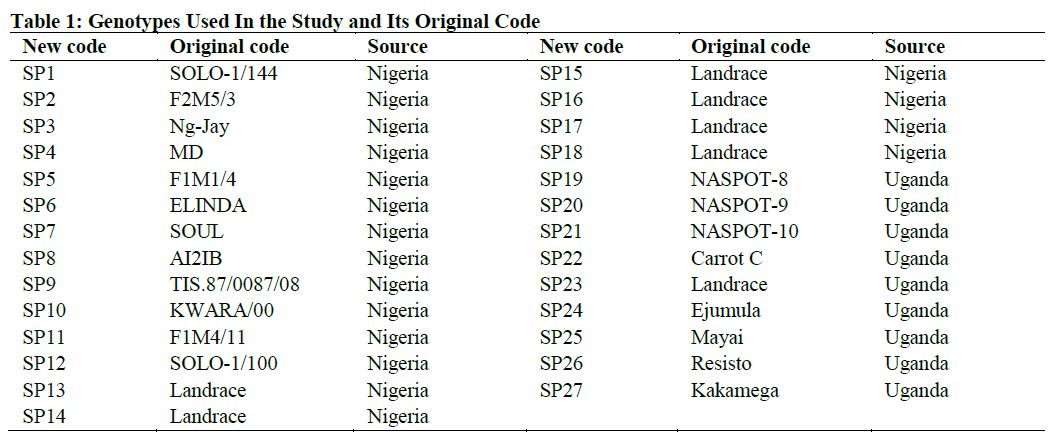
All breeding programs aimed at developing new and improved cultivars with desired traits primarily rely on information related to genetic diversity. Molecular characterisation of plant material has been fundamental for crop improvement, and genetic diversity has long been recognised as vital for the rational management and utilisation of crops. In this study, twenty-seven (27) genotypes of orange-fleshed sweet potato (Ipomoea batatas [L.] Lam) and ten (10) simple sequence repeat (SSR) markers were used to assess genetic diversity. The ten SSR markers proved highly informative in discriminating among the genotypes. These markers exhibited moderate average values for the number of alleles per locus (3.7), with a total of 282 alleles detected across all loci. Additionally, polymorphic information content (PIC) values were high (PIC > 0.50), indicating strong marker informativeness. Using the unweighted pair-group method with arithmetic averages (UPGMA) based on similarity matrices, the 27 genotypes were clustered into eight primary groups at a similarity coefficient of 0.84. The findings of this study demonstrate that SSR markers can effectively estimate genetic diversity and analyse phylogenetic relationships. Moreover, these markers can assist sweet potato breeders in selecting desirable quantitative traits within their breeding programs.
References
Agili, S., Nyende, B., Ngamau, K. & Masinde, P. Selection, yield evaluation, drought tolerance indices of orange-feshed sweetpotato (Ipomoea batata Lam) hybrid clone. J. Nutr. Food Sci. https://doi.org/10.4172/2155-9600.1000138(2012).
Andrade, M. I., Ricardo, J., Naico, A., Alvaro, A., Makunde, G. S., Low, J., & Grüneberg, W. J. (2017). Release of orange-fleshed sweetpotato (Ipomoea batatas [l.] Lam.) Cultivars in Mozambique through an accelerated breeding scheme. The Journal of Agricultural Science, 155(6), 919-929.
Arancibia, R. A. et al. Optimizing sweetpotato production for fresh and processing markets through plant spacing and plantingharvest time. HortTechnology 24(1), 16–24. https://doi.org/10.21273/horttech.24.1.16(2014).
Datta DR, Yusop MR, Misran A, Jusoh M, Oladosu Y, Arolu F, Sulaim an NM (2021) Genetic diversity in eggplant (Solanum melongena L.) germplasm from three secondary geographical origins of diversity using SSR markers. Biocell 45(5): 1393. https://doi.org/10.32604/biocell.2021.015321
Doyle J J and Doyle J L. 1987. A rapid DNA isolation procedure for small quantities of fresh leaf tissue. Phytochemical Bulletin 19, 11–5.
Elameen A, Fjellheim S, Larsen A, Rognli OA, Sundheim L, Msolla S, Masumba E, Mtunda K, Klemsdal SS. 2008. Analysis of genetic diversity in a sweet potato (Ipomoea batatas L.) germplasm collection from Tanzania as revealed by AFLP. Genet Resour Crop Evol. 55:397–408.
Falconer, D. S., & Mackay, T. F. C. (1981). Introduction to quantitative. Genetics, 2nd edition. FAOSTAT. http://www.fao.org/faostat/en/. Accessed 4 Dec 2019.
FAOSTAT. Production of Commodity in Selected Country, Production Share by Region and Production of Top 10 Producers. (FAO, 2022).
Gichuru V, Aritua V, Lubega GW, Edema R, Adipula E, Rubaihayo PR (2006). A preliminary analysis of diversity among East African sweet potato landraces using morphological and simple sequence repeats (SSR) markers. ActaHortic.703:159-164.
Gwandu C, Tairo F, Mneney E, Kullaya A. 2012. Characterization of Tanzanian elite sweet potato genotypes for sweet potato virus disease (SPVD) resistance and high dry matter content using simple sequence repeat (SSR) markers. African Journal Biotechnology. 11:9582–9590.
Kalia RK, Rai MK, Kalia S, Singh R, Dhawan AK (2011) Microsatellite markers: an overview of the recent progress in plants. Euphytica 177: 309–334. https://doi.org/10.1007/s10681-010-0286-9
Karuri HW, Ateka EM, Amata R, Nyende AB, Muigai AWT, Mwasame E, Gichuki ST (2010). Evaluating diversity among Kenyan sweet potato genotypes using morphological and SSR markers. International Journal of Agriculture and Biology 12: 33–38. DOI https://doi.org/10.1007/s11032009-9264-0.
Kawuki SR, Morag F, Maryke L, Liezel H, Dong-Jin K (2009). Identification, characterisation and application of single nucleotide polymorphisms for diversity assessment in cassava (Manihot esculentacrantz). Molecular Breeding 23: 669–684. DOI https://doi.org/10.1007/s11032-009-9264-0.
Koussao, S., Gracen, V., Asante, I., Danquah, E. Y., Ouedraogo, J. T., Baptiste, T. J., & Vianney, T. M. (2014). Diversity analysis of sweet potato (Ipomoea batatas [L.] Lam) germplasm from Burkina Faso using morphological and simple sequence repeats markers. African Journal of Biotechnology, 13(6), 729-742.
Kosieradzka I, Borucki W, Matysiak-Kata I, Szopa J, Sawosz E. Transgenic potato tubers as a source of phenolic compounds. Localization of anthocyanins in the peridermis. J Anim Feed Sci. 2004; 13: 87– 92.
Laurie, S.M., Calitz, F.J., Adebola, P.O., Lezar, A., 2013. Characterization and evaluation of South African sweet potato (Ipomoea batatas (L.) LAM) land races. South African Journal of Botany 85, 10–16.
Li P, Wang Y, Sun X, Han J (2009). Using microsatellite (SSR) and morphological markers to assess the genetic diversity of 12 falcata (Medica gosativa spp. falcata) populations from Eurasia. African Journal Biotechnology 8: 2102–2108.
Loebenstein, G. and Tottappilly, G. Te Sweetpotato (Springer, 2009). https://doi.org/10.1007/978-1-4020- 9475-0.
Ibrahim Musa, MY Rafii, Usman Magaji, Samuel Chibuike Chukwu, Isma’ila Muhammad, Arolu Fatai Ayanda , Bashir Yusuf Rini, Audu Sanusi Kiri (2024) Morphological and molecular diversity of eggplant accessions (Solanum melongena L) using Simple Sequence Repeats (SSR) markers Innovations in Agriculture. 2024; 7: 01-08
Ibrahim Musa, M. Y. Rafii, Ahmad Khairulmazmi, ShairuI Ramlee, Muhammad Asyraf Md Hatta, Usman Magaji, SC Chukwu & Awosan Elizabeth Adetutu (2024) Grafting as an effective approach for improvement of eggplant resistance against bacterial wilt (Ralstonia solanacearum) in screen-house condition. The Journal of Horticultural Science and Biotechnology. 1-10
Nair, A. G., Vidya, P., Ambu, V., Sreekumar, J., & Mohan, C. (2017). Genetic diversity studies in cultivated sweet potato (Ipomoea batatas (L.) Lam) revealed by simple sequence repeat markers. International Journal of Advanced Biotechnology Research, 7(1), 33-48.
Rahman, K. A. M. M., Juraimi, A. S., Molla, M. R., Hatta, M. A. M., Sulaiman, Z. B., Sultana, S., & Hossain, A. (2023). Molecular characterization of sweet potato (Ipomoea batatas [L.] Lam) germplasms for desirable traits by using simple sequence repeats markers. Biocell, 47(1), 227-237.
Rodriguez-Bonilla L, Cuevas HE, Montero-Rojas M, Bird-Pico F, Luciano-Rosario D, Siritunga D (2014). Assessment of genetic diversity of sweet potato in Puerto Rico. PLoS One 9: e116184. DOI https://doi.org/10.1371/journal.pone.0116184.
Rohlf, F.J. NTSYS-pc: Numerical Taxonomy and Multivariate Analysis System; Applied Biostatistics Inc.: Setauket, NY, USA, 2008.
Shih YH, Tseng YT, Lo HF (2002). Application of simple sequence repeats in determining the genetic relationships of cultivars used in sweetpotatopolycrossbreeding in Taiwan. Sci. Hortic. 93:215-224.
Soegianto A, Ardiarini NR, Surgiarto AN (2011). Genetic diversity of sweet potato (Ipomoea batatas L.) in East Java, Indonesia. J. Agric. Food. Technol. 1(9):179-183.
Sree L, Santha S, Pillai V, Sree KJ (2010). Molecular genotyping of Indian cassava cultivars using SSR markers. Advances in Environmental Biology 4: 224–233.
Sulaiman, N. N. M., Rafii, M. Y., Duangjit, J., Ramlee, S. I., Phumichai, C., Oladosu, Y., and Musa, I. (2020). Genetic Variability of Eggplant Germplasm Evaluated under Open Field and Glasshouse Cropping Conditions. Agronomy, 10(3), 436.
Tairo F, Mneney E, Kullaya A. 2008. Morphological and agronomical characterization of sweet potato [Ipomoea batatas (L.) Lam.] germplasm collection from Tanzania. African Journal Plant Science 2:77–85.
Teow CC, Truong V-D, McFeeters RF, Thompson RL, Pecota KV, Yencho GC. Antioxidant activities, phenolic and β-carotene contents of sweet potato genotypes with varying flesh colours. Food Chem. 2007; 103: 829–838.
Turyagyenda LF, Kizito EB, Ferguson ME, Baguma Y, Harvey JW, Gibson P, Wanjala BW, Osiru DSO (2012). Genetic diversity among farmer-preferred cassava landraces in Uganda. African Crop Science Journal 20:15–30.
Veasey, E.A., Silva, J.R.Q., Rosa, M.S., Borges, A., Bressan, E.A., Peroni, N., 2007. Phenology and morphological diversity of sweet potato (Ipomoea batatas) landraces of the Vale do Ribeira. Scientia Agricola 6, 416–427.
Veasey EA, Borges A, Rosa MS, Queiroz-Silva JR, Bressan EA, Peroni N (2008). Genetic diversity in Brazilian sweet potato (Ipomoea batatas (L.) Lam., Solanales, Convolvulaceae) landraces assessed with microsatellite markers. Genet. Mol. Biol. 31(3):725-733.
Wang A, Li R, Ren L, Gao X, Zhang Y, Ma Z, et al. A comparative metabolomics study of flavonoids in sweet potato with different flesh colors (Ipomoea batatas (L.) lam). Food Chemistry. 2018; 260:124-134
Weir, B. S. (1990). Genetic data analysis. Methods for discrete population genetic data. Sinauer Associates, Inc. Publishers
Yada B, Tukamuhabwa PS, Wanjala B, Kim DJ, Skilton RA, Alajo A, Mwanga ROM (2010). Characterization of Ugandan sweet potato germplasm using fluorescent labeled simple sequence repeat markers. HortScience 45: 225–230. DOI https://doi.org/10.21273/HORTSCI.45.2.225.
Yeh FC, Yang RC, Boyle T (1999). POPGENE version 1.31: Microsoft Windows-based freeware for population genetic analysis. University of Alberta and Center for International Forestry Research, Alberta, Canada.
Downloads
Published
Issue
Section
Categories
License
Copyright (c) 2026 Ibrahim Musa, Usman Magaji, Idris Abbas, Jibrin Mohammed, Mohammed Usman

This work is licensed under a Creative Commons Attribution 4.0 International License.


