BREAST CANCER AI ASSISTANT: MULTIMODAL DEEP LEARNING-BASED CLASSIFICATION AND SURVIVAL PREDICTION USING CLINICAL AND MAMMOGRAM DATA
DOI:
https://doi.org/10.33003/fjs-2026-1006-4878Keywords:
AI Assistant, Breast, Cancer, Deep Learning, Multimodal, PredictionAbstract
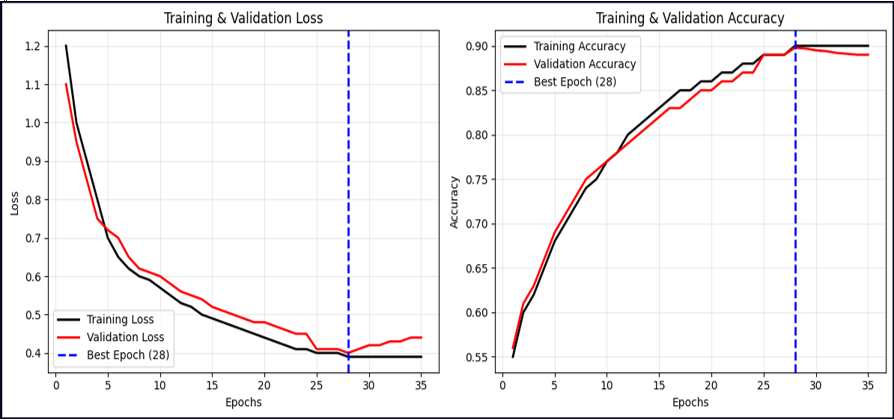
Breast cancer remains a leading global health challenge, with survival outcomes strongly influenced by complex clinical, pathological, and radiological factors. Traditional prognostic methods often fail to capture nonlinear interactions within data, limiting predictive accuracy. This study aims to develop and evaluate deep learning model for breast cancer classification and survival prediction using primary clinical and mammogram data from a Nigerian hospital. A total of 18,909 clinical records and 7,595 mammogram images were collected, preprocessed, and augmented to ensure robust model training. An EfficientNetB3-based convolutional neural network with dual classification and regression heads was employed for image-based diagnosis and survival prediction, while decision tree, gradient boosting, and linear regression models were applied for structured clinical data analysis. The model was trained using stratified datasets with 70:15:15 splits for training, validation, and testing, and evaluated using metrics such as accuracy, precision, recall, F1-score, AUC, MAE, RMSE, and R². Results demonstrated strong predictive performance, with the EfficientNetB3 model achieving up to 85.88% validation accuracy in classification, and gradient boosting attaining an R² of 0.9072 in survival prediction. Survival analyses revealed expected trends across cancer stage, tumor grade, and treatment adherence. The developed system was deployed as a web-based application, enhancing accessibility for clinical use. In conclusion, the integration of deep learning with clinical and imaging data provides accurate, interpretable, and practical tools for breast cancer prognosis, while future work should incorporate additional multimodal data, improve model sensitivity, and validate findings across larger, diverse populations.
References
Alamu, O. S., Gutierrez Choque, B. J., Rizvi, S., Hammed, S., Medani, I. E., Siam, M. K., & Tahir, W. (2024). Predicting Breast Cancer Survival: A Survival Analysis Approach Using Log Odds and Clinical Variables. https://doi.org/10.48550/arxiv.2410.13404
Arya, D., & Saha, S. (2021). A gated attentive deep learning model for multimodal breast cancer survival prediction. Computers in Biology and Medicine, 134, 104458. https://doi.org/10.1016/j.compbiomed.2021.104458
Bray, F., Laversanne, M., Sung, H., Ferlay, J., Siegel, R. L., Soerjomataram, I., & Jemal, A. (2024). Global cancer statistics 2022: GLOBOCAN estimates of incidence and mortality worldwide for 36 cancers in 185 countries. CA: A Cancer Journal for Clinicians, 74(3), 229–263. https://doi.org/10.3322/caac.21834
Breast cancer (pp. 413–420). (2023). Elsevier eBooks. https://doi.org/10.1016/b978-0-323-99622-8.00024-1
Chai, H., Lin, S., He, M., & OuYang, Y. (2024). An uncertainty-based interpretable deep learning framework for predicting breast cancer outcome. BMC Bioinformatics, 25(88). https://doi.org/10.1186/s12859-024-05716-7
Chen, H., et al. (2023). Classification Prediction of Breast Cancer Based on Machine Learning. PubMed. https://pubmed.ncbi.nlm.nih.gov/36688223/
Ferlay, J., Colombet, M., Soerjomataram, I., Parkin, D. M., Piñeros, M., Znaor, A., & Bray, F. (2021). Cancer statistics for the year 2020: An overview. International Journal of Cancer, 149(4), 778–789. https://doi.org/10.1002/ijc.33588
Hao, Y., Jing, X. Y., & Sun, Q. (2023). Cancer survival prediction by learning comprehensive deep feature representation for multiple types of genetic data. BMC Bioinformatics, 24(1), 1–16. https://doi.org/10.1186/s12859-023-05392-z
Javanmard, Z., Zarean Shahraki, S., Safari, K., Omidi, A., Raoufi, S., Rajabi, M., Akbari, M. E., & Aria, M. (2025). Artificial intelligence in breast cancer survival prediction: a comprehensive systematic review and meta-analysis. Frontiers in Oncology, 14. https://doi.org/10.3389/fonc.2024.1420328
Kalafi, E. Y., Alimohamadi, M., & Shokouhi, S. B. (2019). Machine learning and deep learning approaches in breast cancer survival prediction using clinical data. Computers in Biology and Medicine, 109, 164–173. https://doi.org/10.1016/j.compbiomed.2019.04.002
Kate, R. J., & Nadig, R. (2017). Stage-Specific Predictive Models for Breast Cancer Survivability. 97(January).
Lai, Z., Yu, Y., Wang, Z., Lin, R., Li, Y., & Zeng, J., et al. (2024). Deep learning-based multi-modal data integration enhancing breast cancer disease-free survival prediction. Precision Clinical Medicine, 7(2). https://doi.org/10.1093/pcmedi/pbae012
Liang, Y., Yang, J., Quan, X., & Zhang, H. (2019). Metastatic Breast Cancer Recognition in Histopathology Images Using Convolutional Neural Network with Attention Mechanism. Proceedings - 2019 Chinese Automation Congress, CAC 2019, 2922–2926. https://doi.org/10.1109/CAC48633.2019.8997460
Long, J., Hulse, N. C., & Tao, C. (2015, November). Analysis of empty responses from electronic resources in infobutton managers. In AMIA Annual Symposium Proceedings (Vol. 2015, p. 852).
Lou, S.-J., Hou, M.-F., Chang, H.-T., Lee, H.-H., Chiu, C.-C., Yeh, S.-C. J., & Shi, H.-Y. (2022). Breast cancer surgery 10-year survival prediction by machine learning: A large prospective cohort study. Biology (Basel), 11(1), 47. https://doi.org/10.3390/biology11010047
Mandair, D., Reis-Filho, J. S., & Ashworth, A. (2023). Biological insights and novel biomarker discovery through deep learning approaches in breast cancer histopathology. Npj Breast Cancer, 9(1), 1–11. https://doi.org/10.1038/s41523-023-00518-10.athway to Empower and Support Survivors of Breast Cancer. Journal of the American Society of Clinical Oncologist, 19(6), 353–361. https://doi.org/10.1200/OP.23.00016
Mustafa, A., Ali, H., & Shah, S. A. A. (2023). EBCSP: Ensemble-based breast cancer survival prediction using multimodal deep learning. Scientific Reports, 13, 9024. https://doi.org/10.1038/s41598-023-35717-0
Mustafa, E., Humayun, M. A., & Maray, M. (2023). An ensembled framework for human breast cancer survivability prediction using deep learning. Diagnostics, 13(10), 1688. https://doi.org/10.3390/diagnostics13101688
Othman, M. M., Yusof, U. K., & Rahim, M. S. M. (2023). Hybrid CNN–LSTM and CNN–GRU architectures for breast cancer survival prediction. Diagnostics, 13(5), 882. https://doi.org/10.3390/diagnostics13050882
Othman, N. A., Abdel-Fattah, M. A., & Ali, A. T. (2023). A Hybrid Deep Learning Framework with Decision-Level Fusion for Breast Cancer Survival Prediction. Big Data and Cognitive Computing, 7(1). https://doi.org/10.3390/bdcc7010050
Paul, A., Banerjee, S., & Mitra, S. (2024). DiaDeepBreastPRS: Deep learning model for histopathology-based breast cancer survival prediction. Frontiers in Oncology, 14, 1397642. https://doi.org/10.3389/fonc.2024.1397642
Paul, J., Bossard, C., Rynkiewicz, J., Molinié, F., Salhi, S., Frenel, J., Salhi, Y., & Chetritt, J. (2024). Survival outcome prediction of breast carcinomas on whole-slide histopathology images using deep learning. Journal of Clinical Oncology. https://doi.org/10.1200/jco.2024.42.16_suppl.1070
Pillai, G. G., Andrade, C. J., Ligibel, J. A., Basu, P., Cohen, L., Khan, I. A., Mustian, K. M., Guido, P. C., & Salicrup, L. A. (2022). Integrative oncology : Addressing the global challenges of cancer prevention and treatment. 144–164. https://doi.org/10.3322/caac.21706
Radiomics, M., Cancer, B., & Thesis, D. (2022). Mri-Based Radiomics in Breast Cancer IN BREAST CANCER (Issue 2022). https://doi.org/10.26481/dis.20220922rg
Salvi, M., Acharya, U. R., Molinari, F., & Meiburger, K. M. (2021). The impact of pre- and post-image processing techniques on deep learning frameworks : A comprehensive review for digital pathology image analysis. Computers in Biology and Medicine, 128, 104129. https://doi.org/10.1016/j.compbiomed.2020.104129
Satyanarayana, N., & Chaitanya, M. (2021). Review paper on research direction towards cancer prediction and prognosis using machine learning and deep learning models. Journal of Ambient Intelligence and Humanized Computing, 0123456789. https://doi.org/10.1007/s12652-021-03147-3
World Health Organization. (2023). Breast cancer: Key facts. Retrieved from https://www.who.int/news-room/fact-sheets/detail/breast-cancer
Yadav, A. (2023). Revolutionizing Breast Cancer Management : Harnessing the power of Machine Learning in Diagnosis and Treatment A DISSERTATION SUBMITTED IN PARTIAL FULFILLMENT OF THE REQUIREMENTS FOR THE AWARD OF THE DEGREE Master of Science In Anukriti Yadav. DELHI TECHNOLOGICAL UNIVERSITY.
Zuo, D., Yang, L., Jin, Y., Qi, H., Liu, Y., & Ren, L. (2023). Machine learning-based models for the prediction of breast cancer recurrence risk. BMC Medical Informatics and Decision Making, 23, 276. https://doi.org/10.1186/s12911-023-02377-z
Downloads
Published
Issue
Section
Categories
License
Copyright (c) 2026 Bello Sani Buhari, Auta Timothy, Atalabi T. Ebenezer

This work is licensed under a Creative Commons Attribution 4.0 International License.