
Development of a Load Balancing Framework for Microservices Architecture Using Reinforcement Learning
DOI:
https://doi.org/10.33003/fjs-2026-1019-4875Keywords:
Microservices, Load Balancing, Reinforcement Learning, Proximal Policy Optimization, Kubernetes, Istio, Service Mesh, Cloud ComputingAbstract
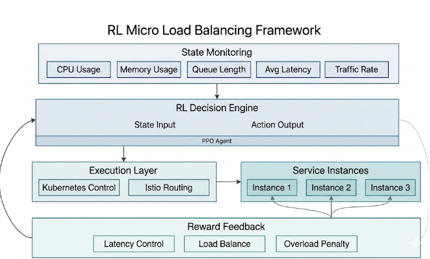
The increasing adoption of microservices architecture has improved the scalability, modularity, and maintainability of cloud-native applications. However, the dynamic and heterogeneous nature of microservices workloads creates significant challenges for conventional load-balancing mechanisms, which typically rely on predefined routing rules and have limited ability to respond to changing runtime conditions. This study develops and evaluates RL-MicroLB, an adaptive load-balancing framework that uses reinforcement learning to dynamically distribute requests among microservice instances. The framework employs Proximal Policy Optimization (PPO) and integrates Kubernetes, Istio Service Mesh, Prometheus, Locust, and StableBaselines3 within a closed loop traffic management architecture. Runtime performance measurements are collected through Prometheus and supplied as observations to the PPO agent. The agent determines traffic-routing weights, which are dynamically enforced through Istio VirtualService resources, while subsequent system measurements provide feedback for continued decision-making. The framework was implemented using the Sock Shop microservices application and evaluated under varying workload conditions. Experimental results showed that RL-MicroLB reduced P95 latency from 420 ms under Round Robin to 285 ms, representing a 32.1% reduction. Average response time decreased from 240 ms to 185 ms, CPU utilization variance decreased from 0.18 to 0.07, CPU balance score increased from 0.72 to 0.91, and throughput increased from 820 to 845 requests per second. Comparative evaluation against Least Connections, Weighted Round Robin, and Deep Q-Network further showed that PPO achieved the best overall performance among the evaluated approaches under the experimental conditions.
References
Boudieb, W., Malki, A., Malki, M., Badawy, A., & Barhamgi, M. (2024). Microservice instances selection and load balancing in fog computing using deep reinforcement learning approach.
Chawla, K. (2025). Reinforcement learning-based adaptive load balancing for dynamic cloud environments.
Daruvuri, R. (2023). Dynamic load balancing in AI-enabled cloud infrastructures using reinforcement learning and algorithmic optimization.
Gasmi, K., Abassi, K., Romdhani, L., & Debauche, O. (2023). Reinforcement learning-based approach for microservices-based application placement in edge environment.
He, X., & Wang, T. (2025). Multi-objective reinforcement learning for adaptive load balancing in cloud data centers.
Kamila, N. K., Frnda, J., Pani, S. K., Das, R., Islam, S. M. N., Bharti, P. K., & Muduli, K. (2022). Machine learning model design for high performance cloud computing & load balancing resiliency: An innovative approach.
Kaveri, P. R., & Lahande, P. (2023). Reinforcement learning to improve resource scheduling and load balancing in cloud computing.
Pattanaik, P., Khan, M. Z., & Mansuri, M. (2025). Large language models and reinforcement learning for efficient load balancing in dynamic cloud environments.
Roy, S., Ojha, K., & Dasandi, A. (2025). AI meets load balancing: A reinforcement learning approach for traffic spike resilience.
Shah, R., Solanki, S., Dave, S., & Sharma, G. (2025). A novel approach to dynamic cloud load balancing based on reinforcement learning.
Yao, Z., Ding, Z., & Clausen, T. (2022). Multi-agent reinforcement learning for network load balancing in data centers.
Caleb, Akanbi. (2023). Reinforcement Learning-Driven Load Balancing Strategies for Microservices: A Path to Optimal Performance.
Roy, S., Ojha, K., & Dasandi, A. (2025). AI meets load balancing: A reinforcement learning approach for traffic spike resilience.
Downloads
Published
Issue
Section
Categories
License
Copyright (c) 2026 Olawuwo Abdulmuiz Adesina, Muhammad Aliyu Suleiman, Prema Kirubakaran, Salisu Ibrahim Yusuf

This work is licensed under a Creative Commons Attribution 4.0 International License.


