
Development of a Hybrid-Model Recommender System for an E-Learning Platform
DOI:
https://doi.org/10.33003/fjs-2026-1017-6000Keywords:
Recommender System, E-learning, Machine Learning, Content-Based Filtering, Collaborative Filtering, HybridAbstract
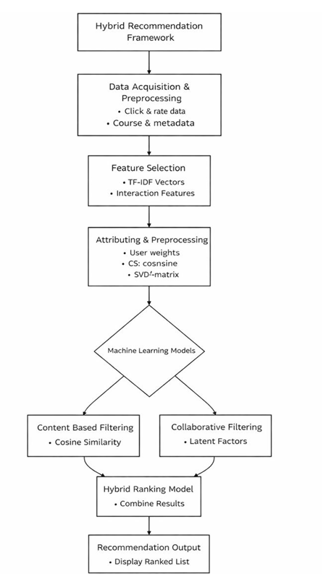
E-learning systems continue to experience a growing number of courses and learning materials, making it increasingly difficult for learners to locate resources that are relevant to their interests, capabilities, and learning goals. This study developed and evaluated a lightweight hybrid recommender system for an e-learning platform that integrates content-based filtering (CBF) and collaborative filtering (CF) to improve the relevance and personalization of learning-resource recommendations. The content-based component employed Term Frequency-Inverse Document Frequency (TF-IDF) and cosine similarity to identify resources based on their content, while the collaborative filtering component used Singular Value Decomposition (SVD) to model learner-item interaction patterns. Experimental evaluation was conducted using accuracy, precision, recall, F1-score, and processing time. The hybrid model achieved the best overall performance, recording an accuracy of 0.88, precision of 0.89, recall of 0.80, and F1-score of 0.84, compared with the content-based model, which achieved 0.74, 0.62, 0.57, and 0.60, respectively, and the collaborative filtering model, which achieved 0.81, 0.74, 0.67, and 0.70, respectively. Although the hybrid model recorded a processing time of 0.068 seconds, slightly higher than collaborative filtering (0.064 seconds) and comparable to content-based filtering (0.067 seconds), the improvement in recommendation quality outweighed the marginal increase in execution time. The results demonstrate that integrating content-based and collaborative filtering can reduce the effects of cold-start and data sparsity while producing more relevant and consistent recommendations. The proposed hybrid model therefore provides an effective and computationally lightweight approach for personalized e-learning recommendation in resource-constrained educational environments.
References
Adomavicius, G., &Tuzhilin, A. (2022). Recommender systems: A multidisciplinary perspective. Communications of the ACM, 65(6), 38–45. https://doi.org/10.1145/3531146 .
Ng, D. T. K. (2021). The impact of online learning on higher education. Educational Technology Research and Development, 69(6), 3041–3063.
Widayanti, R., Chakim, M. H. R., Lukita, C., Rahardja, U., &Lutfiani, N. (2023). Hybrid CF + CBF recommender improvement. Journal of Applied Data Sciences, 4(3), 289– 302.
Dahdouh, H., Dakkak, A., &Oughdir, L. (2019). A survey on recommendation systems for education.
Akhter, S., Javed, M. K., Shah, S. Q., & Javaid, A. (2021). Highlighting the advantages and disadvantages of e-learning. Psychology and Education, 58(5), 1607–1614.
Akhter, S., Rahman, M., & Hossain, M. (2021). Adoption of e-learning systems in higher education: A review of technological and pedagogical factors. Education and Information Technologies, 26(5), 5879–5904.
Pitchford, N. J. (2023). Personalized learning systems and learner engagement. Educational Psychology Review, 35(2), 457–480.
Madhavi, A., Nagesh, A., & Govardhan, A. (2022). Personalized e-learning recommendation systems: A review. Journal of King Saud University – Computer and Information Sciences, 34(5), 1741–1753.
Adomavicius, G., &Tuzhilin, A. (2011). Context-aware recommender systems. In F. Ricci, L. Rokach, B. Shapira, & P. B. Kantor (Eds.), Recommender systems handbook (pp. 217– 253). Springer.
Liu, Y., Zhao, L., & Su, Y. S. (2022). Teacher competence and online learning outcomes.International Journal of Environmental Research and Public Health,19(10), 6282.
Murtaza, M., Abbas, A., & Khan, S. (2022). Reinforcement learning–based adaptive elearning systems: A review. Applied Soft Computing, 114, 108075.
Murtaza, M., Ahmed, Y., Shamsi, J. A., Sherwani, F., & Usman, M. (2022). AI-based personalized e-learning systems. IEEE Access, 10, 81323–81342.
Saleem, Y., Noori, S., &Ozdamli, F. (2022). Deep learning recommender systems in education: Opportunities and challenges. Education and Information Technologies, 27(3), 3431–3453.
Ko, E., Lee, S., & Kim, J. (2022). Recommendation systems: Recent advances and applications. Expert Systems with Applications, 189, 116065.
Ko, H., Lee, S., Park, Y., & Choi, A. (2022). A survey of recommendation systems. Electronics, 11(1), 141.
Afsar, M. M., Crump, T., & Far, B. (2022). Reinforcement learning–based recommender systems: A survey. ACM Computing Surveys, 55(7), 1–38. https://doi.org/10.1145/3523221 .
Chen, J., Dong, H., Wang, X., Feng, F., Wang, M., & He, X. (2023). Bias and debiasing in recommender systems: A survey. ACM Transactions on Information Systems, 41(3), 1–42.
Chen, L., Chen, G., & Wang, F. (2023). Bias and debiasing in recommender systems: A survey. Information Sciences, 620, 1–24.
Chen, L., Zhang, G., & Zhou, H. (2023). Enhancing MOOC engagement through collaborative filtering recommendations. Computers & Education: Artificial Intelligence, 4, 100148.
Downloads
Published
Issue
Section
Categories
License
Copyright (c) 2026 Mohammed Alkali Shettima, Kolapo Ridwan, Anka Salihu, Prema Kirubakaran

This work is licensed under a Creative Commons Attribution 4.0 International License.


