
Deep Learning for Image Steganalysis: A Structured Comparative Review of Dataset, Domain, and Robustness Coverage
DOI:
https://doi.org/10.33003/fjs-2026-1016-5739Keywords:
Adversarial Robustness, Deep Learning, Image SteganalysisAbstract
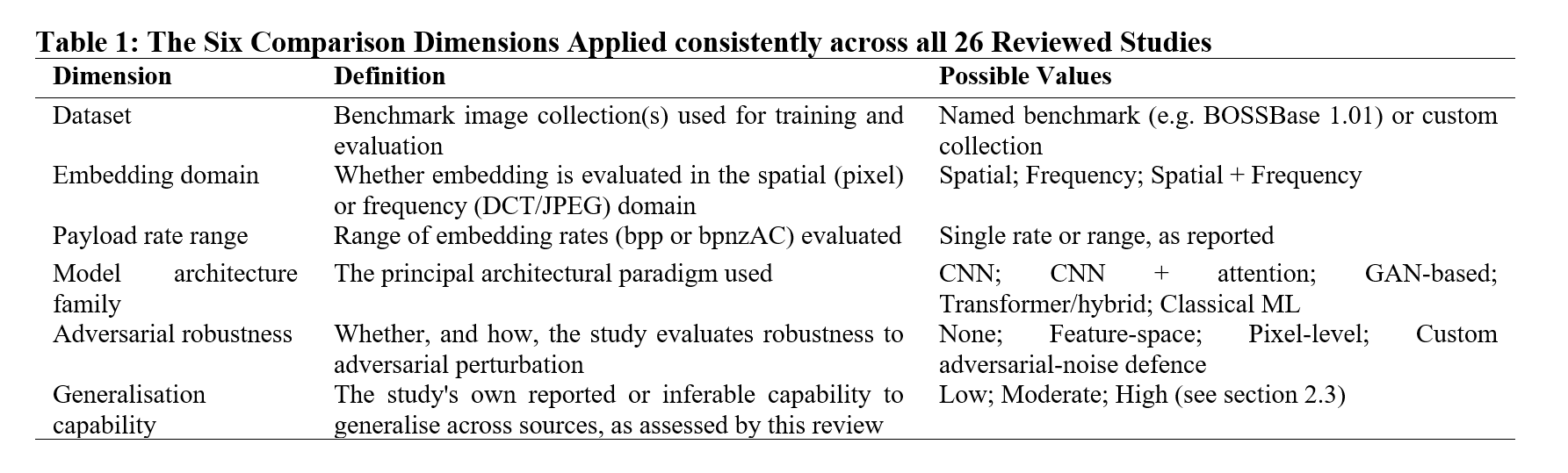
Deep learning has substantially advanced image steganalysis, yet inconsistent evaluations across datasets, embedding domains, payload rates, and threat models obscure the field's readiness for real-world forensic deployment. This structured comparative review analyses 26 deep-learning steganalysis studies (2015–2025) across six standardized dimensions, synthesizing findings into three critical structural gaps. First, adversarial robustness is severely under-addressed: only 19% (5 of 26) of studies evaluate robustness, with just a single study testing pixel-level, norm-bounded perturbations rather than feature-space attacks. Second, single-domain architectural specialization predominates, as no reviewed study evaluates a single unified model across both spatial and frequency embedding domains; limiting multi-domain efforts to separate models or content heterogeneity. Third, cover-source mismatch remains widespread due to dataset homogeneity, with most studies relying solely on single-source benchmarks like BOSSBase 1.01. Ultimately, while individual studies partially address single limitations, none solve all three simultaneously; closing these gaps requires a unified architecture combining multi-source training, dual-domain coverage, and pixel-level adversarial testing, representing an essential open challenge for practical deployment.
References
Agarwal, S., & Jung, K.-H. (2024). Digital image steganalysis using entropy driven deep neural network. Journal of Information Security and Applications, 84, 103799.
Akram, A., Khan, I., Rashid, J., Saddique, M., Idrees, M., Ghadi, Y. Y., & Algarni, A. (2024). Enhanced steganalysis for color images using curvelet features and support vector machine. Computers, Materials & Continua, 78(1).
Al-Obaidi, S. A. R., Lighvan, M. Z., & Asadpour, M. (2024). Enhanced image steganalysis through reinforcement learning and generative adversarial networks. Intelligent Decision Technologies, 18(2), 1077–1100.
Alrusaini, O. A. (2025). Deep learning for steganalysis: Evaluating model robustness against image transformations. Frontiers in Artificial Intelligence, 8, 1532895.
Bohang, L., Ningxin, L., Osama, A., Fahad, A., Amr, T., Zaffar, A. S., Rohallah, A., Pawel, P., & Pol, L. Y. (2025). Image steganalysis using active learning and hyperparameter optimization. Scientific Reports, 15, 7340.
Boroumand, M., Chen, M., & Fridrich, J. (2019). Deep residual network for steganalysis of digital images. IEEE Transactions on Information Forensics and Security, 14(5), 1181–1193.
Bravo-Ortiz, M. A., Mercado-Ruiz, E., Villa-Pulgarin, J. P., Hormaza-Cardona, C. A., Quiñones-Arredondo, S., Arteaga-Arteaga, H. B., & Tabares-Soto, R. (2024). CvT-StegoNet: A convolutional vision transformer architecture for spatial image steganalysis. Journal of Information Security and Applications, 81, 103695.
De La Croix, N. J., Putra, M. A. R., & Ahmad, T. (2024). Toward the confidential data location in spatial domain images via a genetic-based pooling in a convolutional neural network. In 2024 16th International Conference on Computer and Automation Engineering (ICCAE), 283–288.
Dwaik, A., & Belkhouche, Y. (2024). Enhancing the performance of convolutional neural network image-based steganalysis in spatial domain using spatial rich model and 2D Gabor filters. Journal of Information Security and Applications, 85, 103864.
Fridrich, J., & Kodovsky, J. (2012). Rich models for steganalysis of digital images. IEEE Transactions on Information Forensics and Security, 7(3), 868–882.
Fu, T., Chen, L., Fu, Z., Yu, K., & Wang, Y. (2022). CCNet: CNN model with channel attention and convolutional pooling mechanism for spatial image steganalysis. Journal of Visual Communication and Image Representation, 88, 103633.
Hu, J., Shen, L., & Sun, G. (2018). Squeeze-and-excitation networks. In Proceedings of the IEEE Conference on Computer Vision and Pattern Recognition (CVPR), 7132–7141.
Hu, M., & Wang, H. (2023). Image steganalysis against adversarial steganography by combining confidence and pixel artifacts. IEEE Signal Processing Letters, 30, 987–991.
Hu, M., & Wang, H. (2025). Directional adversarial noise-based universal steganalysis method for detecting adversarial steganography. IEEE Signal Processing Letters.
Huang, S., Zhang, M., Kong, Y., Ke, Y., & Di, F. (2024). FACSNet: Forensics aided content selection network for heterogeneous image steganalysis. Scientific Reports, 14, 26258.
Jawad, T. A., Mohasefi, J. B., & Abdelghany, M. S. R. (2025). Adversarial-robust steganalysis system leveraging adversarial training and EfficientNet. TELKOMNIKA (Telecommunication Computing Electronics and Control), 23(2), 393–401.
Ke, Q., & Sheng, L. (2019). Content adaptive image steganalysis in spatial domain using selected co-occurrence features. In 2019 IEEE International Conference on Artificial Intelligence and Computer Applications (ICAICA), 28–33.
Li, H., & Dong, S. (2024). Image steganalysis algorithm based on deep learning and attention mechanism for computer communication. Journal of Electronic Imaging, 33(1), 013015.
Li, J., Wang, X., Song, Y., & Wang, P. (2024). FPFNet: Image steganalysis model based on adaptive residual extraction and feature pyramid fusion. Multimedia Tools and Applications, 83, 48539–48561.
Li, M., & Liu, Q. (2015). Steganalysis of SS steganography: Hidden data identification and extraction. Circuits, Systems, and Signal Processing, 34(10), 3305–3324.
Liu, S., Zhang, C., Wang, L., Yang, P., Hua, S., & Zhang, T. (2023). Image steganalysis of low embedding rate based on the attention mechanism and transfer learning. Electronics, 12(4), 969.
Lu, Y. Y., Yang, Z. L. O., Zheng, L., & Zhang, Y. (2019). Importance of truncation activation in pre-processing for spatial and JPEG image steganalysis. In 2019 IEEE International Conference on Image Processing (ICIP), 689–693.
Mo, C., Liu, F., Zhu, M., Yan, G., Qi, B., & Yang, C. (2023). Image steganalysis based on deep content features clustering. Computers, Materials & Continua, 76(3).
Mohamed, N., Rabie, T., & Kamel, I. (2020). A review of color image steganalysis in the transform domain. In 2020 14th International Conference on Innovations in Information Technology (IIT), 45–50.
Muhammed, F. O., Suleiman, M. A., Abdullahi, S. E., & Ogar, A. O. (2026). An explainable hybrid CNN-LSTM-Random Forest framework for early epidemic outbreak detection from multimodal data, validated by real corpora and controlled simulation. FUDMA Journal of Sciences, 10(10), 26–36.
Peng, Y., Yu, Q., Fu, G., Zhang, W., & Duan, C. (2024). Improving the robustness of steganalysis in the adversarial environment with generative adversarial network. Journal of Information Security and Applications, 82, 103743.
Selvaraj, A., Ezhilarasan, A., Wellington, S. L. J., & Sam, A. R. (2021). Digital image steganalysis: A survey on paradigm shift from machine learning to deep learning based techniques. IET Image Processing, 15(2), 504–522.
Shankar, D. D., & Azhakath, A. S. (2019). Steganalysis of minor embedded JPEG image in transform and spatial domain system using SVM-PSO. In 2019 International Conference on Computational Intelligence and Knowledge Economy (ICCIKE), 46–49.
Yang, S., Jia, X., Zou, F., Zhang, Y., & Yuan, C. (2024). A novel hybrid network model for image steganalysis. Journal of Visual Communication and Image Representation, 103, 104251.
Yu, X., Ma, Y., Zhang, Y., Li, X., & Zhao, Y. (2024). Fast dominant feature selection with compensation for efficient image steganalysis. Signal Processing, 220, 109475.
Zhengliang, L., Chenyi, W., Zhu, X., Jianhua, W., & Guiqin, D. (2025). SG-ResNet: Spatially adaptive Gabor residual networks with density-peak guidance for joint image steganalysis and payload location. Mathematics, 13, 1460.
Downloads
Published
Issue
Section
Categories
License
Copyright (c) 2026 Asma'u Shehu, Prema Kirubakaran, Bilkisu L. Muhammad-Bello, Nurudeen Ibrahim

This work is licensed under a Creative Commons Attribution 4.0 International License.


