
TRADITIONAL METHODS OF BEEKEEPING AND HONEY PRODUCTION AMONG SMALL HOLDER FAMERS IN NASARAWA STATE NIGERIA
DOI:
https://doi.org/10.33003/fjs-2026-1001-4516Keywords:
Traditional beekeeping, honey productionAbstract
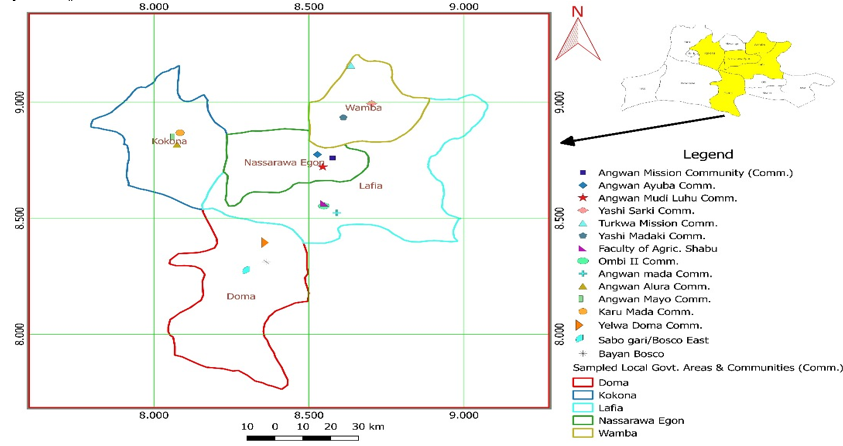
Beekeeping is the art of rearing, breeding and managing honeybee colonies in artificial hives for economic gains leading to the production of valuable materials such as honey, bee wax, bee pollen, bee venom and royal jelly. Unfortunately, these enormous potentials are bedeviled with complicated constraints including the use of traditional bee hives, fire as a traditional practice in honey collection (harvesting) technique which reduces the quality and the quantity of honey and its products. This study assessed the traditional beekeeping methods in Nasarawa State, Nigeria, focusing on socio-economic characteristics, practices, constraints, and productivity. A survey of 150 beekeepers across five Local Government Areas (LGAs)—Nasarawa Eggon, Doma, Lafia, Kokona, and Wamba—revealed that beekeeping is predominantly male-dominated, with most practitioners aged 21–30 years. Log hive was dominant in Wamba, 90%, followed by Kokona, 80% and 56.7% in Doma while skep was higher in Lafia, 56.7%. The findings further indicate that Wamba produced the highest honey yields (21–25 litters/hive). Major constraints included theft, diseases, deforestation, and capital limitations, while government policies were perceived to be neutral. Beekeeping significantly enhanced livelihoods, with 76.7–86.7% of respondents reporting improved living standards. The study concludes that there is considerable potential to enhance beekeeping productivity and sustainability through interventions such as the introduction of improved beehive technologies, access to credit, training in modern apiculture practices, and stronger institutional support. Such measures could strengthen beekeeping as a viable and sustainable income source for rural communities in Nasarawa State and similar regions in Nigeria.
References
Abdullahi, A., Isekenegbe, J. and Mohammed, U.S. (2014), “Comparative economic analysis of modern and traditional bee-keeping in Lere and Zaria local government areas of Kaduna State, Nigeria”, International Journal of Development and Sustainability, 3(5):989-999
Adgaba, N., Al-Ghamdi, A., & Tadesse, Y. (2022). Gender roles in beekeeping: Socio-economic Analysis of Beekeeping and the Effects of Beehive Types on Honey Production. African Journal of Agricultural Research, 5(22), 3003–3008.
Ahaotu, E.O and Nwachukwu, E.A (2014). Honeybee Production and Marketing Systems,
Constraints and Opportunities. : In Micro Livestock Production in the Tropics. Eds. Jeolas Press, Owerri, Nigeria. 22-43.
Aidoo, K., Ohene-Yankyera, K., & Kerapeletswe, C. K. (2023). Financial viability and
constraints of smallholder beekeeping in the Bono Region of Ghana. African Journal of Agricultural and Resource Economics, 18(1), 22-36.
Ajao, A. M., Oladimeji, Y. U., & Ogunjimi, S. I. (2021). Adoption of modern beekeeping impact
on honey yield. Bee World, 98(2), 45-53.
Ayalew, K. (2001) Promotion of beekeeping inrural sector of Ethiopia: Proceedings of the third
National Annual Conference of Ethiopian.
Babatunde, R.O., Olorunsanya, E.O Omotesho, O.A. and Alao, B.I. (2007): Economics of Small
Scale Honey Production in Nigeria: Case Study from Oyo state. Journal of Agricultural Extension 3(2): 23-29.
Bradbear, N (2020): Bees and Rural Livelihoods.16pp Booklet in English, Portuguese and
Spanish Editions Bees for Development, Monmouth, UK.
Chemurot, M. (2022). Hive Technology Adoption and Productivity in African Apiculture.
Agricultural Systems (20)3, 103518.
Chigbo, C., Ahaotu, E.O, Edih, M.Cand Olueze, C.C. (2020). Profitability of Honey Production
in Idemili South local Government area of Anambra State, Nigeria. Journal of Animal Husbandry and Dairy Science 4(2): 21-29.
Chigbo, C., Ahaotu, E.O, Edih, M.CandOlueze, C.C. (2020). Profitability of Honey Production
in Idemili South local Government area of Anambra State, Nigeria. Journal of Animal Husbandry and Dairy Science 4(2): 21-29.
Faleye, O. S., Adekunle, A. E., & Ogunjobi, J. A. (2021). Assessment of beekeeping practices
and honey production in Southwestern Nigeria. Journal of Agricultural Extension and Rural Development, 13(2), 45-55.
FAO. (2022).Youth and Agriculture: Challenges and Opportunities. Rome: Food and Agriculture
Organization.
Gebretinsae, H., et al. (2021).Indigenous Knowledge Transfer in Ethiopian Bee keeping. Journal
of Ethnobiology, 41(3), 398–412.
Gebretsadik, T., & Negash, D. (2023). Long-term beekeeping and its implications for honey Yield. Archives of Current Research International 22(1): 53-63.
Gidey, Y., & Mekonen, T. (2020). Religious Identity and Beekeeping Practices in Northern
Ethiopia. African Studies Review, 63(4), 789–805.
Ibrahim, O., Hudu, A. B., and Ismail, H. A., (2022) Socio-economic Important of Beekeeping in
Lafia Local Government Area of Nasarawa State, Nigeria Archives of Current Research International 22(1): 53-63, 2022.
Kasina, J. M., Mburu, J., & Kraemer, M. (2021). Economic contribution of beekeeping to honey
production in Ethiopia. Apiculture Journal, 12(1), 34-45.
Mazorodze, B. T., & Mwanyambo, M. L. (2022). Post-harvest losses in smallholder beekeeping:
A review of challenges and mitigation strategies in Sub-Saharan Africa. African Journal of Agricultural Research, 18(5), 345-356.
Muli, E., Munguti, F., & Raina, S. K. (2018). The contribution of hive technology to productivity
and profitability of small-scale beekeeping in Eastern Kenya. Journal of Apicultural Research, 57(5), 593-601.
Muli, E., Natukunda, K. and Kugonza, D. R (2018): Factors Affecting the Adoption of
Beekeepin and Associated Technologies in Bushenyi District, Western Uganda Livestock Research for Rural Development, 24(8).
Munyuli, T. M. B. (2016). Farmer’s perceptions of the relative importance of pollination and
pollinators in smallholder agricultural production systems in Kenya. International Journal of Tropical Insect Science, 36(3), 112-129.
Mwangi, J., (2021). Language Barriers in Agricultural Extension. Journal of Rural Studies, 88,
482–491.
National Population Commission (2006) Nigeria’s Population Census 2006.
Njoroge C. K, Tuitoek D. K, Nganai S. K. (2019). 426 Factors Influencing Honey Production in
Marigat, Baringo County – Kenya. International Journal of Research and Innovation in Social Science (IJRISS) 3 (2): 426-434
Njoroge, G. (2017). Gender and Apiculture: Case Studies from East Africa. Journal of Gender,
Agriculture and Food Security, 2(2), 63–82.
Nuru, A., Al-Ghamdi, A., & Tadesse, Y. (2021). Modern beekeeping technologies Bushenyi
District, Western Uganda Livestock Research for Rural Development, 24(8).
Oguntoyinbo, O. O., Ogunjobi, J. A., & Amao, H. O. (2021). Structure and performance of
honey marketing in Oyo State, Nigeria. Nigerian Journal of Agricultural Economics, 11(1), 52-62.
Oladimeji Y. U., and Ajao A. M. (2018). Prevalence of Socio-economic Factors Influencing
Honey Bee Stressors and the Coping Strategies in Bee Farms in Kwara State, Nigeria. FUDMA Journal of Sciences (FJS) 2(3):9- 17.
Otieno, M. O., Nyunja, R., & Otieno, P. (2023). Capital investment and scalability in African
beekeeping: a value chain Approach. African Journal of Agricultural and Resources Economics 18(2), 112-125.
Otim, A. S., Kajobe, R., Kungu, J. M., Echod, R. (2018): The Socio-Economic Factors
Influencing Honey Production in Uganda. Global Journal of Agricultural Research 6(2), 1-9
Sa’aondo S. M, Mathew L. A., Ashe C. B., Egbewale T. Z. and Ogunbode A. S. (2024). The
Assessment of Multifunctional Forest Resources for Improved Rural Livelihood at Akanga Tectona grandis LINN. F. (Teak) Plantation - Proceedings of the Forestry Association of Nigeria held in Osogbo, Osun State Nigeria). 406-415
Shu’aib, A.U., Kyiogwom, U.B. and Baba, K.M (2009): Resource-use efficiency of Modern
Beekeeping in selected LGAs of Kano State, Nigeria. Proceedings of the 23rd Annual National Conference of Farm Management Society of Nigeria, Held at Usuman Danfodio University Sokoto, Sokoto State, Nigeria. 14th-17th December, 2009. p630-634.
Uchechukwu, N.U., Anyaegbunam, H.N. and Mgbeahuru, C.C. (2020): Determinants of
Marketing Efficiency among Bee Honey Entrepreneurs in Umuahia Agricultural Zone, Abia State, Nigeria. Nigerian Agricultural Journal 51(2): 445-452.
Ukanyirioha C. J.1, ErhaborT. A.1, Yakubu C. K., Shoyemi A. O., Olori-Oke O. (2022)
Constarints and Socio Eceonomic Determinants of bee keeping in Sanga Local Government Area Of Kaduna State, Nigeria. Journal of Forestry Research and Management. Vol. 19(1).50-56.
Downloads
Published
Issue
Section
Categories
License
Copyright (c) 2026 F. A Danlami, S Nasiru, T. Z Egbewale, S. M Sa’aondo, M. B Oyun

This work is licensed under a Creative Commons Attribution 4.0 International License.


