
ABOVE GROUND BIOMASS AND CARBON STOCK SEQUESTRATION POTENTIALS AND ECONOMIC VALUE OF FOREST PLANTATION ESTABLISHED IN NASARAWA
DOI:
https://doi.org/10.33003/fjs-2026-1001-4513Keywords:
Aboveground Biomass, Carbon Sequestration, Carbon Credits, Economic Valuation, Forest Plantation, Nasarawa StateAbstract
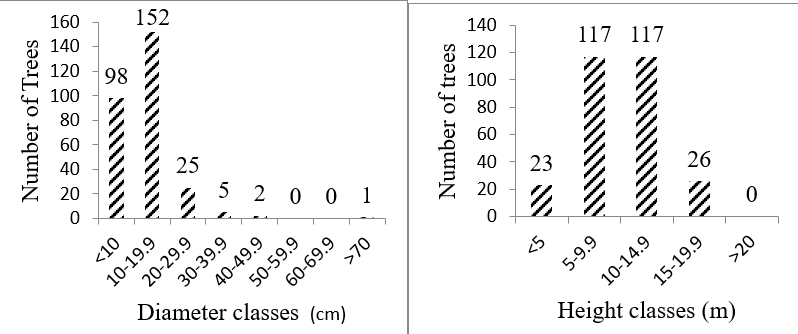
Forest plantations serve as vital carbon sinks for climate change mitigation and provide economic opportunities via carbon credit trading. This study evaluated the aboveground biomass (AGB), carbon sequestration potential, and economic value of a 10-year-old plantation integrated with native tree species at Nasarawa State University, Shabu-Lafia Campus, Nigeria. In the 1.90-hectare site, seven plots were randomly selected, measuring tree DBH and height for all the species. AGB was calculated using allometric model incorporating wood density. Total aboveground carbon stock was 15.49 tonnes, equating to 56.80 tonnes of CO2, primarily from large native trees like Parkia biglobosa (1314.9kg) on average and abundant species such as Khaya senegalensis (73.23kg), Gmelina arborea (51.795kg), and Tectona grandis (60.96kg). This shows that the rate of AGB accumulation is higher in K. senegalensis with lower numbers of trees, 66 compare to G. arborea with higher number of trees,117 lower in AGB, all planted within the same period. Economic valuation estimated US $930 (NGN 1.42 million) in potential revenue. The plantation represents a significant carbon sink with economic benefits, highlighting the value of conserving native species alongside exotic management for optimal sequestration. It is therefore recommended that pursuing carbon credit certification, silvicultural planning with thinning and enrichment, and long-term monitoring for climate finance and research.
References
Akindele S. O. and LeMay V. M. (2006). Development of tree volume equations for
common timber species in the tropical rainforest area of Nigeria. Forest Ecology and Management. 226: 41−48.
Assessment Framework. Retrieved from ICVCM website.
Brown, N., Buse, C., Lewis, A., Martin, D., & Nettleton, S. (2019). Pathways, practices and
architectures: Containing antimicrobial resistance in the cystic fibrosis clinic. Health. https://doi.org/10.1177/1363459319866894
Camille Gonseth1 and Marc Vielle1 (2019). A General Equilibrium Assessment of Climate
Change Impacts on Swiss Winter Tourism with Adaptation. REnvironmental Modeling & Assessment (2019) 24:265–277 HTTPS://DOI.ORG/10.1007/S10666-018-9641-3
Carter, S., Goh, A., & McCormack, C. (2019). Carbon Trading and the Role of Forests.
Chan N. Chan, S. Takeda, R. Suzuki, S. Yamamoto (2013). Establishment of allometric models
and estimation of biomass recovery of swidden cultivation fallows in mixed deciduous forests of the Bago Mountains, Myanmar For. Ecol. Manag., 304 (2013), pp. 427-436, 10.1016/j.foreco.2013.05.038
Chave, J., Réjou-Méchain, M., Búrquez, A., Chidumayo, E., Colgan, M. S., Delitti, W. B.,and
Vieilledent, G. (2014). Improved allometric models to estimate the aboveground biomass of tropical trees. Global Change Biology, 20(10), 3177-3190.
Chazdon, R. L. (2008). Beyond deforestation: restoring forests and ecosystem services on
degraded lands. Science, 320(5882), 1458-1460.
Cosentino A. C. Azzollini S. C., Pablo D. D. Sergio-Edgardo C. (2017). Assessment of The
Affective Aand Rational Bases for Urgent Decision-Making Under Extreme Circumstances. Análise Psicológica, 4 (Xxxv): 543-556 Doi: 10.14417/Ap.1267
Degraded Lands. Science, 320(5882), 1458-1460.
Egbewale, I. O., Jayeoba, O. J., & Oseni, A. M. (2024). The Role of Remnant Mother Trees in
Enhancing Carbon Stocks and Biodiversity in Established Forest Plantations: A Case Study from Nasarawa State, Nigeria. International Journal of Ecology and Environmental Science, 50(2), 115-128. (In Press)
Egbewale, T. Z., Oluwajuwon, T. O., and Mohammed, S. B. (2023). Tree Species Diversity and
Stand Structural Attributes in a Protected Forest Fragment of Southwestern Nigeria. Asian Journal of Environment & Ecology, 22(3), 1-12.
Downloads
Published
Issue
Section
Categories
License
Copyright (c) 2026 S Nasiru, P. B Balogun, F. A Danlami, T. Z Egbewale, S. M Sa’aondo

This work is licensed under a Creative Commons Attribution 4.0 International License.


